
• About
  • Advertise
  • Contact
  • Media Literacy
  • Login
Newsletter
NRI Affairs
Youtube Channel
  • News
  • Video
  • Opinion
  • Culture
  • Visa
  • Student Hub
  • Business
  • Travel
  • Events
  • Other
No Result
View All Result
  • News
  • Video
  • Opinion
  • Culture
  • Visa
  • Student Hub
  • Business
  • Travel
  • Events
  • Other
No Result
View All Result
NRI Affairs
No Result
View All Result
Home News

COVID-19: India questions WHO methodology to estimate the mortality rate in country

NRI Affairs News Desk by NRI Affairs News Desk
December 16, 2022
in News
Reading Time: 3 mins read
A A
0
COVID-19: India questions WHO methodology to estimate the mortality rate in country

Image: PBNS

Share on FacebookShare on Twitter

In a recent turn of events, India has shown disagreement with the methodology used by World Health Organisation in estimating the mortality rate caused by the deadly Coronavirus. The statement issued by the Indian Ministry of Health and Family Welfare suggested that India’s objection has not been with the results but rather the methodology adopted for the same.

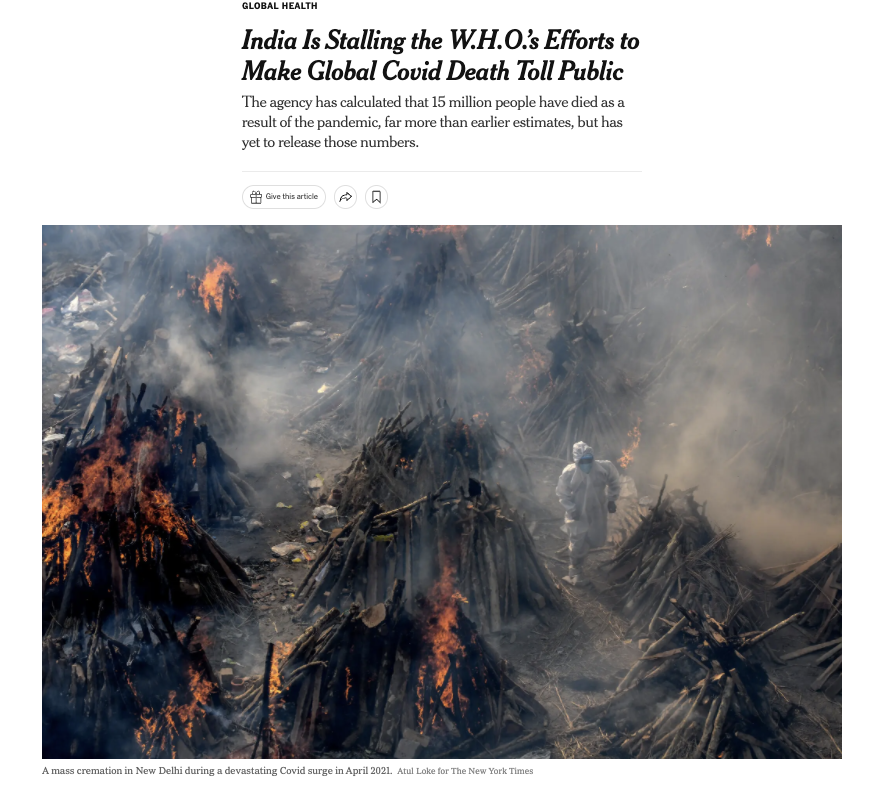
The Indian Health Ministry responded to a New York Times article titled “India Is Stalling the WHO’s Efforts to Make Global Covid Death Toll Public” dated 16th April 2022, which claimed that India’s toll is at least 4 million against the government’s tally of around 520 thousand as of Saturday, i.e 16th April 2022.

According to the Ministry, concerns were shared through a series of formal communications that included issuing six letters to WHO and holding virtual meetings. During these exchanges, specific queries have been raised by India along with the other Member States e.g. China, Iran, Bangladesh, Syria, Ethiopia and Egypt regarding the methodology, and use of unofficial sets of data.

Concerns:

“The concern specifically includes how the statistical model projects estimates for a country of geographical size & population of India and also fits in with other countries which have a smaller population. Such a size fits all approach and models which are true for smaller countries like Tunisia may not be applicable to India with a population of 1.3 billion,” stated Union Health Ministry.
Screen Shot 2022 04 19 at 6.58.45 pm

Further, the Ministry claims that the model gives two highly different sets of excess mortality estimates when using the data from Tier 1 countries and when using unverified data from 18 Indian states. Such a wide variation in estimates raises concerns about the validity and accuracy of such a modelling exercise.

Global Health Estimates pose a confusion:

According to the Ministry, the Global Health Estimates (GHE) 2019 on which the modelling for Tier II countries is based, is itself an estimate. The present modelling exercise seems to be providing its own set of estimates based on another set of historic estimates while disregarding the data available with the country. It is not clear as to why GHE 2019 has been used for estimating expected deaths figures for India, whereas, for the Tier 1 countries, their own historical datasets were used when it has been repeatedly highlighted that India has a robust system of data collection and management.

In view of this, the ministry stated that in order to calculate the age-sex death distribution for India, WHO determined standard patterns for age and sex for the countries with reported data (61 countries) and then generalized them to the other countries (incl. India) who had no such distribution in their mortality data. Based on this approach, India’s age-sex distribution of predicted deaths was extrapolated based on the age-sex distribution of deaths reported by four countries (Costa Rica, Israel, Paraguay and Tunisia).

“The test positivity rate for Covid-19 in India was never uniform throughout the country at any point in time. But, this variation in covid-19 positivity rate within India was not considered for modelling purposes. Further, India has undertaken COVID-19 testing at a much faster rate than what WHO has advised. India has maintained molecular testing as the preferred testing method and used Rapid Antigen for screening purposes only. Whether these factors have been used in the model for India is still unanswered,” said the Union Health Ministry.

Follow NRI Affairs on Facebook and Twitter for news about overseas Indians. Support us on Patreon.

Logo2
NRI Affairs News Desk

NRI Affairs News Desk

NRI Affairs News Desk

Related Posts

‘Culture is no excuse’: dowry abuse summit hears law reform must now reach courts, police and services
News

‘Culture is no excuse’: dowry abuse summit hears law reform must now reach courts, police and services

September 29, 2026
Gagan Biyani, Indian-origin entrepreneur and founder of the Horowitz Andreessen Academy
News

Indian-Origin Entrepreneur Launches Historic $42 Million Free AI Academy

September 26, 2026
South Asian Lens to explore how reporting on India’s AI workers became a feature film
News

South Asian Lens to explore how reporting on India’s AI workers became a feature film

September 25, 2026
Next Post
US Visa Update: USCIS to implement risk-based approach for conditional permanent resident interviews

Visa update: USCIS resumes processing regional center-based Form I-526

NSW overseas travels

NSW, VIC relax rules for unvaccinated overseas travels

Perth Hindu Temple, Photo, Tripadvisor

Morrison government promises one million dollars each for Perth Hindu and Sikh Temples, if re-elected

Leave a Reply Cancel reply

Your email address will not be published. Required fields are marked *

Recommended

Australian universities

International students and working-holiday makers will have visa charges waived: Scott Morrison

5 years ago
How U.S. Tariffs on Canada Could Impact Indian Students’ Study Budgets

How U.S. Tariffs on Canada Could Impact Indian Students’ Study Budgets

2 years ago
US panel recommends designating India as a ‘country of particular concern

US panel recommends designating India as a ‘country of particular concern

4 years ago
History’s biggest census: why India’s new population count is controversial

History’s biggest census: why India’s new population count is controversial

6 months ago

Categories

  • Business
  • Events
  • Literature
  • Multimedia
  • News
  • nriaffairs
  • Opinion
  • Other
  • People
  • Student Hub
  • Top Stories
  • Travel
  • Uncategorized
  • Visa

Topics

Australia Canada caste china cricket Democracy election Europe Gaza Hindu Hindutva Human Rights immigration India Indian Indian-origin indian diaspora indian origin indian student Indian Students Israel Migration Modi Narendra Modi New Zealand NRI Pakistan Palestine politics protest Racism Singapore South Asia student students trade travel trump UAE uk US USA Victoria visa Zohran Mamdani
NRI Affairs

© 2025 NRI Affairs.

Navigate Site

  • About
  • Advertise
  • Contact
  • Media Literacy

Follow Us

No Result
View All Result
  • News
  • Video
  • Opinion
  • Culture
  • Visa
  • Student Hub
  • Business
  • Travel
  • Events
  • Other

© 2025 NRI Affairs.

Welcome Back!

Login to your account below

Forgotten Password?

Retrieve your password

Please enter your username or email address to reset your password.

Log In
WP Twitter Auto Publish Powered By : XYZScripts.com