
Australia will hold a parliamentary inquiry into transnational repression — the practice of foreign governments reaching across borders to intimidate, surveil, punish and silence people living here.
The matter has been referred to the Senate Foreign Affairs, Defence and Trade References Committee, with a final report due 31 May 2027. Submissions close on 19 October 2026.
The referral was secured by the Australian Greens. Announcing it, NSW Senator David Shoebridge, who sits on the committee, said the inquiry would give voice to communities in Australia facing threats and oppression from foreign governments, and credited the persistent advocacy of community organisations for getting it up.
For readers of this masthead, that sentence is not an abstraction.
If you have been on the receiving end, this is addressed to you
You may have received a phone call from someone described as a community leader, telling you that people have noticed what you posted, and that it would be wise to stop.
You may have been told that your OCI card could be reviewed. That your parents in India, Colombo, Dhaka or Lahore might find things becoming difficult. That a visa application some years from now might not go your way.
You may have gone to a protest outside a consulate and then found photographs of yourself circulating in WhatsApp groups, with your employer tagged.
You may have simply read what happened to somebody else — a name you recognised, in another country — and quietly decided to stop writing, stop speaking at events, stop putting your name to things. Nobody threatened you. You just did the arithmetic.
That last category is the one Australia has never counted, and it is the one this inquiry has been asked to examine. Its terms of reference explicitly cover the impact of transnational repression on diaspora communities, democratic engagement and public advocacy — not only on people who were harmed, but on everyone who watched and drew conclusions.
What is already on the public record
Australia’s own agencies have known about this for years.
In March 2021, ASIO Director-General Mike Burgess revealed that his organisation had disrupted a foreign “nest of spies” the previous year. The operation had cultivated politicians, sought classified material on Australia’s trade relationships, asked a public servant about security arrangements at a major airport — and monitored its own country’s diaspora community here. Burgess declined to name the country, saying that doing so would be an unnecessary distraction.
Three years later, in April 2024, the ABC reported that national security and government figures had confirmed the country was India, and that a number of Indian officials were removed from Australia by the Morrison government in 2020. The Washington Post reported that two officers of India’s Research and Analysis Wing were expelled; SBS News later confirmed with intelligence sources that the operatives worked for India’s foreign intelligence service, and that the surveillance included the Sikh community. Asked about it at the time, the Prime Minister, the Foreign Minister, the Defence Minister and the Treasurer all declined to comment. ASIO and the Indian High Commission declined to answer specific questions.
Buried in that same ABC report is a detail that ought to concern every diaspora community in this country, not only ours: government sources named Singapore, South Korea, Israel and India among the friendly nations believed to be most active in espionage operations here. Senior diplomats from all four were invited guests at ASIO’s 2024 threat assessment.
Two months later, ABC’s Four Corners reported the human end of it. Harjinder Singh, a Melbourne taxi driver and Australian citizen helping organise the Khalistan referendum, described receiving calls in the middle of the night, in Punjabi, warning him that things would go badly for him if he did not stop. The program found others who had stepped back from Sikh activism after receiving similar contact. Speaking to the ABC at the time, University of Adelaide associate professor Priya Chacko described a growing use of transnational repression against diaspora groups seen as dissident. Analysts have also argued that Canberra’s silence reflects the value it places on the strategic relationship.
No one has ever been told what happened to the Indian-Australians who were being monitored in 2020. No prosecutions. No numbers. No follow-up.
It has also happened to Australian institutions
Surveillance is the sharp end. The quieter version reaches into universities, newsrooms and community organisations.
In March 2022, thirteen fellows resigned from the Australia India Institute at the University of Melbourne, citing concerns about academic freedom and alleging that the Indian High Commissioner had intervened to discourage research unflattering to India’s image. Three more followed, taking the total to sixteen. One of the instances they gave was a 2019 public event on violence against Muslims in India, downgraded to an invitation-only seminar. India’s Ministry of External Affairs rejected the allegations outright, telling reporters in New Delhi that the government neither funds the Institute nor has anything to do with its decision-making, and that dragging the High Commissioner into the matter was unjustified.
Australian journalism has felt it too. In 2018, the ABC’s Amruta Slee, an Australian journalist of Indian origin, never received visas for a reporting trip and was given no official explanation, receiving instead requests for a list of who her team intended to interview and offers to have someone accompany them in Delhi. The Consulate General of India in Sydney responded that the delay had nothing to do with her article, and alleged the ABC team had breached visa rules. Six years later the ABC’s South Asia bureau chief Avani Dias left India saying her visa extension had been refused because her reporting had crossed a line — an account Indian officials disputed, saying a visa was in fact granted before she chose to depart. Reporters Without Borders has since documented a wider pattern of permits and visas being refused to foreign correspondents, and a third correspondent was forced out within five months. NRI Affairs reported that case in 2021, alongside the first wave of OCI revocations — five years before this inquiry existed.
And it is not only pressure from outside. As this masthead has reported, Australian governments have themselves funded, consulted and publicly defended organisations affiliated with India’s Hindu nationalist movement — in one case, three arms of the New South Wales state apparatus wrote to certify an organisation as a valued partner after a Greens MP questioned its presence in public schools, and that MP was censured. Whichever way a reader judges that episode, it establishes something a committee will need to weigh: when scrutiny of a foreign-aligned organisation has been raised in Australia, the institutional reflex has not always been to examine it.
The paperwork weapon
The other instrument is quieter, and it does not require an agent on Australian soil at all.
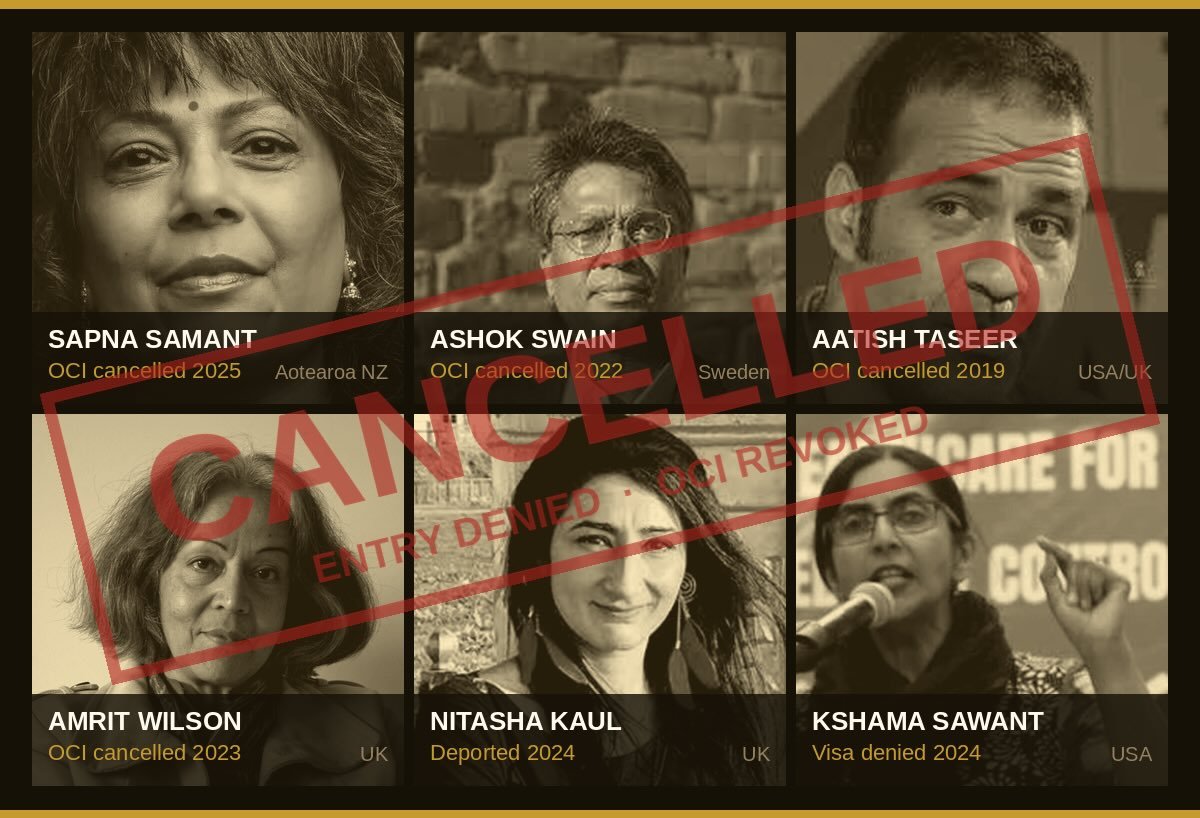
In January 2025, the Indian High Commission in Wellington notified Auckland GP and filmmaker Dr Sapna Samant that her Overseas Citizen of India status was under review. The grounds cited were her X account, her YouTube channel, an interview with a community radio station — and her appearance on the New Zealand Greens website, where she had stood as a candidate at the 2023 general election. Her written appeal was rejected in May 2025.
Samant is believed to be the first person in New Zealand or Australia to be targeted this way. She told RNZ that after a demonstration in Auckland in 2019, she received a phone call from a community figure saying “they are watching me” and that her privileges would be cancelled. The High Commission has said the individual involved did not represent it in any capacity.
She is not alone in the broader picture. Human Rights Watch has documented 102 OCI cancellations between 2014 and May 2023, and its Australia director Elaine Pearson has warned that repression of activists and academics inside India is being extended to foreign citizens of Indian origin abroad.
Writer Aatish Taseer lost his OCI in 2019 after a magazine cover story on Narendra Modi. Uppsala professor Ashok Swain has been fighting his cancellation since 2022; the Delhi High Court has set aside the government’s orders twice, once for lack of reasoning and once for lack of evidence. Writer Amrit Wilson, then in her eighties, lost hers over social media posts on Kashmir and the farmers’ protests. Professor Nitasha Kaul was turned away at Bengaluru airport in February 2024 while holding a valid OCI and a state government’s invitation to speak; her card was cancelled in May 2025, and she described it as a bad faith, vindictive and cruel instance of transnational repression. Former Seattle councillor Kshama Sawant has been refused a visa at least three times, including emergency applications to visit her critically ill mother, and was told her name was on a reject list; she has said she is not the only one being punished. In October 2025 the Hindi scholar Francesca Orsini was denied entry despite holding a valid visa.
The effect is the same in every case: the person can be exiled from a parent’s sickbed, a wedding, a funeral, by an administrative decision that requires no charge, no evidence and no hearing.
What happens to the people you left behind
There is a category in the international literature on transnational repression called coercion by proxy. It does not require any agent to set foot in Australia. It works because you have a mother in Lucknow, a brother with a shop in Bhopal, cousins on an electoral roll in Bengal — and because you know what can happen to them.
Whether or not it is ever used against a particular family, the fear is doing the work. And what feeds that fear is not rumour. It is reported, litigated and, in some cases, judicially condemned.
Demolitions. Amnesty International documented 128 structures punitively bulldozed between April and June 2022 across four BJP-governed states and one governed by the Aam Aadmi Party, most of them belonging to Muslims. In November 2024 the Supreme Court of India ruled the practice unconstitutional. In November 2024 the Supreme Court of India ruled the practice unconstitutional in a 95-page judgment, holding that the executive cannot act as a judge, that guilt cannot be presumed, and that demolishing the home of an accused or even a convicted person without due process is arbitrary. It required 15 days’ notice, videography of demolitions, and made officials personally liable for the cost of restitution. State governments have consistently rejected the allegations, maintaining that the structures breached local building laws and that notices were served. Reporting by Scroll in March 2025 found that punitive demolitions continued after the judgment, and that the ruling left a substantial gap, since it does not cover structures alleged to encroach on public land.
Agencies. In 2023, fourteen opposition parties went to the Supreme Court jointly alleging that the Enforcement Directorate and the Central Bureau of Investigation were being deployed selectively to crush political dissent. The parties noted they had together taken over 45 per cent of votes cast at the most recent state elections and 42.5 per cent at the 2019 general election. The court indicated it would not lay down general guidelines in the abstract, and the plea did not proceed. The Union government has consistently denied that agencies act on political direction, describing enforcement as independent and evidence-led.
For diaspora readers the more direct instrument is the Foreign Contribution (Regulation) Act, under which the licences of large numbers of Indian civil society organisations have been cancelled or not renewed. FCRA determines whether money sent from Australia can lawfully reach a charity, a legal aid group or a research centre in India. It is the mechanism by which a diaspora community’s ability to support civil society in its country of origin can be switched off administratively.
Electoral rolls. In October 2025 the Election Commission of India announced a nationwide Special Intensive Revision of electoral rolls, requiring house-to-house enumeration and, for voters enrolled after a specified date, documentary proof of date and place of birth and of parentage. Opposition parties, civil society groups and a number of UN Special Rapporteurs have argued the exercise places an unreasonable documentary burden on individuals and risks excluding poor, migrant, Muslim and refugee-descended communities disproportionately; researchers have pointed to problems in the technical process, and reporting from Assam has described fraudulent mass objections filed against legitimate voters.
It must be said plainly that on 27 May 2026 the Supreme Court upheld the SIR. A bench led by Chief Justice Surya Kant found the exercise consistent with the Representation of the People Act 1950 and directly connected to the constitutional goal of free and fair elections, and clarified that deleting a name is an electoral decision rather than a declaration that a person is not a citizen. Critics have noted that the judgment arrived six months after the Bihar election it affected had already been held, and constitutional scholars have questioned the technical conduct of the exercise.
One element of that same judgment is what has travelled fastest through diaspora WhatsApp groups: the court directed the Election Commission to forward to the Union government, within four weeks, the names of people removed from the rolls on grounds of doubtful citizenship. Whatever its legal character, for a family that has been struck off, the practical experience is of a list of names going to the central government.
Why this belongs before a Senate committee. None of the above happens in Australia. That is precisely the point. A person in Melbourne deciding whether to put their name to a submission is not only weighing what might happen to them here. They are weighing whether their sister’s house is on land the municipality could reclassify, whether their father’s small business could attract a notice, whether a relative’s name has already gone onto a list. Australian law currently has no way to see that calculation, let alone respond to it — which is why the inquiry’s terms of reference asking about the impact on democratic engagement and public advocacy are the ones that matter most to our readers.
If that is your situation, it is also the strongest reason to use the confidential and name-withheld options set out below.
The communities with no record at all
Almost all of the above is Indian. That is not because other South Asian communities in Australia have been left alone. It is because nobody has looked.
There is extensive international documentation of Sri Lankan monitoring of Tamil diaspora activity abroad, of Bangladeshi harassment of the families of overseas critics under the previous government, and of Pakistani targeting of Baloch and Pashtun activists in exile. There is almost nothing that documents any of it happening in Australia — not because it isn’t, but because no Australian process has ever asked.
This inquiry is that process. If Tamil, Bangladeshi, Pakistani, Nepali, Afghan, Kashmiri and Sikh Australians do not put their experiences into it, the final report will describe a problem that appears to involve only two or three countries, and the protections that follow will be built for those countries alone.
What the inquiry will examine
The terms of reference cover the nature, scale and methods of transnational repression affecting people in Australia; its impact on diaspora communities and public advocacy; whether current laws and institutions are adequate; what protection and support mechanisms exist and are needed; how communities and government can respond together; international best practice; and recommendations for legislative and policy reform.
Notably, no country is named anywhere in them. Every community is in scope by default.
The adequacy question is the sharp one. A Freedom House study of Australia published in September 2025 found that Australian law contains no definition of transnational repression at all, that the foreign interference framework has never been tested for whether it deters threats reaching in from outside, and that Australia has never once used its sanctions regime in response — unlike the United Kingdom, the United States and Canada. That report recommended precisely the inquiry that has now been established.
In April 2026, Human Rights Commissioner Lorraine Finlay wrote to the Foreign Minister calling for exactly this, describing Australia’s current response as fragmented, with no coordinated approach across federal, state and territory governments.
How to make a submission — including without your name
This is the part that matters most, and it is the part least understood in our communities.
You do not have to publish your name. Senate committees can accept a submission with the author’s name withheld, or treat a submission as confidential so that it is not published at all. Committees can also take evidence in camera — in private. If fear of consular retaliation, of OCI cancellation, or of consequences for family overseas is what has kept you silent, these are the mechanisms built for exactly that situation.
Two important cautions. Confidentiality is a decision for the committee, not something anyone else can guarantee on its behalf — so ask for it explicitly and explain why. And parliamentary privilege, which protects you from legal action over what you say, attaches only once the committee has accepted and authorised your submission. Do not publish or circulate your own submission before then.
A useful submission does not have to be long or legal. What committees value is first-hand specificity: what happened, when, where, who contacted you and how, what you did afterwards, and what you stopped doing. Three careful paragraphs from someone it happened to are worth more than thirty pages of general argument.
Submissions can be lodged through the Senate Foreign Affairs, Defence and Trade References Committee page at aph.gov.au. The committee will publish full lodgement details shortly.
NRI Affairs is gathering accounts from readers across Australia’s South Asian communities. If you have experienced surveillance, threats, pressure on family members, consular retaliation, OCI or visa action, or if you have changed what you say publicly because of what you saw happen to someone else, we would like to hear from you. We will not publish anything without your explicit consent, and we can help you prepare a submission — including a confidential one — at no cost.
Contact: contact@nriaffairs.com
Senator Shoebridge’s office has offered to meet community organisations to discuss making submissions.