
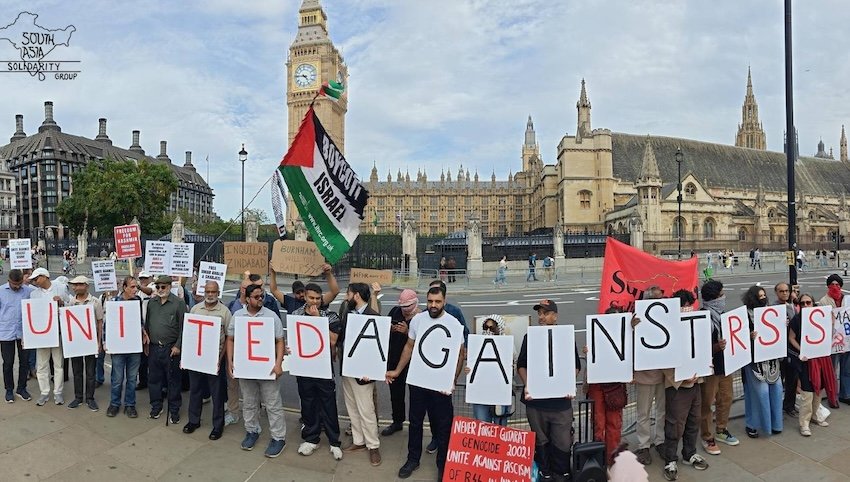
Hundreds of protesters gathered in London’s Parliament Square on Sunday to oppose Rashtriya Swayamsevak Sangh chief Mohan Bhagwat’s visit to the United Kingdom, as his international centenary tour drew political scrutiny and exposed sharp divisions within sections of the Indian and Sikh diaspora.
The demonstration coincided with the concluding phase of Bhagwat’s six-day UK visit, during which he met religious leaders, academics, community representatives and public figures and addressed a “Celebrate Oneness” gathering.
Protesters accused the RSS of keeping much of Bhagwat’s itinerary out of public view to minimise opposition to what they described as an international campaign to rehabilitate the Hindu nationalist organisation’s image.
The demonstration was organised by a coalition that included the South Asia Solidarity Group, Hindus for Human Rights UK, the UK Indian Muslim Council, India Labour Solidarity and StriveUK, with support from the Indian Workers Association (Great Britain) and other civil-society groups.
“The RSS is in hiding,” some protesters declared, pointing to the limited public information available about Bhagwat’s engagements and their locations.
Rajiv Sinha, director of Hindus for Human Rights UK, said opposition to the tour had intensified across its three stops in the United States, Canada and Britain.
“We are not hearing much for the last week about the details of their programmes, and they have been scared — and they should be,” Sinha told the Parliament Square gathering, according to Maktoob Media.
The RSS rejected suggestions that it had anything to conceal. Its head of communications, Sunil Ambekar, said disagreement was normal in a democracy and the organisation was prepared to engage with its critics.
“We are here for peace, integration and oneness, and we are open for dialogue with everyone,” Ambekar said at a media briefing. “We have nothing to hide. We expect a debate and exchange of thoughts. Let them speak.”
A centenary outreach campaign
Bhagwat arrived in London on September 2 for the final leg of a three-country tour marking 100 years since the RSS was founded in 1925. He had previously addressed major gatherings in New York and Toronto.
The RSS described the tour as a programme of “civilisational dialogue” focusing on social harmony, service and shared values. Its London engagements were coordinated by Integral, a UK-based organisation, with support from Hindu Swayamsevak Sangh UK.
According to an RSS statement, Bhagwat visited the Shree Swaminarayan Temple in Willesden and the Khalsa Jatha British Isles Gurdwara and was scheduled to visit a Jain temple. The organisation said more than 115 British socio-cultural organisations had supported the wider programme.
At the September 6 “Celebrate Oneness” event, attended by more than 600 people representing 326 organisations, Bhagwat presented Hindutva as an inclusive civilisational outlook rather than a religious or political doctrine.
He argued that “uniformity is not necessary for unity” and said diversity should be accepted and respected as an expression of a deeper unity.
“The word Hindu cannot be understood on the basis of any religious practice or lifestyle,” Bhagwat said. “It is the nature to respect and accept all diversities.”
He also described the purpose of a “Hindu Rashtra” as demonstrating that “diversity is natural and unity is truth”, according to The Indian Express.
Critics, however, said the language of oneness and interfaith dialogue obscured the RSS’s history, its relationship with India’s governing Bharatiya Janata Party and the consequences of Hindu majoritarian politics for Muslims, Christians, Sikhs, Dalits and other minorities.
Kalpana Wilson of the South Asia Solidarity Group accused the organisers of using an interfaith setting to present Bhagwat and the RSS in a favourable light.
The Indian Workers Association said its opposition was directed at Hindutva as a political ideology, not at Hinduism or Hindu people.
“At the centre of the disagreement is the RSS ideology of Hindutva and its conception of India as a ‘Hindu Rashtra’,” the association said.
It stressed that India belonged equally to Hindus, Muslims, Sikhs, Christians, Buddhists, Jains, followers of other faiths and people with no religion.
“No citizen should have to accept a Hindu national identity in order to establish that they belong to India,” it said. “Our disagreement is with an ideology, not a religion or a people.”
Gurdwara visit provokes Sikh backlash
A separate controversy erupted after Bhagwat visited the historic Khalsa Jatha British Isles Gurdwara in London. The engagement had not been publicly announced beforehand and reportedly took place as a small private gathering without the wider congregation present.
The Sikh Federation UK said dozens of gurdwaras, Sikh organisations and individuals had contacted it to express outrage over the decision to receive the RSS chief.
Bhai Amrik Singh, chair of the federation’s strategy board, said the RSS was “not a normal religious or cultural organisation”.
“It is a political and ideological movement whose influence has repeatedly fuelled division, intimidation and hostility towards minorities,” he said.
“Secretly hosting the RSS leader at a gurdwara in the absence of the sangat, who may have opposed his presence, sends the wrong message to Sikhs in the UK and vulnerable communities in India.”
The federation said gurdwaras should remain “places of refuge, dignity and unity” and should not become platforms for organisations associated with exclusionary politics.
Khalsa Jatha British Isles president Gurpreet Singh Anand defended the decision, saying Bhagwat had visited only to pay his respects and that a gurdwara was open to everyone who observed Sikh religious protocol.
“Allowing someone to enter a gurdwara should not be confused with endorsing that person, their organisation or their politics,” Anand told The Tribune.
He said Bhagwat had not addressed the congregation, held a political meeting or received an institutional endorsement from the gurdwara.
Anand nevertheless acknowledged widespread Sikh concerns about the RSS, including fears that it seeks to subsume Sikh identity within a broader Hindu identity, the treatment of minorities in India, unresolved demands for justice over the 1984 anti-Sikh violence and the targeting of Sikh activists and dissenters.
“The Sikh community will judge it by actions rather than symbolism,” he said.
Visit raised in British Parliament
The controversy reached the British Parliament before Bhagwat’s arrival. Labour MP Nadia Whittome submitted a written question asking whether the Home Office had assessed the proposed visit against the UK government’s commitment to exclude hate preachers and extremists.
Security Minister Dan Jarvis said the Home Office did not comment on individual cases but remained committed to addressing threats and taking action against those who promoted violence or hatred.
“All individuals seeking entry to the UK must meet the requirements of the immigration rules,” Jarvis said. His response did not disclose any assessment made specifically in Bhagwat’s case.
Former Labour leader Jeremy Corbyn also opposed the visit, saying Britain should not host the leader of an organisation he accused of having a history of far-right violence and discrimination.
London Mayor Sadiq Khan’s office said the mayor did not have the power to prevent people from speaking, while adding that London celebrated diversity and had no place for intolerance.
Bhagwat also received significant support. More than 100 Hindu and community organisations — including Hindu Council UK, Hindu Forum of Britain, Hindu Swayamsevak Sangh UK and INSIGHT UK — issued a joint statement welcoming him and praising the RSS’s work in volunteering, education, disaster response and community service.
Conservative MP Bob Blackman publicly welcomed the visit, saying he was pleased to hear Bhagwat’s “thoughts and ideas” about the RSS’s future.
The contrasting responses showed that Bhagwat’s effort to present the RSS as a movement of service and universal harmony has not resolved longstanding concerns about Hindutva’s political implications. Instead, the London visit brought those arguments into British public life, dividing diaspora organisations and renewing calls for closer scrutiny of the RSS and its overseas networks.