

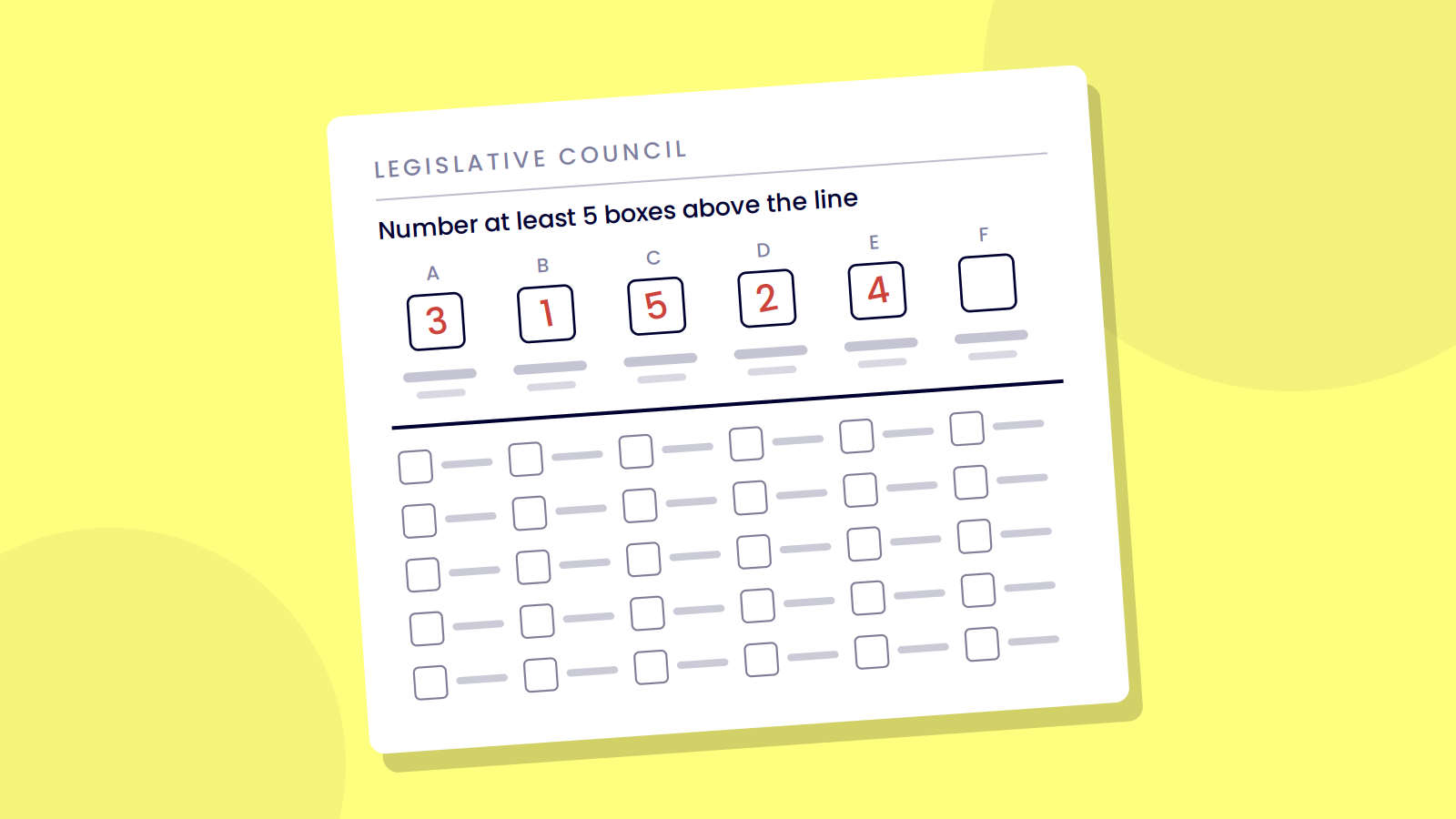
Victorians voting for the Legislative Council on 28 November will fill in their ballot paper differently from every previous state election.
In August, the Victorian Parliament passed the Electoral Amendment (Miscellaneous Matters) Act 2026, which removes group voting tickets from Legislative Council elections. The bill was introduced on 28 July, cleared the lower house the next day, and passed the upper house without amendment on the evening of 11 August with the support of the government, opposition and Greens.
The practical change is simple. Voters must number at least five boxes in order of preference, either above or below the line. Above the line, you write 1 to at least 5 for the parties or groups you want elected, in your order of choice. Below the line, you write 1 to at least 5 for individual candidates. You do not have to fill in every box.
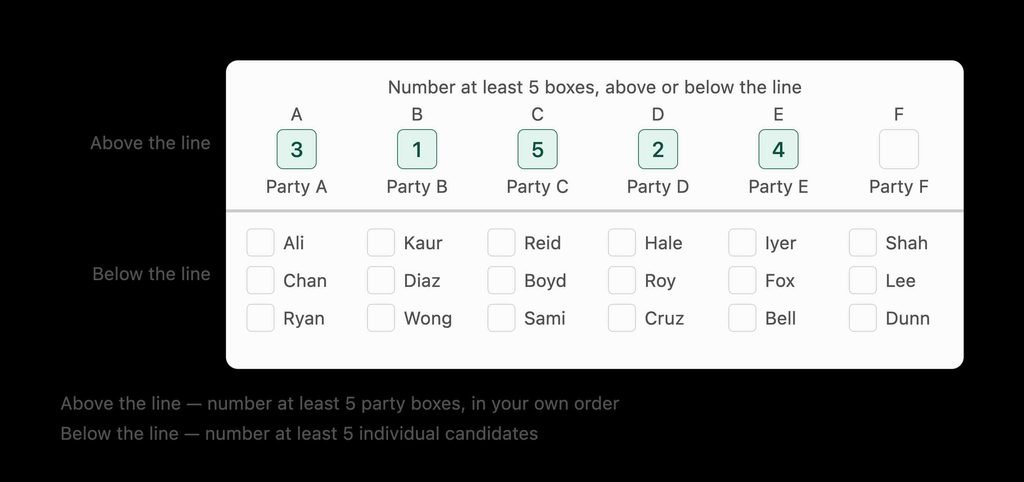
There is one safeguard that voters should understand. Antony Green, who spent more than three decades as the ABC’s chief elections analyst and now writes on electoral systems at his own election blog, notes that Victoria has adopted the Senate’s above-the-line savings provision: a ballot with fewer than five above-the-line preferences will still be counted as formal, provided the first preference is valid. Below the line there is no such safety net. Five preferences are required there, or the vote is informal. [Check Green’s current descriptor before publishing — he stepped back from ABC election-night duties in 2025 and I’d rather you verify how he’s describing himself now than have us guess.]
Voting is otherwise unchanged. The Council still has 40 members elected five at a time from eight regions, which sets a quota of roughly 16.7 per cent in each region. Groups must now nominate the order their candidates appear on the ballot paper when they register.
Also read: Victorian leaders reject ‘myth of monoculture’
What it replaces, and why
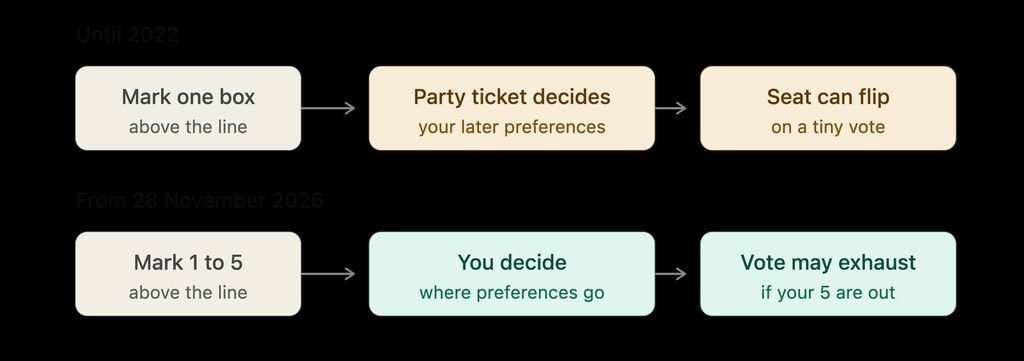
Under group voting tickets, a single “1” above the line handed a party complete control of where the rest of that vote travelled. Parties lodged a ticket before election day setting out an order of preferences for every other candidate, and voters who marked one box — the overwhelming majority — were bound to it. That created a market in preference deals, and a class of operator known as the preference whisperer whose business was arranging them.
Victoria was the last jurisdiction in the country to hold on to the system. New South Wales abolished group voting tickets for the 2003 election, the Senate did so in 2016, South Australia in 2018, and Western Australia at its 2025 election. Tasmania has never used ticket voting at all, and Queensland, the Northern Territory and the ACT have no upper house. Victoria had only adopted tickets for its reformed Legislative Council at the 2006 election. Green describes the new Victorian method as mirroring the reformed Senate system used at the last four federal elections.
What the analysts say
Green has argued for years that the system was indefensible. Writing before the bill was introduced, he said group voting tickets delivered political power into the hands of “a small cabal of party negotiators” arranging preference deals.
His analysis of the change sets out how far results drifted from the votes cast. At the 2018 election, the Transport Matters Party won a seat in Eastern Metropolitan Region from 0.62 per cent of the vote, defeating a Greens candidate who started the count on 9.0 per cent. In South-Eastern Metropolitan, the Liberal Democrats polled 0.84 per cent and defeated the second Liberal candidate, who began on 12.3 per cent. In Southern Metropolitan, Sustainable Australia won from 1.32 per cent against a Greens candidate on 13.5 per cent. Those wins, Green writes, were “created by GVT preference deals, not by the actions of voters”.
Modelling the last three elections as if tickets had not existed, Green estimates the number of non-Greens minor party members would have fallen from 22 to four, with the Greens rising from 10 to 19, Labor from 47 to 50 and the Coalition from 41 to 47. He also estimates that weaker preference flows will make it very difficult for any party polling under about 6 per cent in a region to win a seat. These are his own counterfactual estimates rather than official results, and he declines to predict what the change means for the parties contesting this election.
Parties can still hand out how-to-vote cards recommending an order of preferences, and the major parties, the Greens and One Nation are the ones most likely to influence how their supporters number the boxes. But a recommendation is no longer binding. If none of the parties you numbered remains in the count, your ballot is set aside as exhausted, exactly as in a Senate count.
Key dates
- Enrolment closes 8pm, Tuesday 3 November 2026 (Melbourne Cup Day)
- Candidate nominations close 9 November 2026
- Early voting cannot begin before 18 November 2026
- Election day: Saturday 28 November 2026
Correct at the time of publication. For the official ballot paper instructions and to check your enrolment, visit vec.vic.gov.au or call 131 832. Last updated: 6 September 2026.