
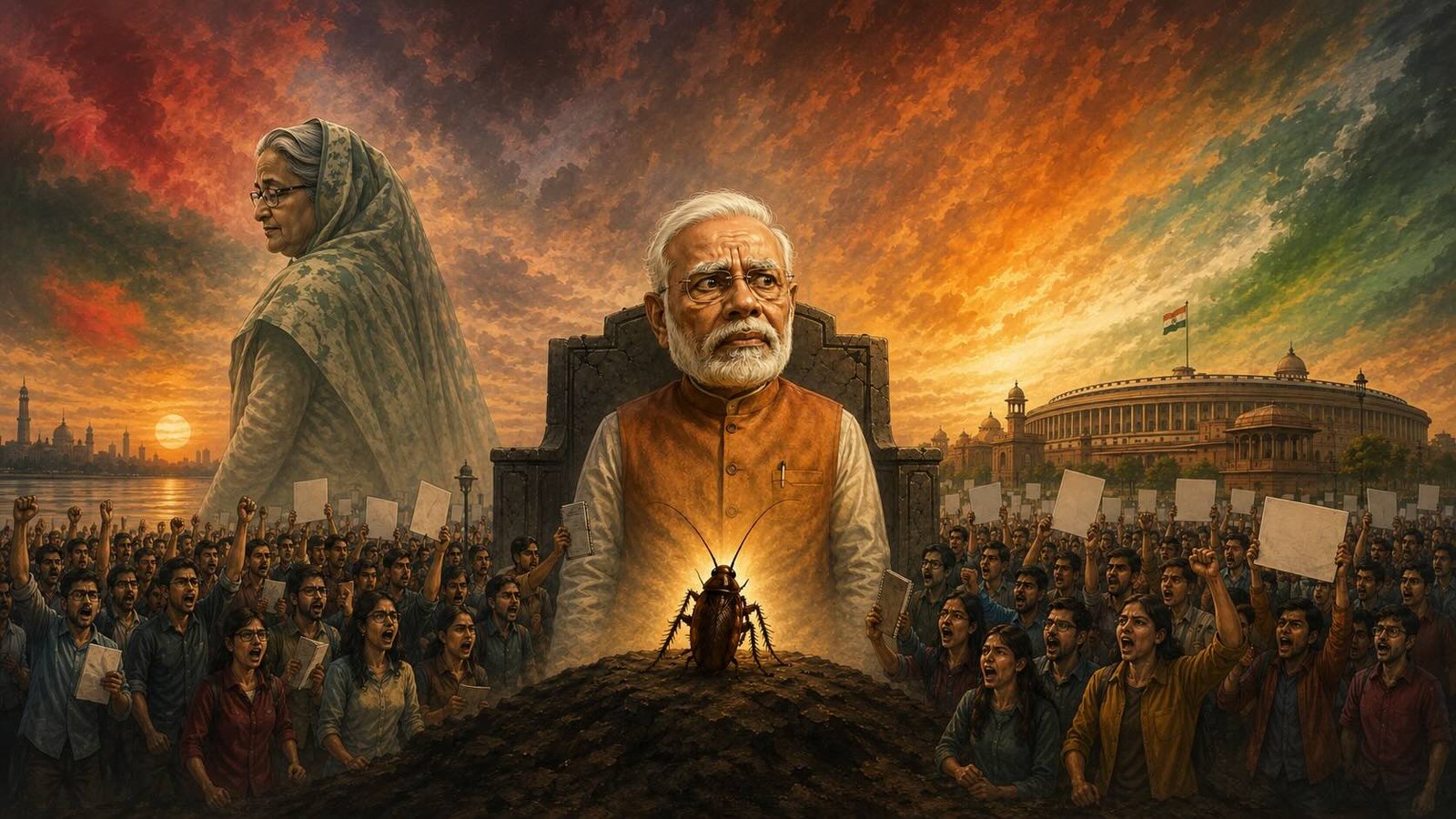
A massive youth revolution is fast brewing in India.
It is quickly evolving into a juggernaut of youth power, driven by frustration, unemployment, failing institutions and a deep hunger for a better future.
And then, who knows?
The day may come when this angry juggernaut gatecrashes the Prime Minister’s residence.
Am I dreaming? Perhaps.
But sometimes today’s dreams become tomorrow’s realities.
Bangladesh offered a dramatic example in 2024, when a massive youth-led uprising forced Prime Minister Sheikh Hasina to flee the country.
At the centre of this emerging youth movement in India stands Abhijeet Dipke.
The “Cockroach” leader has given a name, a voice and a sense of identity to India’s frustrated young generation.
He galvanized the Indian youth in record time and in record numbers.
And last month, under the newly launched Cockroach Janta Party, he brought them onto the magic stage at Jantar Mantar, the dedicated protest site in the capital city of Delhi.
Their massive rally rattled the establishment.
Within 48 hours, the Modi government was forced to remove its failed education minister. An extraordinary demonstration of what organized public pressure can accomplish.
Since then, the Cockroach Janta Party has carried its campaign beyond Delhi. Voices have been raised for education reform, better school facilities and greater accountability.
The protests expose the disturbing conditions confronting students while awakening something even more powerful: youth consciousness.
And that consciousness is spreading.
Even children barely into their teens are beginning to understand that the future being shaped today will ultimately belong to them.
Their collective voice could become a tsunami wave of democratic energy. Unlike anything India has witnessed since Independence.
Modi has failed the nation, particularly its youth, leaving them without jobs and a future.
The larger concern is democracy itself.
Modi, his party, the Bharatiya Janata Party, along with its several affiliates and thousands of “andh-bhakats”, the blind faithfuls, have immensely destroyed every fabric of India’s democracy.
After more than a decade of Narendra Modi’s leadership, India faces deepening unemployment and shrinking democratic space.
Not only that, under his leadership since 2014 as the nation’s prime minister, he created divisions between the Hindus and minorities, hatred against Muslims, Christians and the low-caste Dalit communities.
Modi corrupted every governing body, its bureaucracy, the judiciary, the election commission, the cinema, cultural institutions, Indian history, the armed forces, the police, and the media.
He did immense damage to the Opposition, the backbone of the democratic system, with forced or lucrative “buying” traps into the BJP fold.
The autocratic and brutal rule of Modi, which has imprisoned hundreds of political opponents, scores of activists, lawyers, scholars, artists and dissenters, appears to be facing its dead end.
Modi and his sidekick, Home Minister Amit Shah, made a mockery of the parliament and shredded all democratic norms and ethos to pieces.
This regime has shamelessly weaponized its investigative machinery, the Enforcement Directorate (ED), the Central Bureau of Investigation (CBI) and the Income Tax (IT) department, which systematically attempts to dismantle the political opposition.
When formal institutions collapse, and power acts with total impunity, must a nation wait for the scheduled calendar of a 2029 general election to remove such a regime from power.
That is precisely why the “Cockroaches” matter.
The metaphor is almost perfect.
Cockroaches are notoriously difficult to eliminate. They survive, multiply and emerge from places where nobody expects them.
Cockroaches are the force, by their sheer number of millions of frustrated youths, to bring down the curtain on this sad scene, and usher India into its second Independence.