
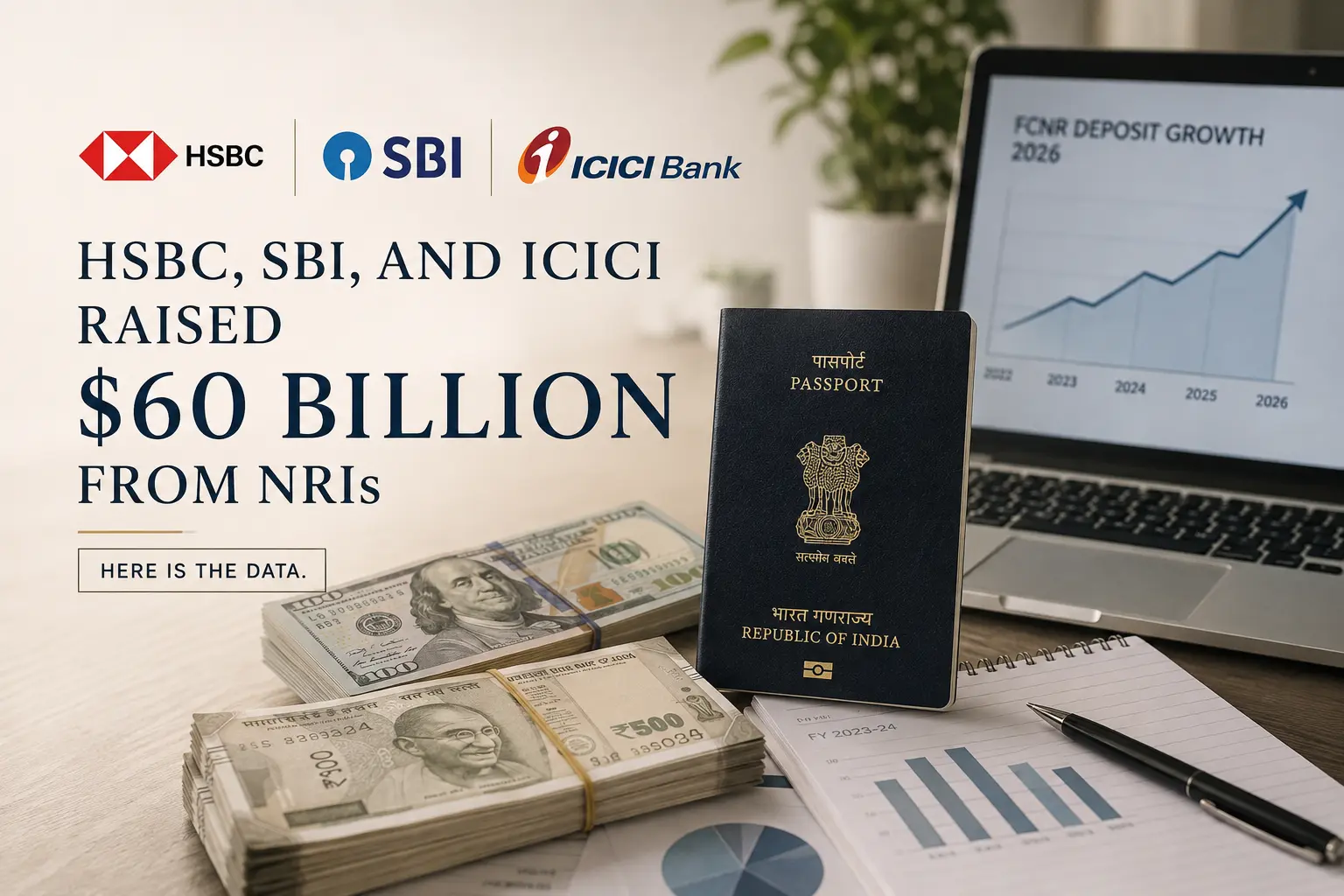
Six billion dollars, from one bank, in eight weeks. That is what HSBC’s India unit alone has raised under the Reserve Bank of India’s special dollar deposit scheme since it launched in June, more than any other lender operating in the country.
Government data released on Monday, 3 August 2026, showed State Bank of India, HSBC and ICICI Bank have garnered the largest amounts under the RBI’s scheme to attract dollar deposits from non-resident Indians. HSBC’s India unit raised approximately $6.14 billion, the most of any lender. SBI, India’s largest bank, gathered around $4.12 billion between 5 June and 30 July. ICICI Bank led private-sector peers with roughly $3.7 billion.
Outstanding FCNR(B) deposits across the entire banking system rose to $60.55 billion, up from $32.56 billion on 5 June, representing fresh net inflows of $27.99 billion in eight weeks.
The full bank-by-bank breakdown
According to data shared by the government in Parliament, the split across categories of lenders shows a distinct pattern. Foreign banks operating in India mobilised $8.37 billion, taking their outstanding FCNR(B) deposits to $8.97 billion, up from just $603 million before the scheme began, a scale of growth no domestic banking category matched. Private-sector banks garnered $10.73 billion. Public-sector banks mobilised $8.84 billion. Small finance banks and cooperative banks together accounted for around $50 million.
| Bank | Amount raised (5 June – 30 July) |
|---|---|
| HSBC | $6.14 billion |
| State Bank of India | $4.12 billion |
| ICICI Bank | $3.70 billion |
| Standard Chartered Bank | $1.86 billion |
| Kotak Mahindra Bank | $1.66 billion |
| Axis Bank | $1.59 billion |
| HDFC Bank | $1.41 billion |
| Bank of Baroda | $1.05 billion |
| Punjab National Bank | $970 million |
| Canara Bank | $933 million |
HSBC’s dominance is striking given it is a foreign bank with a far smaller domestic branch network than SBI, ICICI or HDFC. It reflects HSBC’s strategy of offering leveraged FCNR structures through its GIFT City IFSC Banking Unit, including the 19x leverage product we reported on last month, aimed specifically at high-net-worth NRI investors in the Gulf and Singapore.
Why the RBI launched this scheme
The RBI’s measures, deployed via a concessional swap window that opened on 5 June and runs until 30 September 2026, are the same type of intervention last used in 2013 during the Federal Reserve’s taper tantrum, when India raised roughly $34 billion from NRIs to stem a currency crisis.
This year’s trigger was similar: the rupee had declined to a record low in May 2026, prompting sustained depreciation pressure that the central bank moved to counter. The currency has steadied since the measures were announced in June, though it remains under pressure from the broader forces we reported on last month, rising oil prices tied to US-Iran tensions and expected Federal Reserve rate moves.
What is the RBI’s concessional swap window?
What is the RBI’s concessional swap window?
The RBI’s concessional swap window allows banks to exchange foreign currency raised through FCNR(B) deposits with the central bank at a below-market cost, reducing the hedging expense banks would otherwise face when converting NRI dollar deposits into usable domestic currency. This lower cost allows banks to offer NRIs significantly higher deposit interest rates than would otherwise be commercially viable. The scheme also exempts qualifying incremental deposits from Cash Reserve Ratio and Statutory Liquidity Ratio requirements. It became effective on 8 June 2026 and remains in force until 30 September 2026, giving banks and depositors a defined window in which to act.
The race to catch up
RBI data released over the weekend showed banks had mobilised nearly $41 billion in foreign exchange inflows under the concessional swap facility, and with two months remaining before the window closes, private-sector banks that have trailed foreign lenders and SBI so far are now moving aggressively to close the gap.
HDFC Bank and ICICI Bank have both raised their FCNR(B) deposit rates by 25 basis points to 6.25% in the three-to-five-year maturity bucket, according to Business Standard reporting on the rate moves. The increase signals that private banks, having watched HSBC and SBI capture the largest share of inflows in the scheme’s first eight weeks, are now competing more directly on price to attract the remaining NRI capital before the September deadline.
What analysts expect for the rest of the window
IDFC First Bank said in a note that the pace of capital inflows under FCNR(B), external commercial borrowings and overseas foreign currency borrowings combined has been “much stronger than expected,” projecting total inflows across all instruments could reach $90 billion or higher by the time the window closes.
That figure, if realised, would be nearly triple the $34 billion raised during the comparable 2013 intervention, reflecting both the larger scale of India’s NRI deposit base today and the more aggressive rate and leverage structures banks have deployed this time, including the elevated rates now being matched across HDFC, ICICI and other major private lenders.
What this means for NRIs deciding whether to act
For NRIs in Australia, the UK, the UAE, the US, Canada and New Zealand who have been weighing whether to open an FCNR(B) deposit under the current window, the rate competition now underway among private banks is a direct, practical development. HDFC Bank and ICICI Bank’s move to 6.25% on three-to-five-year deposits puts them ahead of the 6% level that had been standard across major private banks since the window opened, narrowing the gap to smaller lenders like AU Small Finance Bank, which had earlier offered up to 7.10%.
With the window closing on 30 September 2026 and roughly two months remaining, NRIs considering a deposit should compare current published rates directly with their bank, factor in the one-year lock-in that applies to deposits booked under the scheme, and confirm whether any leveraged structure, such as HSBC’s GIFT City product, suits their specific financial circumstances before committing capital.
What NRIs with deposits or considering one need to know
Which bank is currently offering the best FCNR(B) rate?
Rates change frequently during this window. As of the most recent reporting, HDFC Bank and ICICI Bank had raised rates to 6.25% on three-to-five-year USD deposits, matching or exceeding the roughly 6% level most major private banks had held since June. Smaller lenders such as AU Small Finance Bank have offered rates as high as 7.10% at various points. Confirm the current published rate directly with your bank before depositing.
Does HSBC’s lead in total deposits mean it offers the best individual rate?
Not necessarily. HSBC’s $6.14 billion lead reflects total volume raised, driven substantially by its leveraged FCNR structures for high-net-worth investors through its GIFT City unit, rather than necessarily the highest standard deposit rate available to an ordinary depositor. Compare standard, non-leveraged rates across banks separately from any leveraged product being offered.
What happens to my deposit after the window closes on 30 September 2026?
Deposits booked before the window closes retain the elevated rate and terms for their full tenor, subject to the one-year lock-in condition. After 30 September, new deposits will be subject to standard, non-concessional rates and terms, expected to be materially lower.
Is my money safe given how large these inflows have become?
FCNR(B) deposits are held with regulated Indian banks under RBI oversight, the same regulatory framework that has governed NRI deposits for decades. The scale of inflows reflects strong demand for the scheme’s rates, not any change to the underlying safety or regulatory status of the deposit product itself.
Should I choose a public-sector bank like SBI or a private bank like ICICI or HDFC?
This is a personal financial decision depending on your existing banking relationships, service preferences and the specific rate on offer at each bank when you deposit. The government data shows strong inflows across both public and private-sector categories, with SBI, ICICI and the recently rate-competitive HDFC among the leaders in each respective category.