
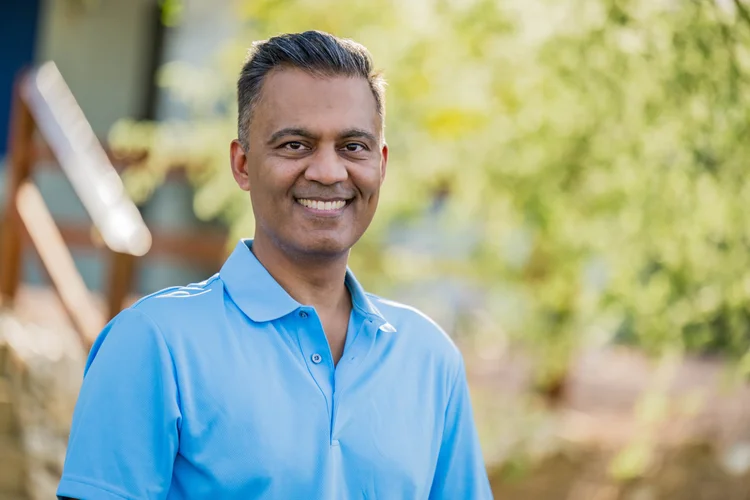
Amish Shah has done what the Democratic Party’s own national campaign committee did not want him to do.
The Indian-American physician and three-term Arizona state lawmaker won the Democratic primary for Arizona’s 1st Congressional District on 22 July 2026, defeating Marlene Galan-Woods, a former broadcast journalist who had been backed by the Democratic Congressional Campaign Committee and party leaders in both Arizona and Washington, D.C.
Shah’s win came despite millions of dollars in outside spending in the final weeks of the campaign, funding attack ads targeting his voting record in the Arizona Legislature and characterising him as aligned with conservatives on certain social issues. He countered by leaning heavily into his legislative record opposing Republicans and the Trump administration in Arizona, and his professional identity as an emergency room doctor campaigning on healthcare access and reproductive rights.
Shah will now face Republican nominee Jay Feely, a former NFL kicker endorsed by President Donald Trump, in the November general election for a seat both parties consider a genuine battleground.
Who is Amish Shah
Shah, 47, was born and raised in Chicago, Illinois. He is an emergency medicine physician by profession and has served three terms in the Arizona House of Representatives, first winning election in 2018 by defeating incumbent Ken Clark, and representing Central Phoenix, Sunnyslope and South Scottsdale.
This is not Shah’s first run for this seat. He was the Democratic nominee for Arizona’s 1st Congressional District in the 2024 election, narrowly winning a six-candidate primary before losing to Republican incumbent David Schweikert in the general election by a 52% to 48% margin. Schweikert is not seeking re-election this cycle, choosing instead to run for governor, which left the seat open and made it one of the most closely watched races of the 2026 midterm cycle.
Shah speaks conversational Spanish and is fluent in Gujarati. His campaign was known for its intensive door-to-door style, with Shah personally reaching nearly 28,000 homes over the course of the race. Outside his political and medical career, he founded the first Arizona Vegetarian Food Festival, a philanthropic project aimed at promoting healthy eating and preventing chronic disease.
Why the party establishment backed someone else
The Democratic Congressional Campaign Committee’s decision to back Galan-Woods over Shah, despite Shah having already been the party’s nominee in this exact district in 2024, reflects a familiar tension in competitive American primaries between a national party apparatus seeking what it calculates as the strongest general election candidate and grassroots primary voters making their own choice.
Galan-Woods, a former local news anchor, was positioned by national and state party leadership as the candidate best placed to appeal to the district’s broader electorate in November. Shah’s 2024 general election loss to Schweikert may have factored into that calculation. Primary voters, however, chose the candidate with the deeper legislative record and a campaign built on direct, high-volume voter contact rather than the candidate with institutional backing.
What is Arizona’s 1st Congressional District?
What is Arizona’s 1st Congressional District?
Arizona’s 1st Congressional District is based in Maricopa County and covers parts of the Phoenix metropolitan area, including Central Phoenix, Scottsdale and surrounding communities. It has been held by Republican David Schweikert for seven terms, but has become an increasingly competitive battleground seat in recent election cycles. Schweikert defeated Democrat Jevin Hodge by less than one percentage point in 2022 and defeated Shah himself by a narrow 52% to 48% margin in 2024. With Schweikert vacating the seat to run for Arizona governor in 2026, the district is now an open race that both national parties consider genuinely competitive heading into November.
The general election matchup
Shah will face Jay Feely, a former NFL placekicker who won the Republican primary with Trump’s endorsement. Feely’s nomination gives Republicans a high-profile candidate with no prior elected office experience but significant name recognition, a profile increasingly common in competitive House races where celebrity status is used to offset an opponent’s institutional advantages.
The general election campaign is expected to focus heavily on the economy, immigration and healthcare, issues that have dominated the broader 2026 midterm cycle nationally. Arizona’s 1st District will be among the most closely watched House races in the country as both parties fight for control of the chamber following the November 3 election.
The broader picture for Indian-American representation in Congress
Shah’s win adds to what has been a period of expanding Indian-American representation in the US House of Representatives. Current Indian-American members include Ami Bera in California’s 6th District, Raja Krishnamoorthi in Illinois’s 8th District, Ro Khanna in California’s 17th District, Shri Thanedar in Michigan’s 13th District, and Suhas Subramanyam, who in 2024 became the first Indian-American elected to Congress from Virginia and the entire East Coast. Pramila Jayapal of Washington’s 7th District, while not of Indian origin herself, was the first South Asian American woman elected to Congress.
If Shah wins the general election in November, he would become the newest addition to that growing cohort, representing a competitive, non-traditionally Indian-American-majority district in Arizona, a state that has increasingly become a focal point of national political attention.
What comes next
The general election is scheduled for 3 November 2026. Both national parties are expected to invest heavily in the race given the seat’s competitive history and its significance to the broader battle for House control. Shah’s ability to replicate or improve on his 2024 general election performance against a first-time Republican candidate, rather than a seven-term incumbent, will be closely watched by both parties as an early signal of the district’s shifting political character.
What Indian-American voters and community members are asking
Has Amish Shah won the general election for Congress?
No. Shah has won the Democratic primary. He now advances to the general election on 3 November 2026, where he will face Republican nominee Jay Feely. The seat remains genuinely competitive, and neither candidate is currently favoured with certainty.
Why did the Democratic Party’s national committee support a different candidate?
The Democratic Congressional Campaign Committee backed Marlene Galan-Woods, calculating she may have had different strengths as a general election candidate, including her background as a broadcast journalist and stronger institutional relationships. Primary voters ultimately chose Shah, who ran on his three-term legislative record and a high-volume, direct voter contact campaign strategy.
How many Indian-Americans currently serve in the US Congress?
As of 2026, Indian-American members of the House of Representatives include Ami Bera, Raja Krishnamoorthi, Ro Khanna, Shri Thanedar and Suhas Subramanyam. If Shah wins in November, he would add to this group, which has grown steadily over the past several election cycles.
What district is Amish Shah running to represent?
Arizona’s 1st Congressional District, based in Maricopa County and covering parts of the Phoenix metropolitan area including Central Phoenix and Scottsdale. The seat is open following incumbent Republican David Schweikert’s decision to run for Arizona governor rather than seek re-election.
What is Amish Shah’s professional background outside politics?
Shah is an emergency medicine physician. He has served three terms in the Arizona House of Representatives since 2018, representing Central Phoenix, Sunnyslope and South Scottsdale. He also founded the first Arizona Vegetarian Food Festival as a philanthropic initiative promoting healthy eating and disease prevention.