
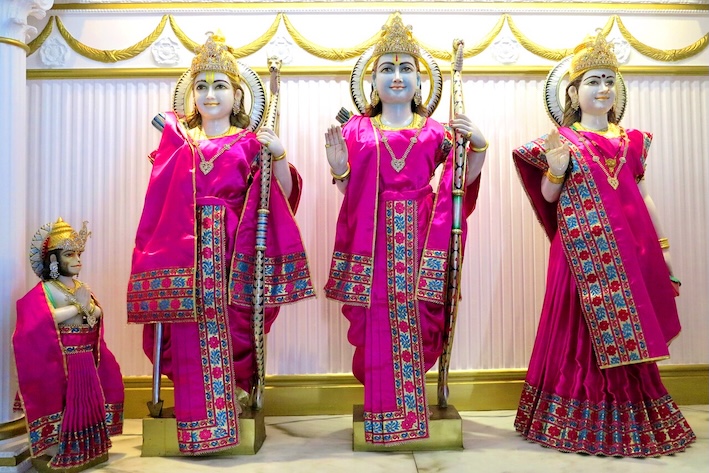
I have a small statue of Śrī Hanumān on the shelf near where I study. So when a clip does the rounds online of an individual dressed as Him at a Bharatiya Janata Party (BJP) rally, flag in hand, working the crowd, I do not watch it with detachment. I am disgusted, because it is not devotion but a costume borrowed for the length of a chant and discarded once the crowd moves on to the next one. I am a British Hindu of Indian (Punjabi) heritage. This is not a country I have ever voted in or ever will, and I will not adjudicate its internal politics; it is not my place, and it would not be fair for me to attempt it from this distance. I am not presenting a case for any party, nor a commentary on the domestic disputes of Indian democracy. It is an objection to a party that has taken it upon itself to speak not just for a country, but for a faith I am part of. It claims that title on behalf of Hindus everywhere, from Haridwar to Harpenden, whether we asked for the representation or not.
To say you are the sole legitimate voice of a faith practised by over a billion people across every continent is to invite a question you cannot then avoid: legitimate by what measure? Not, I think, by electoral mandate alone, since a majority in one parliament does not confer the right to speak for people who have never had a vote in that parliament to begin with (certainly not for the Hindus of non-South Asian, Balinese, Fijian, Trinidadian, or Nepalese backgrounds), for people who have never had reason to think of Delhi as their capital. The only measure left is conduct. If a party wishes to be understood as the political expression of Hindu identity, then its behaviour, not its branding, has to bear some relationship to what that identity is understood to mean. It is exactly there, again and again, that the claim comes apart.
The Hanumān costume is small. The temple is not. It was built to be the physical monument to everything this government says it stands for. The Śrī Rāma Janmabhūmi Tīrtha Kṣetra Trust (The Ram Mandir Trust) has received ₹3,500 crore in cash donations since 2020, much of it from people with considerably less to spare than they gave. It is now the subject of a Special Investigation Team probe, a five-year re-audit, and the resignations of its former general secretary, Champat Rai, and former trustee, Anil Mishra, following allegations of unaccounted cash and jewellery that an internal audit had already flagged as a concern back in 2020, and that nobody acted on for years. Even the radical right-wing RSS has called itself deeply hurt by the affair, which tells you how far this has travelled. I am not criticising the existence of the temple, only the handling of who was entrusted to it, which was not stewardship but negligence dressed in saffron. Negligence of that kind, in an institution built to represent the faith, is not a side issue. It is the faith’s own reputation, spent without permission.
Then there is the harder subject, which I raise carefully because it involves deaths: the pattern of vigilante violence carried out in the name of cow protection, a cause the BJP has for years used to signal its Hindu credentials. I want to be precise about what troubles me here, because it is not the underlying instinct.
If one genuinely wishes to stop the slaughter of cows, there are many peaceful, non-discriminatory ways of doing it: funding gaushalas (cow shelters) properly rather than letting them run on donations and neglect, enforcing existing slaughter laws through courts and licensing rather than through men with sticks on a highway, persuading through example and argument rather than fear. None of that requires a mob, and none of it requires that the burden fall, as it overwhelmingly has, on Muslim and Dalit communities working in the cattle trade.
When Hindus ourselves criticise the vigilantes, we are often met with accusations of being a “false Hindu,” someone who does not respect Gāumātā, Mother Cow. This is grossly unfair. Not only am I a Hindu, I am a devotee of Śrī Kṛṣṇa, one of whose own names is Gopāla — protector of the cows! I do not accept that reverence for that name is best expressed by men who have, state after state, been met with police delay and open political sympathy from BJP figures for the attackers rather than the attacked.
The double standard runs deeper. The state of Uttar Pradesh, governed since 2017 by Yogi Adityanath, a BJP chief minister who has built much of his political identity on cow protection, has for years also been one of India’s largest producers and exporters of buffalo meat, even as vigilante violence against ordinary traders escalated on its roads. A politician can style himself however he likes, but it is hard to watch the self-styled “guardian of the cow” preside over one of the country’s largest bovine meat economies at the same time and conclude that the first role is anything other than theatre for the second. I do not raise this to accuse the individual Hindu; the overwhelming majority would recognise that killing a person cannot be reconciled with reverence for life, however that reverence is understood. I raise it because a party that trades so heavily on Hindu symbolism cannot then disown the violence committed under that symbolism’s cover. Not when its own leaders have, at various points, defended or excused the people responsible.
There is a further problem, quieter than the others but no less real to me: what the BJP’s version of Hinduism leaves out. My faith is an enormous family of traditions. Śaiva and Vaiṣṇava, Śākta and folk, the temple worship of Tamil Nadu, the tribal traditions of central India, the Hinduism kept alive by Nepalis, Balinese, and the descendants of indentured labourers in the Caribbean and the Pacific with almost nothing to sustain it but memory. The political movement that claims to speak for all of this has, in practice, promoted a narrow, temple-and-flag version of the religion: useful for a national campaign, a poor fit for the plurality it claims to represent. Adivasi communities are counted as Hindu when it suits a census or an electoral map, then have their own relationships to land and deity treated as folklore to be absorbed rather than tradition to be respected on its own terms. A faith this varied cannot be spoken for by a single template, however loudly that template is marketed. The marketing is part of the problem. It teaches people, inside India and out, to mistake one modern political style for the religion itself.
Who has this government actually protected? In 2020, a nineteen-year-old Dalit woman in Hathras, Uttar Pradesh, was assaulted by four men and later died of her injuries. Rather than allow her family to perform her last rites according to their own wishes, the state administration, under Yogi Adityanath, cremated her body at midnight without their consent, sealed off the village, and kept journalists and opposition politicians away for days, later telling a court this had been done to prevent unrest. Even a senior BJP leader, Uma Bharti, said at the time that the handling of the case had damaged the party’s claim to be building “Ram Rajya.” If a movement’s account of Hindu India cannot extend basic dignity, in death, to a Dalit Hindu woman, then its claim to speak for Hindus as a single community is not just incomplete, but it is the clearest evidence against itself.
The BJP is entirely comfortable invoking global Hindu identity when it is useful: to court the diaspora, to bristle at criticism from abroad as an attack on Hindus everywhere, to fold events like Ayodhya’s consecration into a story about the whole world’s Hindus finally being vindicated. What it has never done is treat the global Hindu community as people it might actually be accountable to. We are invoked when convenient and set aside when the invoking becomes inconvenient, and that asymmetry is my whole complaint. I am not asking for a different party to run India; that is not a decision that belongs to me, and I would not presume to make it. I am asking that a party stop describing itself as my representative while behaving, again and again, in ways my faith would not ask of a person. I would like to be able to watch a clip like the one I described at the start without wondering what is being sold to me this time.
Jaya Śrī Rāma.
Republished from Medium with the author’s permission.