
A New Zealand journalist asked the question that foreign reporters have now made a habit of asking. Why does Prime Minister Narendra Modi not hold press conferences?
The question was raised at an Indian Ministry of External Affairs (MEA) media briefing in Auckland on 11 July 2026, during the final leg of Modi’s three-nation Indo-Pacific tour covering Indonesia, Australia and New Zealand. MEA Secretary (East) Rudrendra Tandon’s response was to describe Modi as a “quintessential Indian politician” and to defend his communication style by pointing to his electoral record.
“You must remember that the Indian electorate are predominantly rural folk. They want direct contact. They don’t like being spoken down to, and they don’t like being spoken to through intermediaries. And Mr Modi has perfected the art of direct contact with his electorate, and he seems to be doing a rather good job of it, since you know, he’s been elected now, he’s in his third term, he’s one of the longest-serving Prime Ministers in our country,” Tandon said.
MEA spokesperson Randhir Jaiswal, speaking separately, offered a simpler formulation: “The Prime Minister has his own style of communication. He prefers direct contact with the people. He communicates with them directly through various means.”
Tandon acknowledged the question was familiar. He said he got “deja vu” of a similar incident in Norway in May 2026.
What happened in Norway
The Norway incident has become a reference point in the recurring debate about Modi and the media.
During Modi’s visit to Oslo in May 2026, as part of a five-nation European tour, Norwegian journalist Helle Lyng Svendsen of the daily newspaper Dagsavisen shouted a question at Modi as he was leaving a joint appearance with Norwegian Prime Minister Jonas Gahr Støre: “Prime Minister Modi, why don’t you take some questions from the freest press in the world?”
Modi did not respond and walked away. It is not confirmed whether he heard the question. Lyng followed him out and asked: “Do you deserve the trust of our government?” She did not receive a response to that question either.
Lyng posted a video of the exchange on X, captioning it: “Norway has the number one spot on the World Press Freedom Index; India is at 157th, competing with Palestine, the Emirates and Cuba. It is our job to question the powers we cooperate with.” The video went viral across India, garnering millions of views within hours.
The response was not only political. Lyng faced a torrent of online abuse, including death threats and doxing, from social media users identified with right-wing Indian nationalist communities. Her Instagram and Facebook accounts were subsequently suspended, a development she later attributed to the mass reporting campaign against her.
The Indian Embassy in Norway invited Lyng to a MEA press briefing, where she pressed officials on human rights in India. MEA Secretary (West) Sibi George became visibly agitated during the exchange, eventually telling her “This is my press conference.”
What happened in Melbourne
The question was raised again in Australia, three weeks before the New Zealand incident.
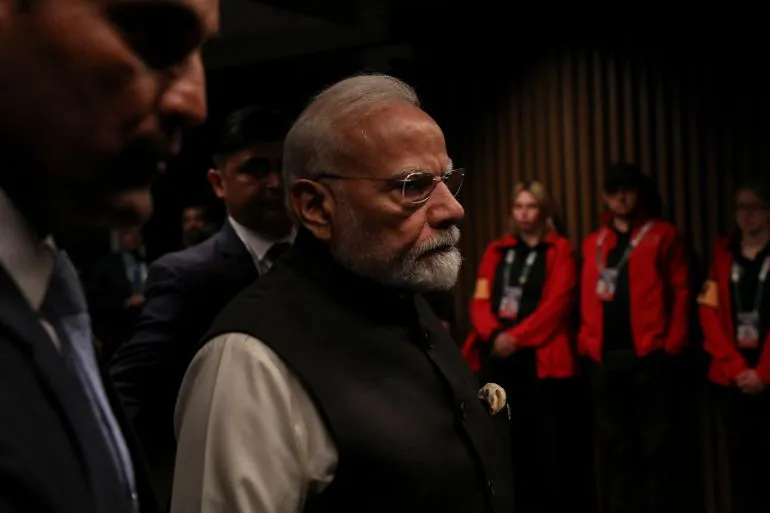
During Modi’s three-day visit to Melbourne from 8 to 10 July, Seven News reporter Blake Johnson remarked on air that Modi “famously avoids unscripted news conferences, preferring more stage-managed appearances instead.” The comment, made alongside visuals of Modi walking during the visit, circulated widely on social media.
Johnson’s observation was factual. Modi has not held a solo unscripted press conference in India since taking office in May 2014, a period of twelve years and three election victories. He has given interviews to selected media organisations, appeared at joint press statements with foreign leaders, and addressed public rallies, religious gatherings and direct-to-public programmes including Mann Ki Baat on All India Radio. He has not submitted to open questioning by the press.
In at least several documented cases, Modi’s office has insisted that media organisations share questions in advance, or has agreed to respond only in writing, eliminating the possibility of follow-up questions.
What the MEA’s argument is
The MEA’s defence of Modi’s media approach across all three incidents has been consistent. The argument has two components: that Modi communicates directly with the people through other means, and that his electoral success validates his method.
Tandon’s reference to the Indian electorate being “predominantly rural folk” who “don’t like being spoken to through intermediaries” is an argument that Modi’s chosen channels- rallies, social media, Mann Ki Baat, and temple visits- reach his core constituency more effectively than press conferences would.
BJP MP Tejasvi Surya has made a similar case, arguing that traditional press conferences are no longer the only means of public communication and that the Prime Minister regularly conveys his views through election rallies, public meetings and social media.
What the critics say
India is ranked 157th out of 180 countries in the 2026 World Press Freedom Index published by Reporters Without Borders, a drop of six places from its 2025 position of 151st. The index places India in the “very serious” category, below countries including Gambia and Sierra Leone.
Reporters Without Borders and independent analysts have noted that India’s legacy television news ecosystem, historically known for adversarial political coverage, has shifted significantly toward the government’s position under Modi’s decade in power, with prime-time debates now widely characterised as supportive of the ruling party’s positions.
Opposition leader Rahul Gandhi addressed the pattern directly during the Norway episode: “What happens to India’s image when the world sees a compromised PM panic and run from a few questions? When there is nothing to hide, there is nothing to fear.”
Helle Lyng, speaking to Newslaundry after the Norway incident, said she had appeared on Indian television channels and was struck not by criticism from government supporters but by the reactions of some Indian journalists. “What surprised her was the reactions of some journalists, who expressed anger at the idea that a prime minister should be expected to answer questions,” as reported by Nieman Reports.
The pattern across three countries
The New Zealand question on 11 July is the third time in two months that a foreign journalist has publicly pressed either Modi or his officials on the press conference question during an overseas visit. Norway in May. Melbourne in early July. Auckland on 11 July.
In each instance, the MEA has offered a version of the same response: Modi communicates differently. In each instance, a video has circulated. In each instance, the exchange has drawn more attention than the bilateral agreements being signed alongside it.
The India-New Zealand summit on 11 July produced a Strategic Partnership declaration and a bilateral trade target of Rs 35,000 crore by 2030. Both outcomes received significantly less international attention than the press conference question.
Modi departed New Zealand on 11 July, concluding the three-nation tour. He did not hold a press conference in New Zealand, Australia or Indonesia.
What the record shows
Modi has held joint press statements with foreign leaders during overseas visits, including in Washington in 2023, when Wall Street Journal journalist Sabrina Siddiqui asked him about the treatment of religious minorities in India. Modi responded by saying that democracy is “in India’s DNA” and that India “does not discriminate between people irrespective of their caste, creed or religion.” He did not take a follow-up question.
He has not held a solo unscripted press conference in India at any point during his three terms in office spanning twelve years. No Prime Minister of India in the modern era has gone this long without holding one.