
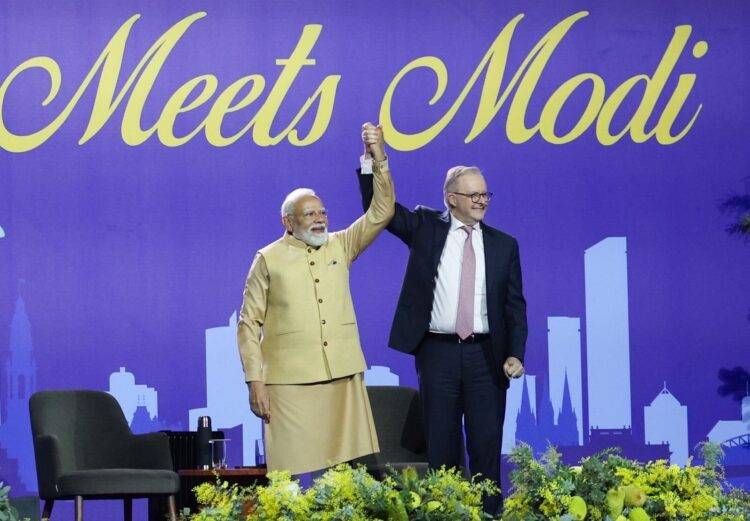
Prime Minister Narendra Modi and Australian Prime Minister Anthony Albanese co-chaired the third India-Australia Annual Leaders’ Summit in Melbourne on 9 July 2026, emerging with a joint declaration on defence and security, a joint statement on energy ties, and a roadmap for collaboration in cyber and critical technologies. The two leaders addressed a joint press conference at which Modi described the relationship as a “partnership of the future” and Albanese said Australia’s relationship with India had “never been more consequential than it is today.”
Modi arrived in Melbourne on 8 July to a welcome from the Indian community at the airport, where the Australian-India Orchestra performed Maa Tujhe Salaam. He addressed thousands of Indian-Australians at the Melbourne Meets Modi community event at Marvel Stadium on 9 July, the largest gathering of Indian-Australians at a single event in Australia’s history.
The Uranium deal
The most significant individual announcement of the summit was the formal activation of Australia’s uranium exports to India.
“Australia will supply uranium to India. We have signed an important agreement in the field of nuclear energy. It will give new momentum to our clean energy goals,” Modi said at the joint press conference.
Albanese confirmed the arrangement facilitates Australian uranium exports to India for peaceful purposes under the 2015 Australia-India Nuclear Cooperation Agreement. He described it as providing an additional market for Australian resources while helping India increase the share of non-fossil fuel power capacity in its energy mix.
What is the Australia-India Nuclear Cooperation Agreement?
India and Australia signed a civil nuclear cooperation agreement in 2014, coming into force in 2015, under which Australia agreed in principle to supply uranium to India for peaceful civilian nuclear energy purposes. Despite the agreement being in place for over a decade, uranium exports had been limited by concerns over safeguards and verification mechanisms. The 9 July arrangement provides the specific framework for exports to proceed. India is not a signatory to the Nuclear Non-Proliferation Treaty, which had historically complicated uranium supply arrangements with NPT-member countries including Australia.
Australia holds approximately 28% of the world’s known uranium reserves, the largest share of any country. India has committed to expanding nuclear power to 100 gigawatts by 2047 as part of its clean energy transition. The two objectives align directly.
The trade agreement
Bilateral trade in goods and services between India and Australia reached AUD 54 billion in 2025-26, up 25% since the Economic Cooperation and Trade Agreement was signed. Both leaders acknowledged this figure remains well below the potential of two economies of their respective sizes.
Modi called for the early conclusion of the Comprehensive Economic Cooperation Agreement at the Australia-India CEOs Forum earlier on 9 July, describing it as a “balanced, ambitious and mutually beneficial pact.” Albanese confirmed both sides would move forward on the CECA and on a bilateral investment treaty to deepen economic engagement.
The CECA has not been concluded. Both leaders characterised the summit as providing fresh momentum to negotiations that have been running for several years. No completion date was announced.
What is the CECA?
The Comprehensive Economic Cooperation Agreement is a proposed full free trade agreement between India and Australia that would build upon the interim Economic Cooperation and Trade Agreement signed in 2022. The ECTA eliminated tariffs on approximately 96% of Australian goods exported to India and 85% of Indian goods exported to Australia. The CECA, when concluded, would be significantly more comprehensive, covering services, investment, intellectual property, government procurement and labour mobility, among other areas. India-Australia bilateral trade in goods and services was valued at AUD 54 billion in 2025-26.
The five new frameworks announced
Beyond the uranium deal and the CECA commitment, the summit produced five new bilateral frameworks.
Australia-India Partnership on Cyber, Critical Technologies and Supply Chains: A new joint initiative covering digital security, emerging technology cooperation and supply chain resilience. Both leaders described it as central to their strategic security and clean energy transition goals.
Critical Minerals Corridor: Modi announced India and Australia would work together on a dedicated Critical Minerals Corridor to strengthen resilient supply chains and support the clean energy transition. Australia is one of the world’s largest producers of lithium, cobalt and rare earth elements. India is seeking to reduce dependence on Chinese supply chains for these materials.
India-Australia Defence Innovation Corridor: A new framework to deepen collaboration in defence technology, announced by Modi at the joint press conference. No specific projects were named at the time of the announcement.
Joint Declaration on Defence and Security: A formal declaration committing both sides to a deeper practical defence partnership. Albanese said it would boost strategic coordination, increase the complexity of joint defence exercises, and build interoperability between the two countries’ defence forces. Both leaders framed it in the context of growing concern over China’s military activity in the Indo-Pacific.
Joint Statement on Energy Ties: A formal statement covering the broader energy relationship, of which the uranium supply arrangement is one component. The statement encompasses clean energy cooperation, critical minerals and energy security more broadly.
The Indo-Pacific framing
Both leaders placed the agreements in the context of the Indo-Pacific security environment. “The Indo-Pacific is not just the confluence of two oceans. It also symbolises the shared aspirations of like-minded democracies like India and Australia,” Modi said.
Albanese said Australia values India as a “top-tier security partner” and that the joint declaration on defence reflects a shared commitment to a peaceful, stable and prosperous Indo-Pacific. Both leaders referenced freedom of navigation, a rules-based order and the importance of dialogue over conflict.
Modi also raised terrorism, saying India and Australia share an unwavering resolve to fight it and that cooperation between the two countries on counterterrorism continues to strengthen.
The announcements came on the second leg of Modi’s three-nation Indo-Pacific tour covering Indonesia, Australia and New Zealand, framed by the Indian government as a visit aimed at boosting trade and defence ties at a moment of geopolitical uncertainty.
What the summit means for Indian Australians
The summit’s outcomes touch Indian-Australians across multiple dimensions.
The CECA, when concluded, will be the most consequential trade development for Indian professionals and businesses operating between the two countries. The services chapter of the agreement, which has not yet been concluded, is the one most directly relevant to Indian-Australian workers, covering professional recognition, labour mobility and the movement of people. Both leaders have described this as a priority area.
The Critical Minerals Corridor creates new investment and employment opportunities in a sector where Indian-Australian professionals in engineering, geology and resource management are well positioned. Australia’s critical minerals industry is actively seeking skilled workers and capital, and a dedicated bilateral corridor would formalise the investment flows that are already developing.
The uranium deal is primarily a government-to-government energy and strategic arrangement. Its indirect effect for Indian-Australians is as a signal of the depth of the bilateral relationship: Australia is now prepared to supply nuclear fuel to India, a step that was politically and technically complex for over a decade.
The Melbourne Meets Modi community event at Marvel Stadium on 9 July, which drew the largest gathering of Indian-Australians in the country’s history, sat alongside the formal summit as a demonstration of what Albanese described as the people-to-people dimension of the relationship. Modi called the Indian community in Australia “an important pillar” of the bilateral relationship on arrival.
The summit did not produce announcements on the specific mobility and visa concerns most frequently raised by Indian-Australians: student visa processing times, skilled migration pathways, and the skills assessment backlog. These remain active issues that the CECA services chapter is expected to address when negotiations conclude.
What the summit left unanswered
The CECA has been “fast-tracked” before. What is different this time?
Both the 2021 and 2023 summits produced commitments to accelerate CECA negotiations. The agreement has still not been concluded. What is different in 2026 is the services chapter momentum: Australia and India have both signalled that professional recognition and labour mobility are now priority items, not deferred ones. Whether that translates into a signed agreement before the next Australian federal election remains the real test.
India is not a signatory to the Nuclear Non-Proliferation Treaty. How does Australia justify supplying uranium?
Australia’s uranium export policy allows supply to non-NPT countries provided they have a safeguards agreement with the International Atomic Energy Agency, which India does under the 2008 India-IAEA Safeguards Agreement, and a bilateral nuclear cooperation agreement with Australia, which India has had since 2015. The 9 July arrangement operationalises what the 2015 agreement already permitted in principle. The political hesitation over the past decade was about verification confidence, not legal authority.
The Critical Minerals Corridor was announced. What does that actually mean in practice?
At this stage it is a framework, not a funded project. It commits both governments to developing joint supply chain mechanisms for lithium, cobalt, rare earths and other critical minerals. Specific projects, investment vehicles and procurement arrangements are to be developed under the framework over the coming months. The corridor will be watched closely by Indian and Australian companies already operating in the critical minerals space, for whom a formal bilateral structure creates new investment and contracting opportunities.
Modi addressed the largest gathering of Indian-Australians in the country’s history at Marvel Stadium. Did he announce anything specific for the community?
No specific policy announcements for Indian-Australians were made at Melbourne Meets Modi. Modi described the Indian community as “an important pillar” of the bilateral relationship and framed their success in Australia as part of the broader India-Australia story. The practical concerns most raised by Indian-Australians, student visa processing, skilled migration backlogs and professional recognition, were not addressed in specific announcements at the community event or the formal summit. These are expected to be addressed in the CECA services chapter when negotiations conclude.
Does the uranium deal affect Indian-Australians directly?
Not directly. The uranium supply arrangement is a government-to-government energy deal under which Australian uranium will be exported to India for civilian nuclear power generation. It does not change visa rules, employment conditions or community services. Its significance is strategic: it signals the depth of the bilateral trust and will contribute to India’s clean energy expansion over the coming decades.
When will the CECA be completed and what will it mean for Indian professionals?
No completion date was announced at the 9 July summit. Both leaders described the negotiations as progressing and committed to early conclusion. When concluded, the CECA’s services chapter is expected to improve professional recognition and labour mobility between India and Australia, making it easier for Indian-qualified professionals to work in Australia and vice versa. Until the agreement is signed, the existing ECTA remains in force.
What is the Critical Minerals Corridor and are there jobs in it for Indian-Australians?
The Critical Minerals Corridor is a framework to link India’s and Australia’s critical minerals supply chains, covering lithium, cobalt, rare earths and other materials essential to clean energy and technology manufacturing. Specific projects and investment mechanisms are to be developed under the framework. Indian-Australian professionals in mining, engineering, geology and resource finance are well positioned to work across both sides of this corridor as it develops.
How significant is the Defence Innovation Corridor for the bilateral relationship?
The Defence Innovation Corridor adds a technology cooperation layer to what has been primarily an operational and exercise-based defence relationship. No specific joint projects were named at the summit. The corridor will be developed through the existing India-Australia Defence Science and Technology Implementing Arrangement. Details are expected to emerge over the coming months.
Did Modi raise Indian student visa issues or migration concerns with Albanese?
No specific announcements on student visas, skilled migration processing or the skills assessment backlog were made at the summit. These are among the most pressing concerns for Indian-Australians and are expected to be addressed in the CECA services chapter when negotiations conclude. The summit communique referenced mobility and people-to-people ties as priority areas without specifying new measures.