
In 2024-25, more than 360,000 Indian students were enrolled at American colleges. India was the largest source of international students in the United States, accounting for nearly a third of all overseas enrolments. Eighteen months later, that pipeline is contracting at a pace that has alarmed university administrators across the country.
The Institute of International Education released its Spring 2026 Snapshot on International Educational Exchange on 9 July, surveying 585 US colleges and universities that together host 48% of all international students in the country. The findings confirm what campus administrators have been watching develop since late 2025: fewer students are coming, the decline is steepest from India, and the outlook for 2026-27 is worse than the year just ended.
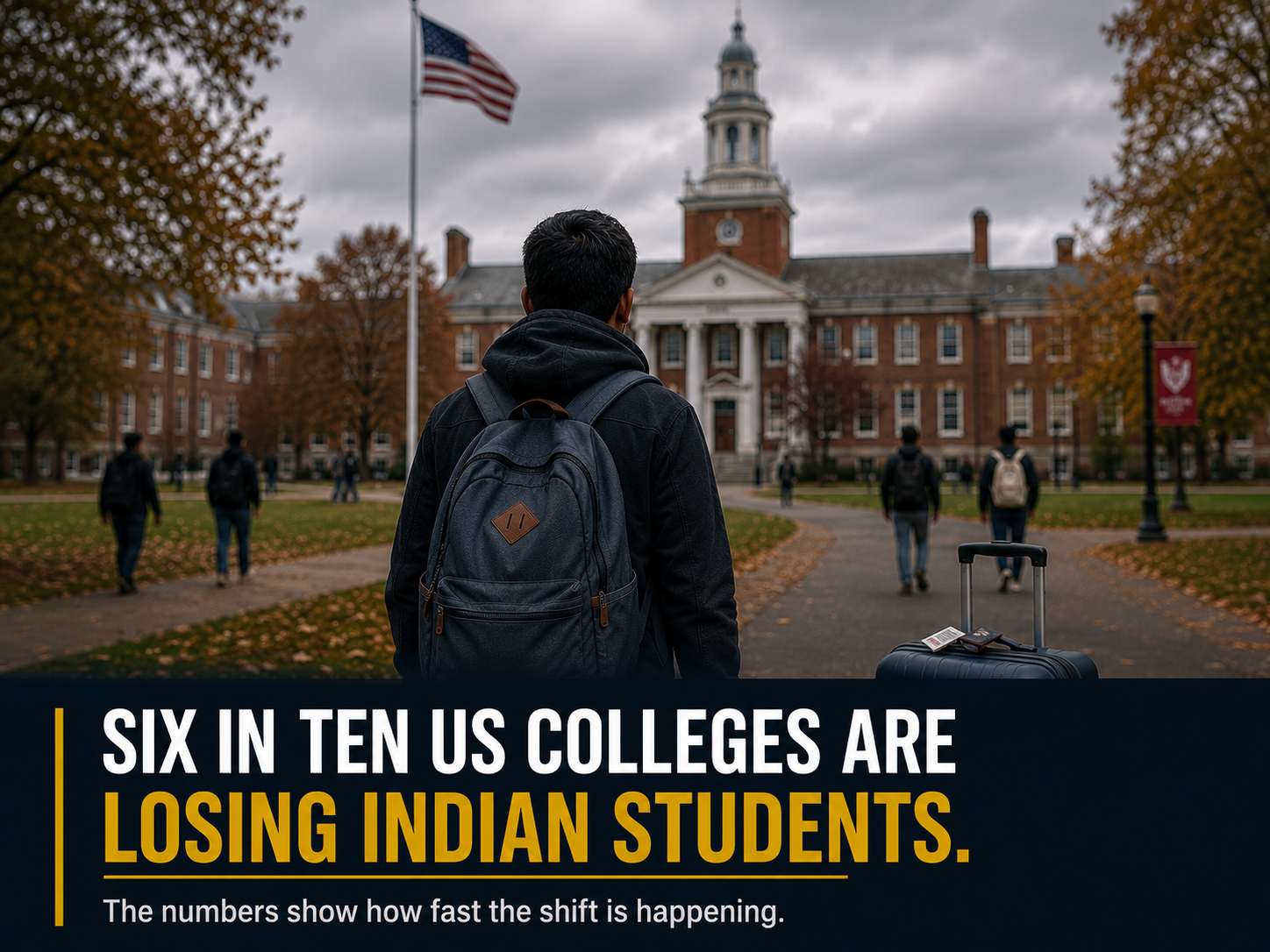
Fifty-nine per cent of surveyed institutions reported a decline in international applications for the 2026-27 academic year. Sixty-three per cent expect international enrolment to fall. One in four expects a substantial decline. Among the institutions anticipating lower numbers, 92% cited visa application barriers as a contributing factor, 80% cited US travel restrictions, and 77% said students were choosing other destinations.
Where the India numbers stand
Over 60% of institutions saw a drop in applications from India, largely due to soaring F-1 visa denials, as study visa issuance to Indian applicants plummeted 62% last year.
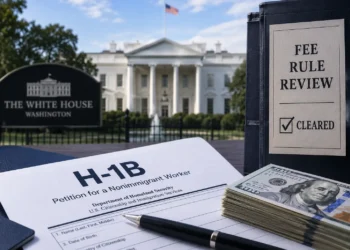
American consulates in India issued visas to only about 22,000 students last summer. The year before, the figure was significantly higher. That collapse in visa issuances has now translated directly into enrolment numbers: the number of international students arriving on visas from India to the United States declined by 44.5% between August 2024 and August 2025, according to ADIS/I-94 data reported by the US International Trade Administration.
The postgraduate level has been hit hardest. Sixty-five per cent of institutions reported decreases in graduate applications, compared with 60% reporting declines in undergraduate applications. Across the survey, 43% of institutions reported a substantial decrease in graduate applications versus 31% at the undergraduate level.
The State Department’s near month-long suspension of study visa interviews in 2025 was a primary driver of the fall intake decline. A 36% year-over-year decline in new F-1 visa issuances was recorded as of March 2026. Graduate programmes have faced a particularly steep challenge: international graduate enrolment sank 4.3% in spring 2026 compared to the year prior, with public four-year colleges seeing a 9.2% year-over-year loss in international graduate students.
What is an F-1 visa?
The F-1 is the primary US non-immigrant student visa for full-time academic study at accredited universities, colleges, language training programmes and other academic institutions. It allows the holder to study for the duration of their programme plus a grace period after graduation. F-1 holders are eligible for Optional Practical Training, which permits them to work in their field for up to 12 months after graduation, extendable by 24 months for STEM graduates. The visa is issued by US consulates and embassies. Indian students are the largest group of F-1 visa holders in the US.
Why students are looking elsewhere
The IIE data makes the direction of travel explicit. Students are not rejecting the US; they are pricing in its volatility, and increasingly, the maths favours elsewhere, said Sanjay Laul, founder of international recruitment platform MSM Unify.
Germany has emerged as the clearest winner among Indian students, whose interest in the destination has doubled from 2022, where they see visa approval rates of 90 to 95% processed in as little as six working days.
The shift is not confined to Germany. Canada, Australia and Singapore have each expanded post-study work pathways in recent years, directly targeting the Indian student market that the US is losing. Schools say the effect goes beyond paperwork. Prospective students now weigh visa processing, travel limits, work restrictions and the possibility of abrupt status loss against offers from institutions in Europe and Asia, where enrolment has reportedly risen as the US share falls.
The OPT programme, which allows F-1 graduates to work in the US for up to three years in STEM fields, is under active review by the Trump administration. Over 30% of Indian students in the US are currently participating in OPT, with the government undertaking a re-evaluation of the programme amid widespread expectations of its curtailment or elimination. That uncertainty is influencing application decisions at the point of enquiry, not just at the visa stage.
The Indian family of 2026 is running a five-year career calculation, Laul said. That calculation now includes the probability of completing a degree, working legally after graduation and building a career in the US without abrupt policy shifts overturning the plan mid-course.
What it costs American universities
International students contribute about USD 43 billion to the US economy annually, and a sustained decline on the scale now reported would translate into an estimated USD 7 billion loss in revenue and roughly 60,000 lost jobs nationwide.
The losses would not fall evenly. Public universities that rely on higher international tuition, graduate programmes that depend on foreign enrolment in research fields, and local businesses near campuses all face the impact if fewer students arrive in autumn 2026.
The University of Texas at Arlington predicted that a 40% decline in international graduate students would contribute significantly to an expected loss of between USD 13 million and USD 15.6 million in tuition revenue for the 2026 fiscal year. DePaul University in Chicago saw international enrolment fall by approximately 755 students year on year for autumn 2025, including a nearly 62% decline among new international graduate students.
The longer-term forecast
QS expects significant contraction in overall enrolment in 2027 before the downturn bottoms out ahead of moderate recovery towards the end of the decade. Demand from India is expected to fall by 7% by 2030, with this cohort particularly vulnerable to changes in work-rights policies.
Among those anticipating drops, institutions that are weathering the slowdown most effectively are those offering admissions flexibility, including deferrals, and those communicating with prospective students clearly and honestly to minimise unpredictability as much as possible.
Laul urged universities to diversify within India, not just beyond it, and to focus on outcomes rather than brand. The advice reflects a structural shift in how Indian families approach US higher education: the brand premium of an American degree is no longer sufficient on its own if the conditions for completing the degree and building a career afterwards are uncertain.
What the data means for Indian families considering the US
The IIE Spring 2026 Snapshot is a survey of institutional intent and application data, not a final enrolment count. The actual autumn 2026 numbers will be clearer by October. What the data shows right now is the direction: fewer Indian students are applying, more institutions expect enrolments to fall, and the visa barrier is the primary cited reason.
For Indian families in Australia, the UK, the UAE and Canada currently weighing a US university application for 2026-27 or 2027, the practical picture is this. F-1 visa issuances to Indian applicants fell 62% last summer. The OPT programme, the primary post-study work pathway, is under active review. Processing times remain unpredictable. Germany, Canada, Australia and Singapore are actively competing for the same students with faster visa processing and clearer post-study work rights.
The data does not say the US is no longer worth considering. It says the calculation has changed.
What Indian students and families are weighing right now
Why did F-1 visa issuances to Indian students fall so sharply?
The State Department suspended student visa interviews for nearly a month in 2025, creating a backlog that compressed the summer 2025 issuance window. Broader tightening of F-1 approval criteria and increased administrative processing times have continued into 2026. The result: approximately 22,000 Indian students received F-1 visas last summer, compared to a significantly higher number the year before.
Is OPT at risk and what does that mean for Indian students?
Optional Practical Training allows F-1 graduates to work in the US for up to 12 months after graduation, with a 24-month STEM extension. The Trump administration has announced a re-evaluation of the programme. No change has been enacted as of the date of publication. Over 30% of Indian students in the US currently participate in OPT. If it is curtailed or eliminated, the post-graduation career pathway that makes a US degree financially viable for many Indian families would be significantly diminished.
Which countries are gaining the Indian students the US is losing?
Germany has seen Indian student interest double from 2022. Canada, Australia, Singapore and the UK have all expanded post-study work pathways. The IIE data confirms 77% of US institutions believe students are choosing other destinations. None of these alternatives fully replicates the US labour market access that OPT provides, but the visa certainty and processing speed they offer is increasingly the deciding factor for Indian families running a multi-year career calculation.
Does a decline in Indian applications affect the quality of US universities?
Indian students are disproportionately concentrated in STEM and graduate programmes, where they represent a significant share of teaching assistants, research assistants and doctoral candidates. A sustained decline in Indian graduate enrolment affects research output, lab capacity and the financial model of programmes that depend on graduate student labour. The effect is already visible at institutions such as DePaul and UT Arlington.
Should my child still apply to US universities for 2026-27?
The IIE data reflects institutional-level trends, not individual outcomes. Top-ranked US universities have largely maintained their international application numbers. The risk factors visa uncertainty, OPT review, and processing delays are real and should be factored into any decision alongside the quality of the specific programme and institution. Seek independent advice from a registered education consultant with current knowledge of US visa processing conditions.