
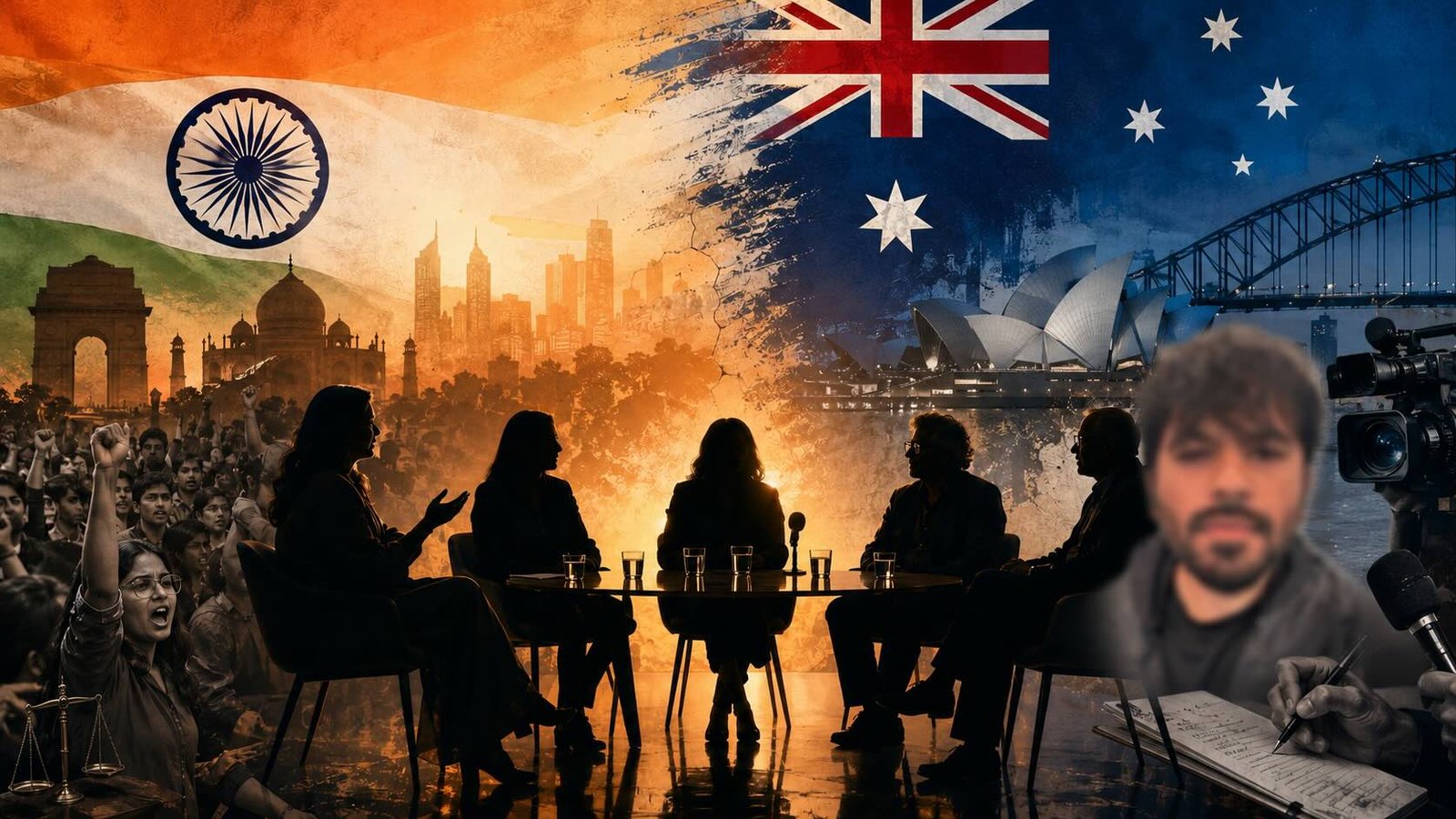
When Prime Minister Modi visits Australia in July, he will be met with pageantry, packed stadiums and carefully managed public events. What he is unlikely to encounter, if the panel on the latest episode of NRI Affairs’ Pause with Nandini is to be believed, is a single uncomfortable question.
That candour set the tone for an hour-long roundtable that ranged across press freedom, economic distress, diaspora identity, transnational repression and the surprising political force of a cockroach. Hosted by NRI Affairs Culture Editor Nandini Sen Mehra, the panel brought together journalist and former Outlook editor Chinki Sinha joining from Delhi, artist and political commentator Shuddhabrata Sengupta, former ABC South Asia Bureau Chief Meghna Bali, and Humanism Project co-founder and NRI Affairs Editor Deepak Joshi.
The Shrinking Space for Dissent
Chinki Sinha, who built Outlook into one of India’s most distinctive and culturally courageous publications, was blunt about the state of Indian journalism. “Explicitly we are told in newsrooms that we will not do this, we will not do that,” she said. “There’s not much room for any navigation anymore.”
She spoke of activist and student leader Umar Khalid, imprisoned for six years under the Unlawful Activities Prevention Act, whose essays Outlook published while he wrote from behind bars. The contrast she drew was pointed: Ram Rahim, the convicted rapist and self-styled godman, has repeatedly been granted parole, while Khalid, who called only for peaceful, non-violent dissent, remains in custody.
Shuddhabrata Sengupta went further, placing the repression of dissent within a broader structural crisis. “The regime is so mean right now that it seeks to criminalise ordinary human decency,” he said, citing the case of Srishti Gupta, a 27-year-old artist arrested in Noida after expressing solidarity with striking factory workers. She was detained by policemen after dark without an arrest memo and without policewomen present, in clear violation of legal procedure. Bail has been denied. “It says she’s not a worker or an employee of any of these companies in Noida, then why was she there?” Sengupta said, reading from the bail order. “Effectively what it does is criminalise sympathy and solidarity, and turns it into an offence.”
He described a widening wave of industrial unrest moving across northern India, from a walkout at an oil refinery in Sonipat to wildcat strikes in Gurugram and Noida, driven by workers whose real wages are falling as the cost of living climbs. “It is expensive to be poor,” he said. “If you make a smaller amount, more of it goes away in your monthly wage.”
A Relationship Built on Half the Picture
Meghna Bali, who spent two and a half years reporting across India as the ABC’s South Asia Bureau Chief until April 2026, offered a journalist’s assessment of what the Australia-India relationship consistently leaves out. “When Australia talks about India, the conversation often goes to these big-ticket items. They talk about trade and education and migration and the diaspora. And all of that does matter, of course. But having spent the last two and a half years reporting across India, I think it’s important to look beyond that diplomatic language and ask what is actually happening in the country.”
She identified three things she watches closely: India’s democratic health, the tension between its economic ambitions and social pressures, and the diaspora itself. On the latter, she was unequivocal. “Indian Australians are often talked about as one community, but of course we’re not. We’re divided by generation, by class, by caste, by religion, and by the migration story.”
She reserved particular scepticism for the notion that Australian governments have ever genuinely pressed India on difficult matters. “Time and time again, the Australian government has shown that they will also not ask the tough questions,” she said, recalling how both Scott Morrison and Anthony Albanese accepted garlands from Hindu nationalist organisations without scrutiny. “If you are saying that the relationship has gone past curries, cricket, and the Commonwealth, then you need to have a real understanding of what’s happening in the country.”
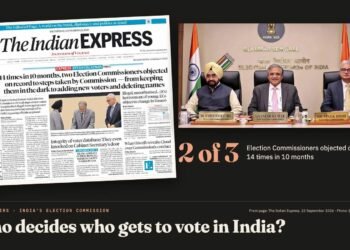
The panel also raised concerns less visible in mainstream coverage: the weaponisation of visa processes against diaspora critics of the Indian government, the reported deportation of Indian intelligence operatives from Australia, and the systematic disenfranchisement of voters through what Sengupta described as a politically manipulated revision of electoral rolls. In West Bengal alone, he said, roughly nine million people were removed from voter lists, with 2.7 million contesting the decision only to be told they would have to wait for the next election cycle.
Geopolitics, Trade and Uncomfortable Contradictions
The roundtable did not spare Australia’s own contradictions. The panel noted that more than 35 per cent of Australian trade flows through China, even as Australia deepens its strategic alignment with the United States, India and Japan through the Quad. India, meanwhile, sits uneasily between Quad commitments and its BRICS membership, recently declining to endorse a statement on Israeli actions in Gaza during a BRICS meeting. The discussion touched on how trade deals between the two countries risk benefiting corporate elites on both sides rather than working people, and how pressure from farming communities could yet derail agreements struck without sufficient public scrutiny.
The Cockroach That Shook the Establishment
Perhaps the liveliest stretch of the conversation centred on the Cockroach Janta Party, the decentralised Gen-Z digital movement that erupted after India’s Chief Justice made a statement dismissing ordinary citizens as cockroaches. Rather than being cowed, young Indians claimed the insult as a badge.
“In a long time we’ve not had fun actually, and I think that is one of the most underrated things in public life right now,” Sinha said. She described a rapper she knows in Patna, previously known for rapping about students’ living conditions, who has gone “totally out there rapping about cockroaches.” The movement’s power, she argued, lies not just in its creativity but in its dignity. “Using cockroach and making cockroach the symbol and giving that dignity: that is the biggest disruption according to me.”
Sengupta agreed, pointing to a deeper pattern: young people excluded from institutional media coverage turning outside established channels, creating new forms of accountability. “When those young people see that they’re not being covered, what they will turn to is outside the institutional mechanism.”
Bali situated the moment regionally: “I covered the Gen Z revolution in Bangladesh when that government fell. We started seeing a little bit of it with the Imran Khan protests. Before I arrived in India, we’d seen Sri Lanka.” The mood across South Asia, she said, reflects a real and building anger, economic pressure that transcends ideological divides and is looking for an outlet.
As for what Modi’s Australia visit will actually produce in terms of journalistic scrutiny, the panel’s expectations were low. Sengupta said he hopes Australian journalists will do what the Norwegian press did, ask the prime minister questions he doesn’t want to answer, knowing that the backlash could include being de-platformed. “There’s nothing that this man is more afraid of than journalists asking him questions,” he said. “Which is why he doesn’t take questions from Indian journalists.”
Bali was measured but not optimistic. “I just don’t think it’s quite at that level yet, unfortunately.”
Sinha, characteristically, found the last word in humour. Noting the criminal prosecution of stand-up comedians including Kunal Kamra, she pointed out that the state’s fear of satire is itself proof that satire is working. “Humour diffuses everything,” she said. “They’re very scared of humour. Which means humour is working.”
It was, perhaps, the most hopeful note the conversation could have ended on.
Pause with Nandini is available on the NRI Affairs YouTube channel.