

Phebyn Joseph, La Trobe University; Maggie Paul, La Trobe University, and Ruth Gamble, La Trobe University
The greatest challenge to India’s government in years began as an online joke.
On May 16, after Supreme Court Chief Justice Surya Kant described unemployed youth as “cockroaches”, Abhijeet Dipke, an international student in the United States, mused on X, “What if all cockroaches come together?”
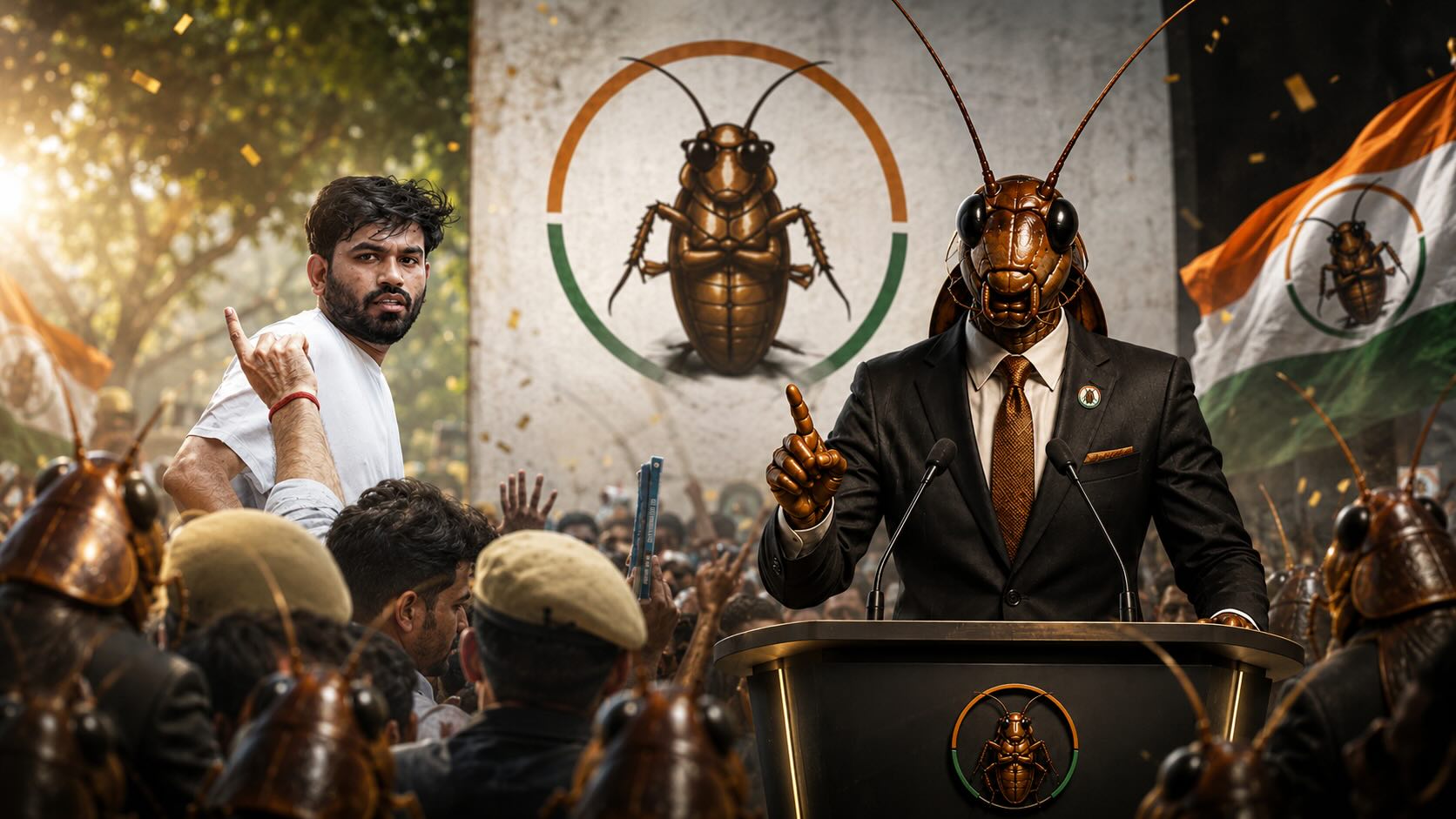
Thousands responded. Dipke had hit a nerve. Soon after, he launched a parody political party that would represent all “cockroaches”, calling it the Cockroach Janata Party (CJP), a play on the name of India’s ruling Bharatiya Janata Party (BJP).
But as Dipke returned to India on June 6 and the CJP’s rallies did not lead to a revolution that toppled the BJP-led government, many have dismissed the online movement’s chances of succeeding “in real life”.
But perhaps the better question is, has the CJP fundamentally changed Indian politics?
‘Voice of the lazy and unemployed’
On the new party’s website, Dipke described the CJP as the “Voice of the Lazy and Unemployed” and insisted membership required being both, as well as chronically online and “able to rant professionally”.
The CJP became an instant internet sensation, accruing 10 million Instagram followers in four days. The only account to grow faster belonged to Kim Taehyung, a member of the K-pop boy band BTS, in 2021.
Within a month, CJP’s following had reached 22.5 million, more than twice as many as the BJP.
The CJP’s success, like many good jokes, mixed humour and pain. It spoke to young Indians who face intense competition for university places, unemployment and precarious gig work, a mental health crisis, and eco-anxiety about increasing pollution and longer heat waves.
Generational pain
Chief Justice Kant’s “cockroach” remarks followed weeks of student protests against the cancellation of the national medical entrance exam, after its questions were leaked and widespread irregularities were uncovered.
Students also alleged there were discrepancies in the class 12 (school leaving) and public service entrance exams.
The exams are intensely competitive, and the education system is so underfunded that families drain their savings to pay for private coaching.
For many, cancellation was not a delay. Their families could not afford a re-sit.
This crushing exam pressure reflects deeper problems. Much of India’s economic growth has gone to the top 10%, who earn three-fifths of the country’s income and own two-thirds of its wealth.
Meanwhile, 40% of young graduates are unemployed.
Young Indians are anxious about the future, distrustful of unaccountable institutions, and convinced the rules no longer work.
They have also seen advocates punished for criticising the government. The CJP represents a break in the cycle of silent frustration.
Its immediate demands were the resignation of Education Minister Dharmendra Pradhan – whom it holds accountable for the exam fiascos – and educational improvements.
It also pressed for broader democratic reforms: judicial independence, voting rights, 50% parliamentary representation for women, a media free from billionaire capture (such as the BJP-aligned Gautam Adani and Mukesh Ambani), penalties for politicians’ party defections and public accountability for government spending.
Crackdown response
The government response was heavy-handed. It blocked the CJP’s website in India and pressured X to suspend its account.
Dipke also reported its Instagram account was hacked, so the CJP switched to WhatsApp, Telegram and Discord.
The government justified its X ban on “national security” grounds. Officials also invoked familiar claims of foreign interference, and incorrectly claimed the CJP’s followers were overseas or bots.
Speaking on France 24, Dipke dismissed these allegations, insisting “94% of our followers are from India”.
The government’s jumpy response may reflect broader anxieties. Gen Z-driven protests have recently brought down governments in Bangladesh, Nepal and Sri Lanka. In the southern Indian state of Tamil Nadu, young voters propelled actor-turned-politician C. Joseph Vijay’s new party to electoral success.
The opposition Congress party has recognised the shift. Its AI-driven campaign against the controversial development in the Nicobar Islands is aimed at Gen Z voters and includes a cockroach-headed human like those on the CJP website.
Did the revolution fizzle?
The CJP’s first offline test came after Dipke returned from the United States last week and led rallies at multiple cities across the country. At Monday’s Jaipur rally, he was attacked as he was carried through the crowd, then tried to protect his attacker.
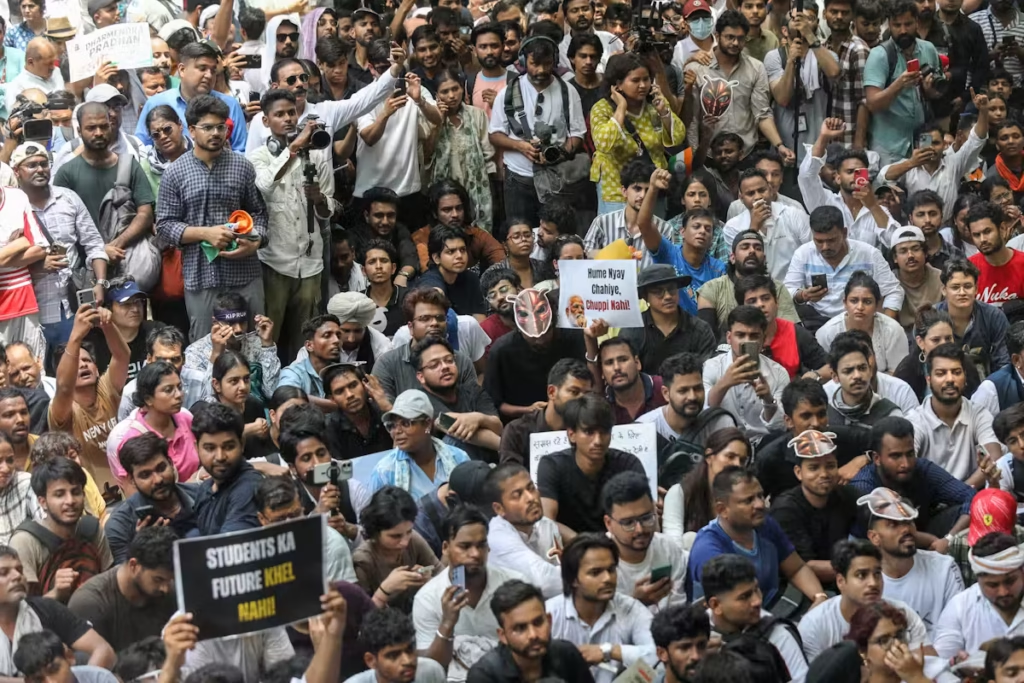
The protests were well attended, but they did not start another Gen Z revolution. This is likely because CJP has yet to develop a coherent ideological core or messaging strategy.
Despite their calls for equal representation, they have had no female spokespeople. The CJP also has no plans to establish a formalised party, saying it would remain a “pressure group” to hold the government accountable.
A growing blind spot
A youth-led revolution is less likely in India than elsewhere in South Asia. Over the past decade, the BJP has combined populist rhetoric, nationalist ideology, local networks, caste-based social engineering, and a disciplined party machine to dominate India’s democratic institutions.
The party has also made an art of co-opting other movements, and there are fears it could do the same with the CJP.
Yet the CJP’s rise suggests a potential weak spot for the ruling party. Gen Z voters have come of age with near-universal smartphone access and constant connectivity. Across class and caste lines, they are digitally fluent and politically aware, while remaining detached from traditional political structures. They will soon be India’s largest voting block.
Whether the CJP succeeds electorally may matter less than what it represents. It has shown a generation that can stand up to surveillance, censorship and fear. It has also used the tool that authoritarians fear most – humour – to do so.
Even if the CJP fails, this idea, like cockroaches, will be hard to exterminate.
Phebyn Joseph, Lecturer in Hindi, La Trobe University; Maggie Paul, Lecturer in Politics, La Trobe University, and Ruth Gamble, Senior Lecturer in History, La Trobe University
This article is republished from The Conversation under a Creative Commons license. Read the original article.