

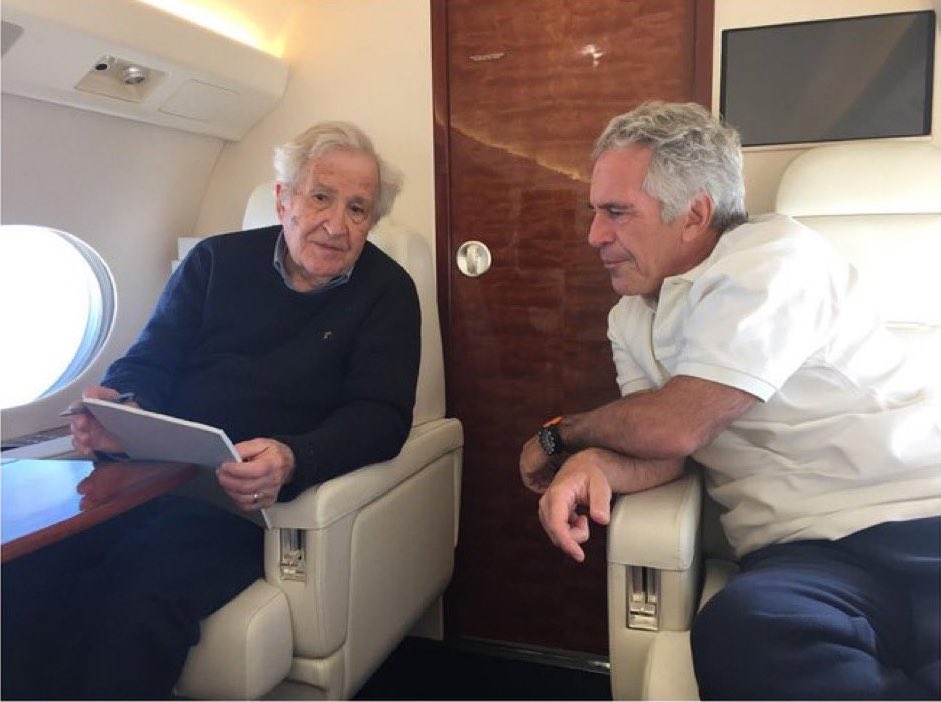
I learned my analysis of propaganda, communication and imperialism by reading Noam Chomsky. I was sixteen years old. But I also learned my understanding of power and control from Adivasi activists and organisers, who articulated their theories of change through everyday observation and struggle at the global margins.
The Epstein files and Chomsky’s linkages reveal the impermanence of elite critique formed in spaces of privilege, distanced from embodied struggles and marginalised voices. Such critique often falls short, and in doing so becomes complicit in power. By contrast, critique that emerges from within struggle carries transformative potential: it can disrupt the very games that sustain imperial power.
When outrage is dismissed as “hysteria”
In February 2019, Chomsky wrote to Jeffrey Epstein, dismissing public concern about sexual abuse as “hysteria”. He described press coverage as “horrible” treatment — not of the victims, but of Epstein himself.
The women centred by journalist Julie Brown’s reporting — given faces, names, and voices — were reduced in Chomsky’s framing to a hysterical mob. The intellectual who spent decades explaining how power manufactures consent now deployed the same mechanism to silence the powerless.
A sustained relationship, not a momentary lapse
This was not an isolated error or a single compromised interaction. The relationship between Chomsky and Epstein was sustained and warm, continuing well after Epstein’s 2008 conviction for soliciting prostitution from a minor.
By 2019, the nature of Epstein’s crimes was public knowledge. The plea deal that allowed him to serve thirteen months in a county jail — with work release privileges — was already widely understood as a grotesque failure of justice enabled by privilege and influence. Yet Chomsky and his wife Valeria continued affectionate correspondence with a man whose properties were sites of systematic sexual violence against girls and young women.
Praise, access, and patronage
Valeria described Epstein as a “very dear friend”, even a “hero”. Chomsky praised Epstein’s “penetrating insights” into global finance, calling him a “highly valued friend and regular source of intellectual exchange”.
Their correspondence discussed dinners, holidays, and politics. Epstein introduced Chomsky to powerful figures including Ehud Barak and Steve Bannon. Significant sums of money flowed to Chomsky and his family through financial arrangements facilitated by Epstein.
These details matter because they reveal a pattern, not an accident. This was long-term engagement, maintained even as Epstein’s predation became undeniable.
A structural failure, not just a personal one
This is not merely a story of individual moral failure. It is a case study in how elite power operates through its critics.
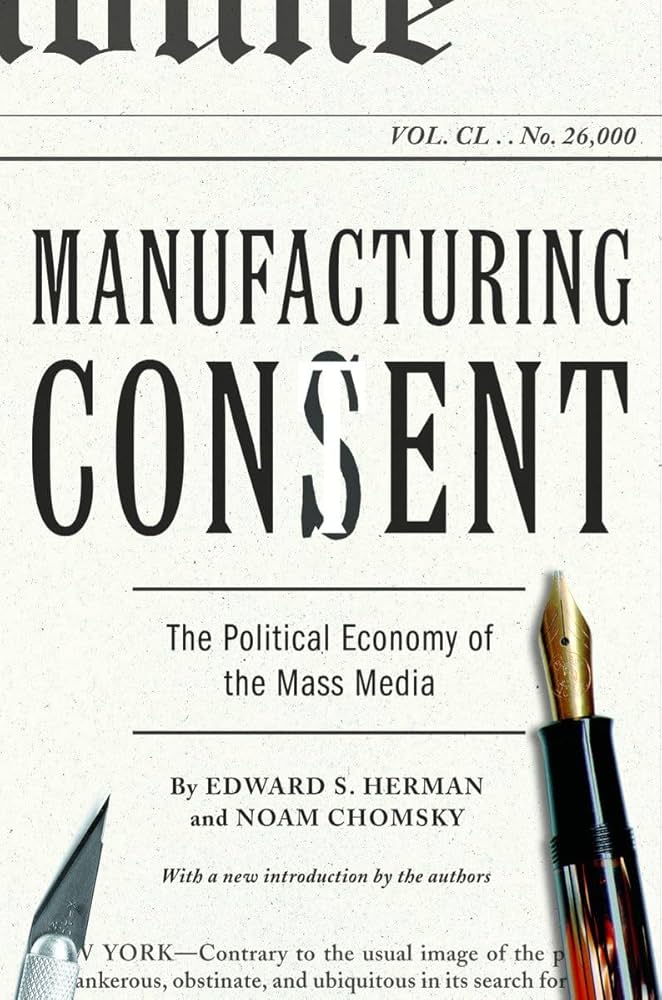
Chomsky’s own work rests on the insight that intellectuals are embedded within systems of power, serving as gatekeepers who police the boundaries of acceptable discourse. In Manufacturing Consent, Chomsky and Edward S. Herman demonstrated how media systems simulate debate while excluding perspectives that threaten entrenched power.
Yet here stood Chomsky himself, embedded within Epstein’s circuit — a financier-trafficker nexus that perfectly embodied the unaccountable global elite he spent decades analysing.
The critic absorbed by the system
The irony would be darkly comic if the stakes were not so devastating. Epstein’s victims — overwhelmingly young women from economically precarious backgrounds — were precisely the kinds of people Chomsky’s political analysis claimed to centre.
When Chomsky dismissed outrage at their abuse as “hysteria”, he enacted the very communicative violence his own framework should have made him most alert to. He used cultural capital and intellectual authority to delegitimise those with no comparable platform, aligning himself with the exploiter rather than the exploited.
How distance dulls moral clarity
From elite vantage points — university offices, private jets, island estates — suffering becomes abstract. Sexual violence dissolves into an intellectual inconvenience; victims become “accusers”; accountability becomes “mob justice”.
This is communicative inequality in its starkest form: those closest to power decide whose pain counts and whose does not. The rest becomes noise.
Chomsky understood this dynamic clearly when analysing American wars, corporate abuse, and colonial violence. But inside Epstein’s orbit, benefiting from its privileges, he failed to recognise the same pattern at work.
Detached critique and its limits
Critique produced from spaces of comfort, without bodies on the line, is easily absorbed by power. This is not unique to Chomsky; it is structural.
Embodied solidarity requires refusal — of elite hospitality, of compromised funding, of flattering proximity to power. It demands risk and the willingness to foreclose opportunity. Some contradictions cannot be resolved through good intentions or careful phrasing.
Hypocrisy is not the real lesson
The political right has weaponised the Epstein scandal to discredit Chomsky’s entire body of work. This response is lazy and dishonest. Chomsky’s analysis of imperialism, media power, and intellectual complicity does not become false because he failed to apply it to himself.
The propaganda model still functions. Empire still operates. Media still manufactures consent.
The real scandal is deeper: the Epstein relationship confirms Chomsky’s own most unsettling insights about how power absorbs even its sharpest critics.
Patronage as a system of control
Epstein cultivated intellectuals deliberately. He funded research, hosted salons, and positioned himself as a patron of ideas. This intellectual legitimacy was not incidental to his crimes — it helped protect him.
For intellectuals, the appeal was clear: money without oversight, access without accountability, recognition without risk. The seduction worked not through crude bribery but through inclusion.
Chomsky appears to have believed he could accept these benefits without compromising his independence. But power does not work that way.
The cost of proximity
Epstein’s world was never about ideas. It was about leverage, impunity, and ownership — including of those who believed themselves beyond ownership.
Accepting hospitality creates investment. Investment creates silence. Silence creates cover.
From his position of security and prestige, Chomsky could analyse violence elsewhere while remaining blind to its presence within his own social networks. That blindness was not accidental; it was structured by elite positioning.
What power truly fears
Power does not fear intellectuals who accept invitations and dine at its table. It fears those who refuse.
It fears critique emerging from struggle: Adivasi organisers, Indigenous resistance, sex workers demanding rights — people whose bodies, livelihoods, and futures are on the line.
This is not romanticism. It is recognition that critique detached from embodied solidarity is perpetually vulnerable to accommodation.
Beyond manufactured consent
Chomsky’s failure was not primarily intellectual. His framework remains largely sound. His failure was one of practice: whose money to accept, whose company to keep, whose testimony to believe.
Those choices shape what becomes visible and what disappears.
Anything less than this reckoning becomes another form of manufactured consent — this time produced not by states or corporations, but by the critic himself, absorbed so thoroughly into power that he can no longer recognise his own complicity, even as he continues to name it in others.