


Neven S. Fučkar, University of Oxford
Since April 2024, wide areas of south and south-east Asia, from Pakistan to the Philippines, have experienced prolonged extreme heat. Covering some of the most densely populated regions in the world, the series of heatwaves has affected everything from human health and wellbeing to the economy and education.
Many pupils in India, Bangladesh, and Philippines have been told to stay at home for days due to a severe health risk from extreme heat, while the heatwaves are becoming a major issue in India’s election. Bangladesh even closed all primary schools for weeks while the temperature reached 43.8°C on April 30.
Once the temperature goes above 38°C, it exceeds the core human body temperature (about 37°C) and the chance of heat exhaustion and even heatstroke increases dramatically. This is compounded by increasing humidity in the region which puts additional heat stress on the human body, as sweat is not able to evaporate as effectively (the primary mechanism for cooling the human body).
That is why extreme heat in a tropical country can be less pleasant and more dangerous than the same temperature in a desert.
Tens of millions of people have been exposed to such health threatening conditions in south and south-east Asia in April and May so far, and this extreme heat has substantially affected labour productivity.
Unusually prolonged periods of extreme heat:

Now shifting westwards:

How it got so hot
Extreme heat is driven by several processes, operating from global down to local scales. At the local level, less vegetation and soil moisture tends to mean more heat, while cities of concrete and asphalt are hotter than the surrounding countryside thanks to the urban heat island effect. Other local and regional factors include the wind, and whether conditions are ripe for clouds to form.
Then there are the more global factors: El Niño, and of course global warming. El Niño refers to the warm phase of a natural fluctuation of temperatures in the tropical Pacific (its opposite side is La Niña).
The Pacific has been in an El Niño phase since May 2023, releasing additional heat and exacerbating global warming in many regions. In parts of Asia, this leads to periods of extreme heat happening more often, lasting longer and being even more extreme in addition to global warming contribution.
This is particularly dangerous for the many cities in south and south-east Asia being hit by the current series of heatwaves, which over the past 85 years have already experienced long-term increase in the number of days in April with such dangerously high temperatures.
Short term noise, long term trends:
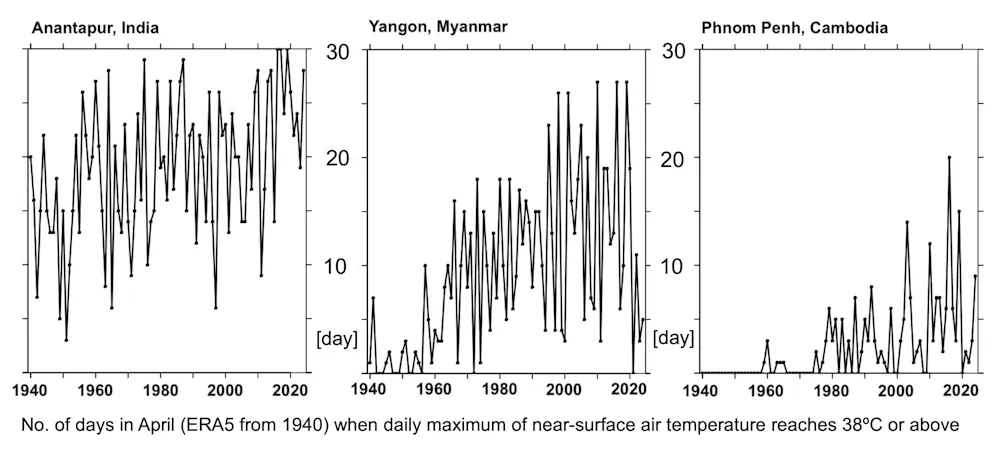
Occurrences of extreme heat days over years typically looks rather noisy when plotted on a graph. Some years may have many days of extreme heat, others only few or none. But over a longer timescale of multiple decades, a clear trend emerges of more and more very hot days, driven by climate change.
Indeed, scientists from the World Weather Attribution team recently described the latest heatwaves as “impossible” without climate change.
Action needed
April and May are typically the hottest months in south and south-east Asia. As the climate keeps warming, is the region ready for extreme heat?
The projected increases in extreme hot temperatures demands rapid adaptation measures, along with the obvious global efforts to reduce greenhouse gas emissions. That means heat action plans that are tailored to address the specific climate, public health and socioeconomic conditions in a given region. What works in Singapore (urban, wealthy, incredibly humid) might not be appropriate in drier, poorer and more rural parts of India.
We have to combine estimates of environmental hazards with exposure and vulnerabilities information on population and assets to provide actionable risk assessment and formulate efficient temperature mitigation measures for different levels of extreme heat.
Some countries in south and south-east Asia are making progress with their heat action plans in response to extreme heat they have already experienced. However, there is room for further improvement and a more targeted approach at the district level. This is critical as we expect that disruptive extreme heat events in this part of the world will become more frequent, widespread, and intense.
Neven S. Fučkar, Senior Researcher, Environmental Change Institute, University of Oxford
This article is republished from The Conversation under a Creative Commons license. Read the original article.