


John Arnold, University of South Australia and Tom Wycherley, University of South Australia
The game of cricket is believed to have originated in rural England sometime in the 16th or 17th century.
The earliest versions of cricket balls had no standard size, weight or stitching: they were handmade by locals and consisted of a round leather case filled with materials such as cork or wool.
As there were no set requirements or construction methods, each ball was different, and this affected how it bounced, moved and rebounded off the bat.
However, cricket spiked in popularity in the first half of the 18th century, which prompted consistency in the rules and equipment to ensure fairness and facilitate further growth of the game.
The modern cricket ball
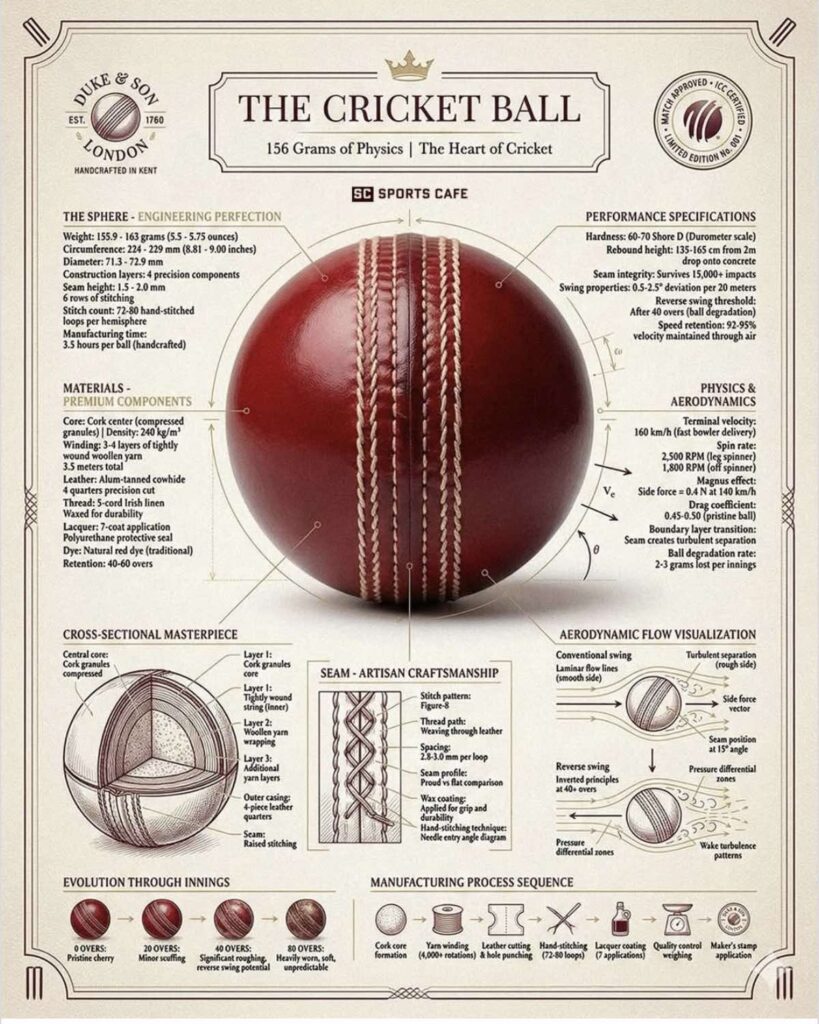
Modern balls consist of four main components: a cork and twine (string) core, a leather casing, a raised middle section (the seam) with stitching on either side and a wax or lacquer coating.
Balls are either red (for long formats such as international Test matches), white (for shorter formats such as One Day Internationals or Twenty20 games) or pink (for day-night Tests and first-class games).
The laws of cricket state that when new, the ball should weigh between 5.5 and 5.75 ounces (155.9–163 grams) and have a circumference of 22.4–22.9 centimetres.
For women’s cricket, the ball can weight slightly less (140–151g) and for junior cricket (under 13) even less again (133–144g).
A set of technical standards was formalised in 1994 which stipulate the mechanical requirements for factors such as hardness, to help different manufacturers produce balls with more consistency and ensure fairness across the globe.
So why are balls so hard?
Cricket balls are the product of centuries of tradition and the extreme physical demands of the game. They must be robust and hard-wearing, able to withstand repeated high-force impacts from both the bat and the pitch over the course of a match.
Consider the forces involved when a ball is struck by a bat.
Reasonable estimates of peak forces when the ball is struck by the bat are about 17 kilonewtons (the weight of 1,700 kilograms) – enough to lift a 1.7 tonne car off the ground.
The ball also repeatedly impacts the pitch at high speeds, experiencing shear forces that gradually wear its surface. On deteriorating pitches, this wear is even more pronounced.
In Test cricket, a single ball can be bowled up to 480 times (80 overs) before the fielding team is allowed to request a replacement.
While cricket ball construction has evolved over the past 300 years, its main elements have remained largely consistent.
The introduction of the seam – the raised stitching that runs around the ball’s circumference – and the practice of shining one side of the ball to create swing are fundamental aspects of match play.
These features allow bowlers to generate movement in the air – challenging batters and shaping the strategy of the game.
The materials, construction and physical characteristics of the ball – including size, mass and density – determine its mechanical properties and influence how it bounces, spins and interacts with different surfaces and equipment.
These properties are central to cricket’s nature and style – changing them would fundamentally alter the way the game is played.
Tradition and the physical requirements of the game have ensured this construction is tried, tested and fit for purpose, creating the ball we know today.
Is the ball dangerous?
Bowlers vary their deliveries to deceive the batter and gain a tactical advantage. This can include changing the speed or where they aim the ball.
A specific strategy fast bowlers may use is to aim to bounce the ball directly at a batter’s upper body or head (referred to as a “bouncer)”.
This can be used to intimidate the batter and/or force them to make a mistake.
Perhaps the most infamous example of this was the 1932–33 Ashes series, in which the English cricket team controversially used a consistent “bodyline” delivery approach to contain Australian batting legend Don Bradman.
Various rule changes since the 1990s have limited the number of bouncers that bowlers can deliver, making the game safer.
At the elite level, cricket balls are commonly bowled at speeds of 130–150 kilometres per hour.
Occasionally, fast bowlers can exceed 160km/h. At amateur and recreational levels, bowlers commonly still reach 100km/h.
When a person is struck – whether it be a batter, fielder or umpire – the ball hardly rebounds and the momentum is absorbed by the body.
The force is also concentrated in a small area, making serious or even fatal injury possible – particularly if contact is made directly to the head.
The exact force depends on the timing, location and angle of impact. But there’s no doubt the combination of a small, dense ball moving at high speed and stopping almost instantly makes cricket-ball injuries potentially deadly.
There have been fatal incidents, albeit rare. The most high-profile such incident was the death of Phillip Hughes in 2014, who was hit on the neck in a Sheffield Shield match and died two days later from a vertebral artery injury.
The number of deaths has declined significantly in the past 30 years, most likely due to widespread use of enhanced safety equipment, especially helmets, by batters and close-in fielders.
So while a layperson may view cricket as a non-contact sport, the truth is batting and fielding require great courage, considering the hardness of the ball and the speeds it can reach.
John Arnold, Senior Lecturer, Sport & Exercise Biomechanics, University of South Australia and Tom Wycherley, Associate Professor of Nutrition and Exercise Science, University of South Australia
This article is republished from The Conversation under a Creative Commons license. Read the original article.