

I. Posturing
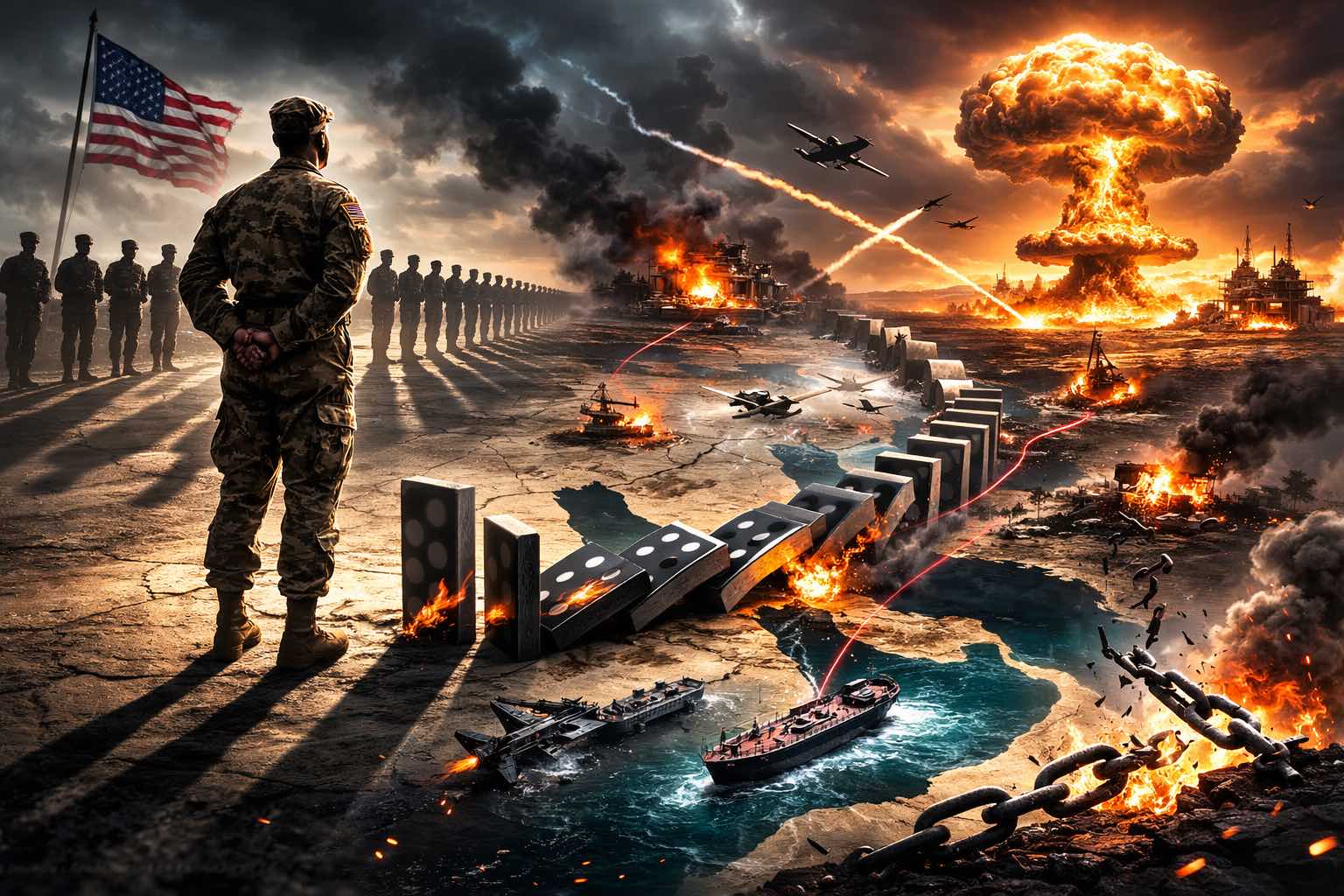
Ten-hut! Every soldier knows the command. Spine straight, eyes forward, body locked. It is the first thing the military teaches and the last thing it takes away. It is also, in its institutional form, the reflex that replaces thinking when an operation has stopped working but nobody in the chain has the authority – or the incentive – to say so.
The war was sold, in part, on nuclear grounds – the claim that Iran posed a nuclear threat requiring military action. The IAEA had found no evidence of a structured weapons programme. Pentagon officials told Congress Iran was not planning to attack unless struck first. Hours before the bombs fell on 28 February, Oman’s Foreign Minister Al-Busaidi appeared on CBS to announce that Iran had agreed to zero stockpiling of enriched uranium, full IAEA verification, and irreversible down-blending of existing material. “A peace deal is within our reach,” he said. The justification was posture. The consequences are real.
In 1968, psychologists Darley and Latané published a study demonstrating that the probability of intervention in an emergency decreases as the number of observers increases. They called it the bystander effect. The critical insight is not that nobody sees the problem. It is that seeing the problem and acting on it are separated by a social calculus: what will happen to me if I break formation? The bystander effect does not require ignorance. It requires a rational assessment that the cost of intervention exceeds the cost of silence.
Senator Warner, Vice Chairman of the Intelligence Committee, stated publicly: “There was no credible evidence of an imminent threat.” Congress has not voted. The cabinet has not objected. The Joint Chiefs have not spoken. The posture holds because everyone inside the room has calculated that breaking it costs more than maintaining it.
The bystander effect does not require ignorance. It requires a rational assessment that the cost of intervention exceeds the cost of silence.
* * *
II. Escalation Trap
With the posture locked, the institution does what locked institutions always do: it escalates. Each failure justifies the next commitment. Each commitment produces the next failure. The loop feeds itself.
CSIS calculates US spending at $16.5 billion in twelve days. Thirteen American service members dead, seven by enemy fire, six when a KC-135 tanker crashed over western Iraq in an apparent mid-air collision – the second aircraft landing in Israel with half its tail sheared off. Approximately 200 wounded. More than 1,444 Iranian civilians killed per Iran’s Health Ministry. Over 3.2 million displaced per UNHCR. 2,300 dead across the region per ACLED. Oil at $114 a barrel, up from $70. Not one objective achieved. Every condition worsened.
The institution’s response is not to revise. It is to extract. The Washington Post reported that THAAD missile defence components are being transferred from South Korea to the Middle East. President Lee confirmed, stating Seoul “cannot fully push through our position.” Defence News and Newsweek corroborated. The US operates eight THAAD batteries worldwide. The ones in Korea protected 51 million people from a nuclear-armed North Korea. They are now replacing systems Iran has destroyed.
The 31st Marine Expeditionary Unit – the only permanently forward-deployed MEU in the Pacific, trained for Taiwan contingencies – has been ordered to the Gulf. A reinforced infantry battalion, up to 2,500 Marines, self-sustaining for fifteen days. Ordered from the Philippine Sea on 13 March, tracked approaching Singapore on the 17th. Still days from the Gulf.
Kharg Island – ninety percent of Iran’s exports – is a twenty-square-kilometre coral platform twenty-five kilometres from the mainland. The US struck ninety military targets there. The 112th Zolfaghar Brigade defended it with fast-attack boats, missiles, and mines. Marine specialist Hackett told the Jerusalem Post the MEU is trained for “seizing and holding gas and oil platforms.” The environment: 5,000-6,000 mines, midget submarines, dispersed coastal anti-ship launchers. A battalion may seize a platform. It cannot hold an island under fire from a mainland it cannot suppress, resupplied across a sea lane it does not control, for longer than it can feed itself.
Israel has invaded Lebanon. Ali Larijani, Secretary of Iran’s Supreme National Security Council, is dead. The Basij commander is dead. Israel killed Intelligence Minister Esmail Khatib on the 18th; Defence Minister Katz announced he has authorised the military to kill “any senior Iranian official” without additional approval. On the same day, the US and Israel struck the South Pars natural gas field. More than a dozen Reaper drones – $32 million each – lost. The Strait of Hormuz remains under Iranian interdiction, with only a handful of commercial vessels allowed through. Trump has postponed his China trip. The trap operates by its own logic: each failure justifies the next escalation, each escalation produces the next failure, and the loop cycles without external correction because nobody inside the room will say stop.
* * *
III. Chain Reaction
On 17 March – Day 18 of Operation Epic Fury – one person did. Joe Kent, Director of the National Counterterrorism Center, Green Beret veteran of eleven combat deployments, Gold Star husband whose wife was killed by an ISIS suicide bomber in Syria, posted his resignation on X. “I cannot in good conscience support the ongoing war in Iran. Iran posed no imminent threat to our nation.” He is MAGA-aligned, Trump-endorsed, confirmed 52-44 by a Republican Senate. The institutional in-group.
The response was instantaneous. Trump: “Weak on security. It’s a good thing that he’s out.” Budowich: “A crazed egomaniac. What a loser.” Representative Bacon: “Good riddance.” An anonymous White House official: Kent was a suspected “leaker,” already cut from presidential briefings.
Eleven combat deployments were not enough to earn the standing to question the war. The institution does not evaluate the message. It eliminates the messenger. That is the ten-hut reflex operating as an immune response: not a failure of courage but a failure of feedback, sustained by making dissent so costly that silence becomes the rational choice for everyone still inside the room. Kent tried to insert a control rod into an unmoderated reaction. The system ejected it.
* * *
IV. Critical Mass
The Arms Control Association assesses that military force cannot eliminate the proliferation risk. The IAEA has lost continuity of knowledge over Iran’s fissile material since inspectors were expelled after the June 2025 strikes. Iran’s stockpile of 60 percent enriched uranium is sufficient, if processed at an undeclared facility, for multiple devices. On 18 March, a projectile struck the Bushehr Nuclear Power Plant site. The monitoring that might detect a breakout has been destroyed by the campaign that was sold as preventing one.
War on the Rocks published the assessment that matters: two military campaigns that degraded monitoring without eliminating Iran’s nuclear programme send an unmistakable signal to every government in the region that the nonproliferation regime cannot constrain a determined state. MBS has already stated the conclusion: if Iran gets one, we have to get one. The THAAD batteries stripped from Korea to feed this war were the backbone of nuclear deterrence on the peninsula. New START expired in February. The NPT Review Conference convenes in April. The institution started a war to prevent a nuclear threat. It is producing the conditions for nuclear anarchy.
* * *
I have served in operations where the gap between the briefing room and the battlefield was measured in lives. The reflex is always the same: when the plan stops working, the institution doubles the commitment and calls it resolve.
Twenty days. $16.5 billion. Thirteen Americans dead. More than 1,400 Iranian civilians killed. Three million displaced. One million Lebanese driven from their homes. The Strait choked. The Pacific exposed. The nuclear order unravelling.
Posturing. Escalation Trap. Chain Reaction. Critical Mass. That is the trajectory of an institution that has replaced strategy with display. And the half-life of a war built on posture is measured not in days but in decades.