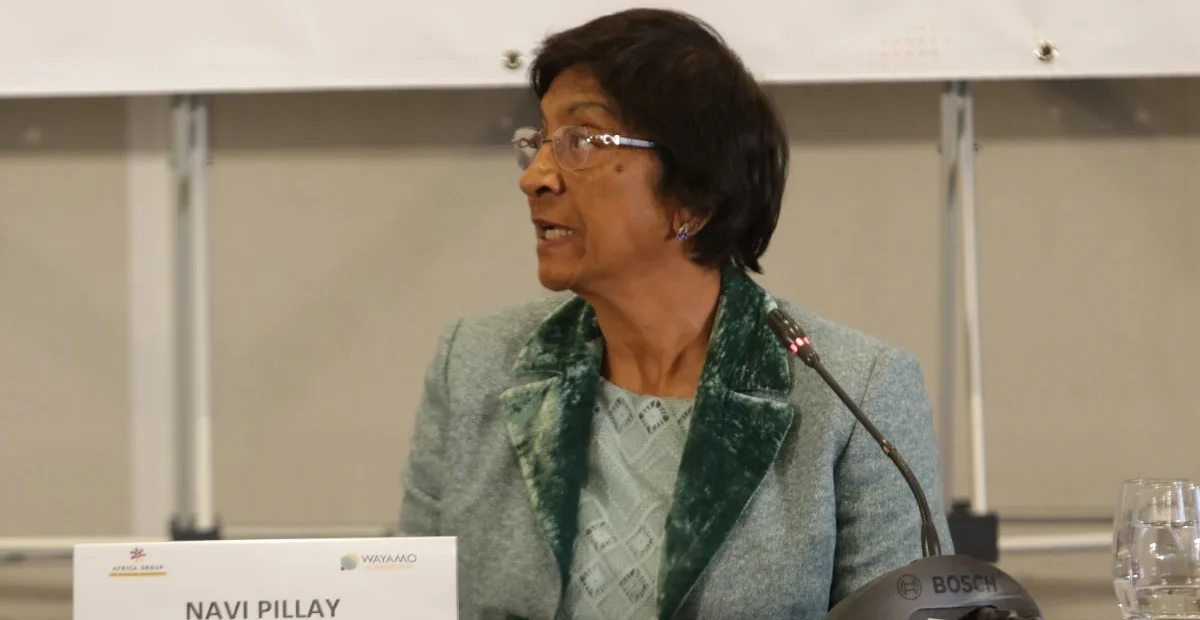
A bus driver’s daughter who grew up in a Durban suburb set aside for people of Indian descent has won the Nobel Peace Prize. The Norwegian Nobel Committee announced in Oslo on Friday 9 October 2026 that the award goes to Navanethem “Navi” Pillay “for her efforts to promote peace and international law”.
The Navi Pillay Nobel Peace Prize recognises a career spent building the courts that try war crimes and genocide. Pillay, 85, was born into a family of Indian Tamil origin in Durban under apartheid, the committee said, and went on to serve as a High Court judge in South Africa, a judge and president of the international Rwanda tribunal, a judge of the International Criminal Court and UN High Commissioner for Human Rights.
For the Indian diaspora, her story begins in the sugar cane fields of Natal. “My grandparents came from India and toiled on a sugar cane farm for five years,” she said in a 2023 interview, describing how they saved before they could buy land.
Why did the committee choose Navi Pillay?
The committee said she has been instrumental in ensuring that war crimes, crimes against humanity and genocide are prosecuted. “Navi Pillay has held states and national leaders accountable and brought hope to victims of violence and conflict,” its announcement said, adding that “peace requires justice”.
Jørgen Watne Frydnes, chair of the Norwegian Nobel Committee, said the system of international law is “under tremendous pressure” and that its institutions are “under attack”. He described her work as “a source of hope and inspiration to all those who seek to bring about a more peaceful world”.
The prize carries 12 million Swedish kronor and will be presented in Oslo on 10 December, the anniversary of Alfred Nobel’s death.
Who is Navi Pillay?
Pillay was born Navanethem Naidoo on 23 September 1941 and grew up in Clairwood, a suburb of Durban. In her own account, the area was “explicitly designated for people of Indian descent” and neglected, with potholed roads and no sewage system. A 2022 profile by the University of the Witwatersrand records that her grandfather was an indentured sugar cane labourer who lost both arms in a mill accident, and that her father, who left school at about eight, drove buses all his working life.
She studied law at the University of Natal and in 1967 opened her own practice, the first non-white woman to do so in the province. Early in her career she defended Nelson Mandela and other opponents of apartheid, the committee noted. In 1995 she became the first non-white woman to sit on South Africa’s High Court.
That year she joined the International Criminal Tribunal for Rwanda and served as its president from 1999 to 2003. She was a judge of the International Criminal Court from 2003 until 2008, when she became UN High Commissioner for Human Rights, a post she held until 2014.
EXPLAINER
What was the Akayesu judgment?
The Akayesu case, against Jean-Paul Akayesu, was heard by the International Criminal Tribunal for Rwanda, where Pillay sat as a judge.
The judgment established that rape and sexual violence can constitute genocide when committed with intent to destroy a group. The Nobel Committee cited Pillay’s influence on that principle, and on a separate case in which a defendant was charged with incitement to genocide based solely on spreading propaganda.
How does the Rwanda tribunal shape the prize citation?
The committee’s reasoning leans heavily on her years at the Rwanda tribunal. It said her influence helped establish that rape and sexual violence can amount to a crime against humanity and genocide.
Her later work drew her into contested territory. Until recently she chaired the UN Independent International Commission of Inquiry on the Occupied Palestinian Territory, which concluded last year that Israel had committed genocide in Gaza. She also sits as a judge at the International Court of Justice in the case in which Myanmar is accused of genocide against the Rohingya.
How have governments reacted to the Navi Pillay Nobel Peace Prize?
South Africa’s President Cyril Ramaphosa called the award a “profound tribute” to her courage, integrity and commitment to justice. UN Secretary-General António Guterres described it as a tribute to those upholding international law, and Volker Türk, the current UN High Commissioner for Human Rights, called it a collective win for human rights.
Israel’s Foreign Ministry rejected the decision. It described the award as “the grotesque weaponisation of an award to legitimise anti-Israel hatred and prejudice”, and Israel had earlier dismissed the commission’s genocide finding. The committee’s own citation centres on her decades of work in apartheid South Africa, at the Rwanda tribunal and across the UN system.
Why does her win matter to the Indian diaspora?
Her family history runs from the cane fields to the bench in two generations: a grandfather who was an indentured sugar cane labourer, a father who drove buses, and a daughter who became the first non-white woman on South Africa’s High Court. The Nobel Committee’s announcement itself notes that Indian Tamil heritage and her childhood under apartheid.
Her recognition has also reached diaspora audiences in recent years. She received the Sydney Peace Prize in 2025, and the Olof Palme Prize for 2026, which she shares with South African jurist John Dugard.
What happens next?
Pillay will receive the medal and diploma at the ceremony in Oslo on 10 December. Her work on the International Court of Justice bench in the Myanmar case continues.
Earlier coverage of the announcement is on our report on Navi Pillay and the Gaza inquiry, and more international stories are in our news section. The committee’s full reasons are in the official announcement.
What readers are asking about Navi Pillay’s Nobel win
Is Navi Pillay Indian?
She is South African. The Norwegian Nobel Committee says she was born into a family of Indian Tamil origin in Durban. In her own words, her grandparents came from India and worked on a sugar cane farm in Natal for five years before they could buy land. She grew up in Clairwood, an area set aside for people of Indian descent.
Why did she win the 2026 Nobel Peace Prize?
The committee awarded her the prize “for her efforts to promote peace and international law”. It said she has been instrumental in ensuring that war crimes, crimes against humanity and genocide are prosecuted, and that she has held states and national leaders accountable while bringing hope to victims of conflict.
What roles has she held?
She was a South African High Court judge from 1995, a judge of the International Criminal Tribunal for Rwanda from 1995 to 2003 and its president from 1999, a judge of the International Criminal Court from 2003 to 2008, and UN High Commissioner for Human Rights from 2008 to 2014.
When will she receive the prize?
The prize will be presented at the ceremony in Oslo on 10 December, the anniversary of Alfred Nobel’s death. It carries 12 million Swedish kronor. Pillay, who turned 85 in September, is also serving as a judge in the International Court of Justice case concerning Myanmar.