

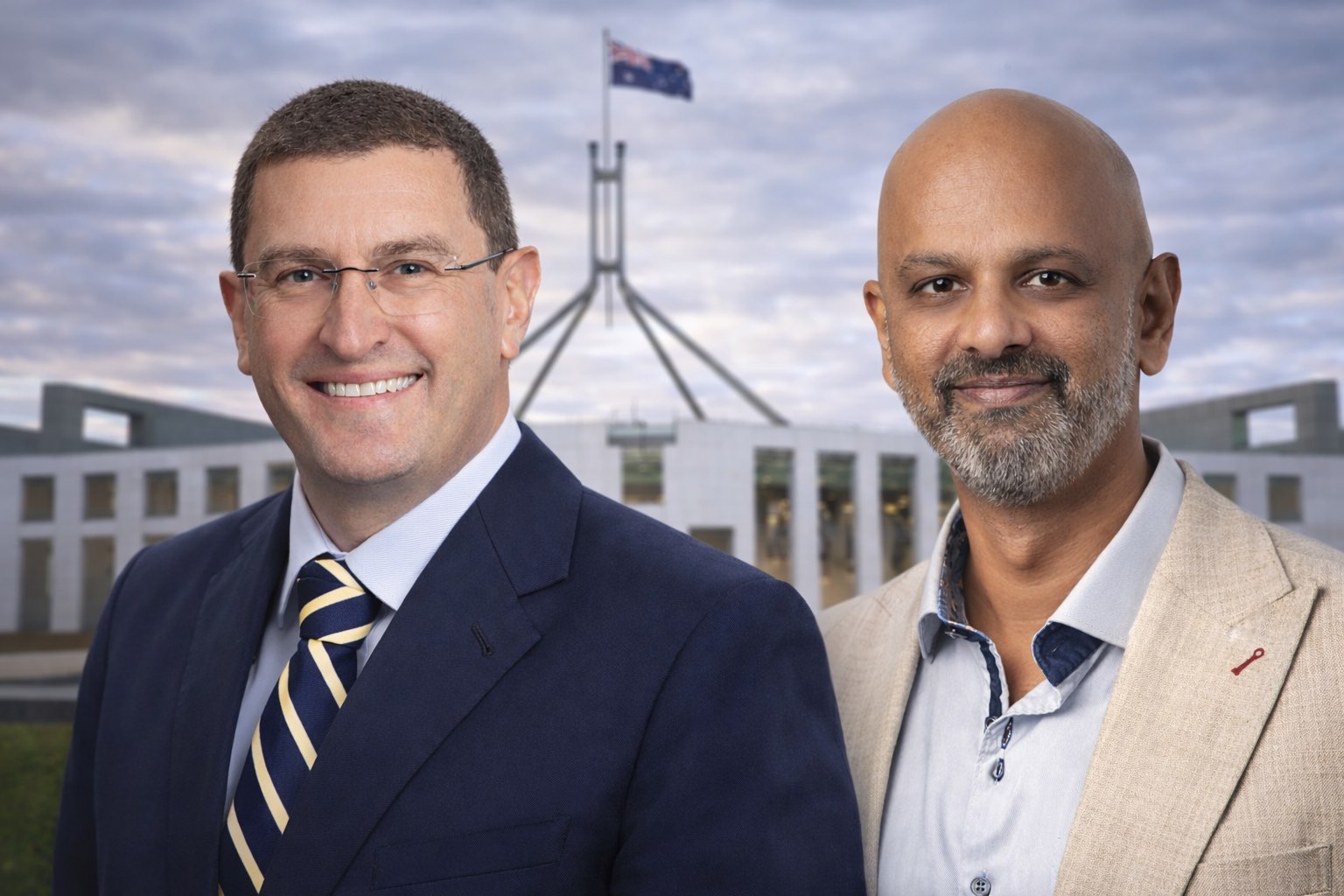
When Julian Leeser, the Liberal Member for Berowra, claims in Parliament that Australian Hindus have lost confidence in Race Discrimination Commissioner Giridharan (Giri) Sivaraman, he is not speaking for our community. He is speaking for a narrow faction, one whose ideological interests are served by undermining the most comprehensive and inclusive anti-racism framework Australia has ever produced. His claim is not only factually wrong; it is dangerous and divisive.
Who Does Leeser Actually Speak For?
Leeser’s intervention arrives against a specific political backdrop. He is a politician with documented ties to the Israel lobby organisations, having travelled to Israel in 2022 in a trip organised by the Australia/Israel & Jewish Affairs Council, and having consistently championed a selective approach to racism, one that regards antisemitism as requiring the full weight of law, criminalisation and public condemnation, while treating Islamophobia, caste discrimination, and anti-Aboriginal racism as secondary concerns, worthy of a more ‘balanced’ response.
The organisations that have been loudest in aligning with Leeser, including the Hindu Council of Australia (HCA) do not represent the breadth of Hindu opinion in this country. The HCA’s own leadership has faced a formal complaint to the Australian Human Rights Commission for alleged Islamophobia, with the Alliance Against Islamophobia citing social media posts that reportedly characterised Muslims as ‘inherently criminal, dangerous, violent or evil by nature’ and which shared content from far-right figures including Tommy Robinson and Charlie Kirk. That such an organisation should position itself as the arbiter of Hindu community confidence is both audacious and revealing.
The Hindu community in Australia is not a monolith. It encompasses progressive activists, Dalit rights advocates, academics, lawyers, social workers, and faith leaders, many of whom not only support Commissioner Sivaraman’s work but regard it as long overdue. To allow Leeser to erase this diversity and substitute it with the voice of far right Hindutva-aligned bodies is to participate in a profound misrepresentation.
Giri Sivaraman: A Commissioner Who Walks the Talk
Giridharan Sivaraman was born in India, raised in Zambia, and migrated to Australia, a life journey that has given him a direct, personal understanding of what it means to experience racism. Before taking up his role as Race Discrimination Commissioner in March 2024, he spent decades fighting for racial equity as a lawyer, running major state and national race discrimination cases, and leading the pro bono compensation scheme for hundreds of underpaid 7-Eleven workers, many of them migrants. He served as Chair of Multicultural Australia from 2021 to 2024. His appointment was celebrated across civil society and multicultural communities precisely because he embodied the community-first, legally rigorous approach that the role demands.
Commissioner Sivaraman has made it unambiguously clear that his mandate is to combat all forms of racism, without fear or favour. His calls for a nationally coordinated response to racism have explicitly included antisemitism alongside anti-Muslim bigotry, anti-Black racism, caste discrimination, and racism against First Nations Australians. As NRI Affairs published in their February 2026 opinion piece, ‘The Price of Speaking Truth — When a $400,000 Salary Becomes a Weapon,’ the attacks on Sivaraman reveal a troubling pattern:
“The Race Discrimination Commissioner position was created to represent the historically least represented, the voiceless, the most marginalised. Not to appease powerful lobby groups, but to give voice to those systematically silenced. When a brown person holds this position and speaks truth to power, their salary becomes weaponised.”
The article directly challenges the framing that Sivaraman has overstepped his role. Their analysis, grounded in Australian constitutional principles and the lived experience of the Indian diaspora, makes clear that attempts to silence the Commissioner are less about accountability and more about discomfort with a voice that refuses to stay within politically convenient limits.
The National Anti-Racism Framework: Groundbreaking and Necessary
The National Anti-Racism Framework (NARF), launched in late 2024, is the most significant anti-racism policy document in Australian history. It was developed through extensive community consultation, involving hundreds of voices from First Nations communities, migrant and refugee communities, faith groups, and civil society. Its inclusion of caste discrimination, through Recommendation 17, which calls on the federal government to investigate explicit legal protections against caste-based discrimination is not a provocation against Hindus. It is an act of justice for Dalit Australians who have experienced discrimination within South Asian diaspora communities here in Australia.
The evidence base for this recommendation is irrefutable in spite of blatant denials by the HCA. The Commission’s 2022 Scoping Report documented how caste discrimination manifests in Australian workplaces, student groups, religious and cultural associations, and matrimonial networks. Research has consistently shown that caste-oppressed South Asians face real, material harm in Australia. The Periyar Ambedkar Thoughts Circle of Australia (PATCA) has welcomed the Framework, with Dr Anna Mahizhnan, PATCA’s President, describing it as a transformative step grounded in the ideals of equality championed by figures such as B.R. Ambedkar, a revolutionary reformer revered across caste lines. Another Australia-based secular social justice organisation within the Indian diaspora, The Humanism Project, has also supported the inclusion of caste discrimination in the National Anti-Racism Framework. In its submission to the Australian Human Rights Commission, drawing on scholarly work by caste experts from around the world, the organisation emphasised the need to recognise caste as a protected category in anti-discrimination legislation and policy.
To characterise the inclusion of caste discrimination as an attack on Hinduism is a deliberate misrepresentation. Many voices calling for caste protections are themselves Hindu including members of Hindus for Human Rights ANZ, who have been allies in this advocacy. The conflation of anti-caste activism with anti-Hindu sentiment is a rhetorical trick borrowed directly from the Hindutva nationalist playbook, and it should be recognised as such.
Hindus for Human Rights: The Inclusive Voice of Hindu Australia and Liberal Democracy
Hindus for Human Rights ANZ was established in 2021 and has since become one of the most active and principled voices for equity in the Australian Hindu community. As their mission states, they work ‘to build a progressive and inclusive Hindu platform and movement in Australia and New Zealand, one that is opposed to Hindutva and to caste and casteism.’ They speak from a deeply Hindu perspective, drawing on concepts of shanti (peace), nyaya (justice), and manavta (human rights), but they refuse to allow their faith to be weaponised against other faiths or for nationalist ends.
HfHR ANZ has also explicitly questioned the concept of ‘Hinduphobia’ as a systemic equivalent to Islamophobia or antisemitism, describing it as ‘a recently coined term popularised by far-right groups to claim systematic and targeted discrimination against Hindus for being Hindu. Their April 2025 statement on a proposed ‘Hinduphobia envoy’ made clear that such proposals ‘will pit Hindu communities against South Asian Muslims, Christians, Sikhs and caste-oppressed communities.’ This is precisely the kind of division that Leeser’s intervention risks entrenching.
The Hindutva-Zionist Alliance: When Far-Right Movements Find Common Cause
There is a deeper political story here that demands to be named clearly. Analysts across the ideological spectrum, from the Transnational Institute to Jewish Voice for Liberation have documented the convergence of Hindutva nationalism and far right Zionism as global political forces. At the heart of their alliance is a shared Islamophobia: both movements have, in their most extreme expressions, depicted Muslims as an existential threat and deployed that fear to justify expansionist, exclusionary policies.
As Raju Rajagopal of Hindus for Human Rights wrote in Scroll.in in 2024, Hindutva groups in the United States have adopted strategies parallel to those used by right-wing Zionist organisations, including the weaponisation of victimhood claims to deflect legitimate criticism. The parallels in Australia are visible: far right Hindu groups aligning with far right lobby organisations to pressure a Race Discrimination Commissioner whose Framework dares to address all forms of racism, not merely those that affect communities with powerful political advocates.
In Australia, far right Hindutva and far right Zionist representatives have come together in the Minority Impact Coalition. In a submission to the Australian government on January 12, 2026, they expressly state that ‘Antizionism incorporates four core false claims: Israel is committing genocide, Israel is an apartheid state, Israel is illegitimate and that Israel is ethnically cleansing Palestinians’. This denial is condemnable, when Israeli organisations themself concur that Isreal is conducting a genocide in Gaza as evident here: An Amnesty international report. Of course, these findings are in line with United Nations experts and human rights groups who have concluded that Israel is committing genocide in Gaza. In recent weeks, others have done the same, including leading genocide scholars, as per this article in The Conversation.
Julian Leeser has called for the banning of Palestinian flags on vehicles, supported mandatory jail sentences for graffiti of Jewish sites, and organised high-profile trips to Israel with the AIJAC. His advocacy for the Jewish community, legitimate in itself, becomes troubling when paired with silence on Islamophobia, and active opposition to an anti-racism framework that treats Muslim Australians, Dalit Australians, and First Nations Australians with the same seriousness as Jewish Australians.
An anti-racism framework that is deployed selectively, and criminalises protest and dissent is not anti-racism at all and is not consistent with liberal democracy.
The Demand for Equal Treatment Is Not an Attack on Anyone
Commissioner Sivaraman has stated repeatedly and publicly that his mandate encompasses all forms of racism, including antisemitism. He has called for a nationally coordinated response that treats every community’s experience of racism with equal seriousness. That is not a threat to the Jewish community. It is the fulfilment of the universal human rights principles that underpin Australia’s anti-discrimination architecture.
The majority of Australian Hindus, progressive, multicultural, committed to the equal dignity of all communities, stand with the National Anti-Racism Framework. They stand with Giri Sivaraman. They stand with Dalit Australians seeking legal protection. They stand with Muslim Australians targeted by bigotry. They stand with Jewish Australians facing antisemitism. And they stand against the cynical weaponisation of their community’s name by politicians and lobby groups who do not represent them.