
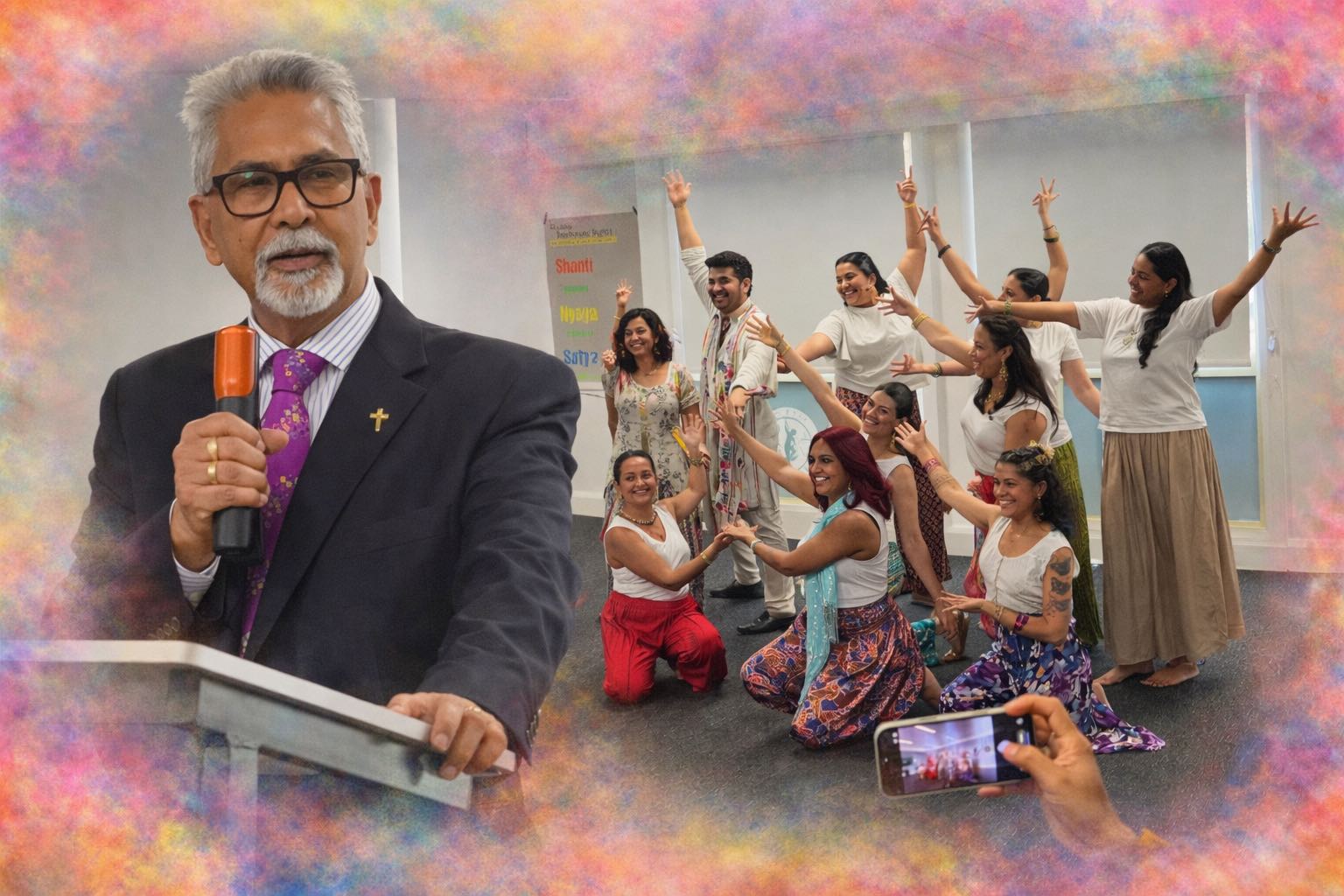
Hindus for Human Rights Australia hosted their annual Interfaith Holi event, Mosaic 2026 in Sydney recently. Reverend Manas Ghosh, of the Uniting Church, delivered a rousing and moving address that captured the essence of our times, as we grapple with a world in distress and a hope for a better future. He poignantly quotes the visionary Indian poet Rabindranath Tagore with “On the seashore of endless worlds children meet” — a quiet testament to a world without borders, hate and strife.
Below is the full text of Reverend Ghosh’s speech.
“Holi in an Unholy Time”
A talk given by Rev Dr Manas Ghosh at the Holi Celebration organised by Hindus for Human Rights Australia and New Zealand on 15 March 2026
Good afternoon, everyone, and namaskar.
Before anything else, I want to acknowledge the original owners and custodians of this beautiful land on which we gather today—the Wallumedegal clan of the Dharug people. I pay my respects to their Elders, past, present, and emerging. May we walk gently on this sacred land and work together for reconciliation, justice, and peace.
My heartfelt thanks to Hindus for Human Rights Australia and New Zealand, and especially to Dr Shanti Raman and Nandini Sen Sharma, for inviting me to share a few words this afternoon.
Holi—the Festival of Colours—is a celebration of joy, friendship, unity and the triumph of good over evil. It is a reminder that love can outshine fear, and that community can outlast cruelty. Today we gather in that spirit of colour and laughter.
I remember standing here last year as a speaker—sharing stories, enjoying the warmth of friendship, and of course, the food and the chai. When I was asked to speak again this year, I found myself reflecting on how much has changed in just twelve months. The world feels heavier. The suffering feels closer. And the cries of the innocent feel impossible to ignore.
While we play with colours today, dark forces elsewhere play with the blood of innocent people—especially children and women. Their pain reverberates across the world, yet too often it is drowned out by propaganda, by the noise of bombs and guns, by the machinery of hatred.
As I sat with these thoughts, searching for words that could hold both the joy of Holi and the sorrow of our times, a poem by Rabindranath Tagore came to mind. Many of you will know his name; for those who may not, Tagore was one of India’s greatest poets—a Nobel laureate, a visionary, and the only writer to have composed the national anthems of two nations: India and Bangladesh.
His writings span more than a thousand poems, two thousand songs, sixty plays, and countless essays, stories, and speeches. And yet, in the midst of this vast body of work, there is a simple, luminous poem that speaks with profound relevance to our world today.
It is called “On the Seashore.”
On the seashore of endless worlds children meet.
The infinite sky is motionless overhead
and the restless water is boisterous.
On the seashore of endless worlds
the children meet with shouts and dances.
They build their houses with sand,
and they play with empty shells.
With withered leaves they weave their boats
and smilingly float them on the vast deep.
Children have their play on the seashore of worlds.
They know not how to swim,
they know not how to cast nets.
Pearl-fishers dive for pearls,
merchants sail in their ships,
while children gather pebbles and scatter them again.
They seek not for hidden treasures,
they know not how to cast nets.
The sea surges up with laughter,
and pale gleams the smile of the sea-beach.
Death-dealing waves sing meaningless ballads to the children,
even like a mother while rocking her baby’s cradle. The sea plays with children, and pale gleams the smile of the sea-beach.
On the seashore of endless worlds children meet. Tempest roams in the pathless sky,
ships are wrecked in the trackless water,
death is abroad and children play.
On the seashore of endless worlds is the great meeting of children.
Friends,
As we gather here in celebration, the world is watching scenes that break the human heart. Innocent children – across regions torn by conflict, across borders drawn by politics, across lands scarred by war – are dying. Their laughter is being silenced by forces they never created. Their futures are being erased before they even begin.
It is in this moment I find this poem by Tagore speaks to us with haunting clarity – a vision of pure innocence:
“On the seashore of endless worlds children meet.”
They meet – not as citizens of nations, not as members of religions, not as inheritors of ancient conflicts – but simply as children.
They meet with open hands, open hearts, and open imaginations.
They do not ask who belongs and who does not. They do not divide the world into “us” and “them.” They simply meet.
And as they meet, “They build their houses with sand, and they play with empty shells.”
What a contrast! Where adults build not with sand but with weapons, not with shells but with ideologies hardened into stone.
Children build fragile homes of sand – because they expect no storms. They trust the world to be gentle. They trust adults to protect them.
But the storms come anyway, as Tagore writes:
“Tempest roams in the pathless sky… death is abroad and children play.”
This line could have been written this morning. While tempests of violence roam across the world, children still try to play. They still try to gather pebbles, still try to laugh, still try to live. But the storms are too strong. And the world is failing them.
Friends, Holi forces us to confront this contradiction.
How can we celebrate colour when so many children see only smoke?
How can we celebrate joy when so many children know only fear?
How can we celebrate unity when so many children are divided by walls, checkpoints, and borders?
The answer is not to stop celebrating.
The answer is to let our celebration become a form of resistance.
Holi is not escapism. Holi is a declaration.
A declaration that every child deserves colour.
Every child deserves safety.
Every child deserves a future.
Every child deserves to meet “on the seashore of endless worlds” without fear.
Tagore reminds us that children “seek not for hidden treasures.” They do not ask for power, or oil, or land, or revenge. They ask for the simplest treasures:
A parent’s embrace.
A safe night’s sleep.
A chance to grow up.
If the world cannot give them even this, then what does our civilisation mean?
So today, as we smear colour on one another, let us also smear colour on the conscience of the world. Let us say clearly:
No child should die because adults cannot make peace.
No child should suffer because leaders choose violence over dialogue.
No child should be sacrificed to the ambitions of the powerful.
Holi teaches us that colour belongs to everyone.
Tagore reminds us that the world belongs to children.
And our shared humanity teaches us that we cannot look away.
Let this Holi be more than a festival.
Let it be a prayer.
A protest.
A promise.
A promise that we will not allow the “death-dealing waves” of our time to wash away another generation.
A promise that we will stand with every child—whether in Gaza, Israel, Iran, Ukraine, Sudan, Myanmar, or anywhere suffering steals childhood away.
A promise that we will work for a world where children can once again meet on the seashore of endless worlds—laughing, dancing, building houses of sand, and believing that the world is safe enough to dream.
May this Holi awaken compassion.
May it ignite courage.
May it remind us that the colours we throw today must become the colours we defend tomorrow.
May peace be our brightest colour.
Thank you and Happy Holi.
Hindus for Human Rights endeavours to create and nurture spaces that bring people together, not through forced or performative homogeneity but through celebrating the rich diversity of our traditions, faiths and cultures. The organisation’s interfaith Holi events, held this year across Sydney and Melbourne, brought together people from many political, cultural, linguistic and ethnic backgrounds to share stories, music, dance, food and colour.