

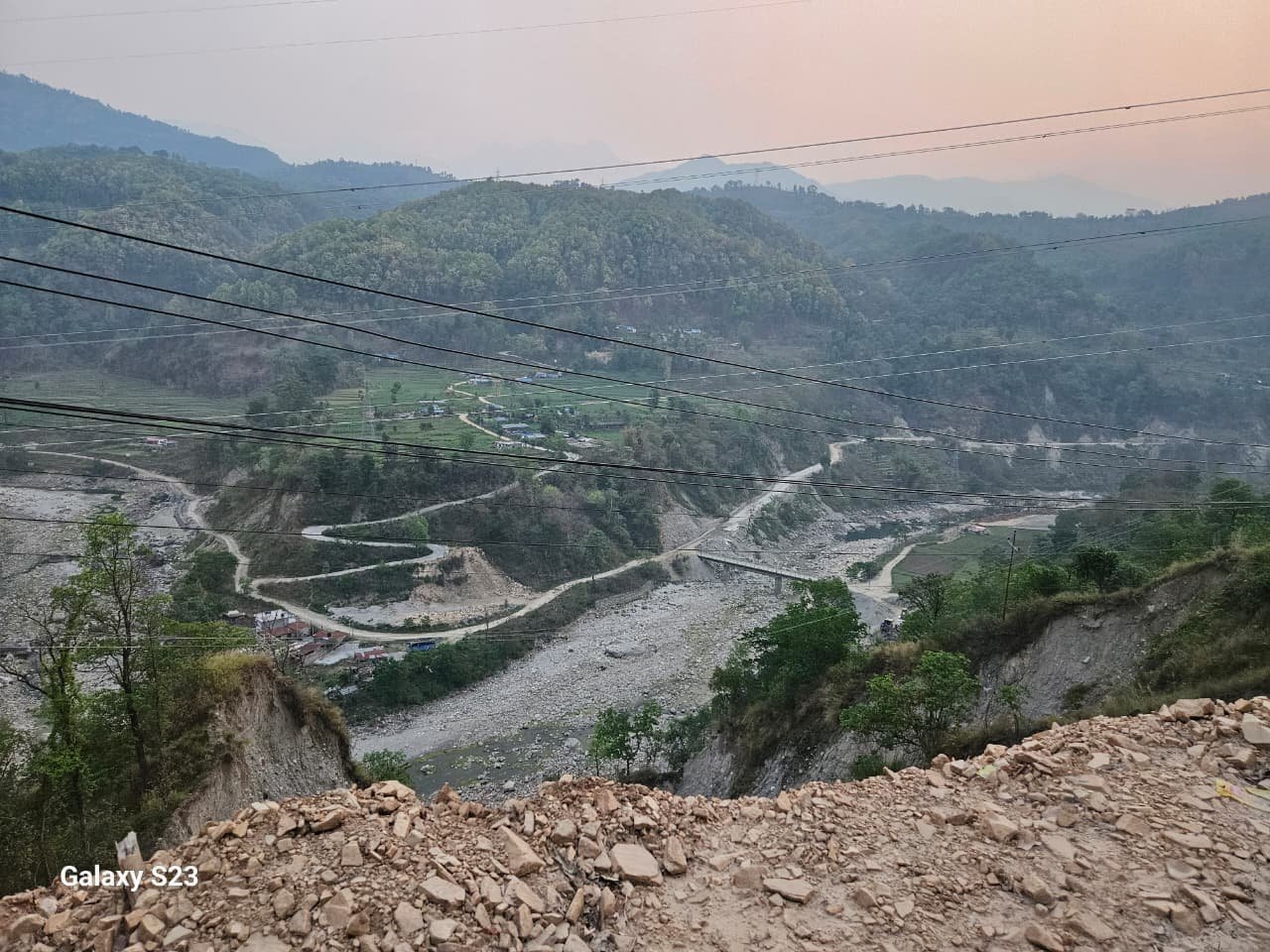
Rasuwa is one of the worst affected districts in the devastating Nepal floods. As of 11 September, the death toll stood at over 1300, while over 5000 are still missing. The mighty Trishuli river flows through the district with one of its sources in the Gosaikunda Lake, an area of cultural significance to Hindus as it is considered to be the abode of Shiva and Parvati. Initially called the Bhote Koshi river when it enters Nepal from Tibet, it then forms what we know as the Trishuli, at Rasuwagadhi, at the Nepal-Tibet border.
In April 2024, I had the opportunity to visit Nepal and be introduced through the Lawyers’ Association for Human Rights of Nepalese Indigenous Peoples (LAHURNIP), an indigenous lawyers’ association based out of Kathmandu, to the some of the project affected Tamang Indigenous Peoples from the Rasuwa district (Bagmati province)*. These were affected people from the Upper-Trishuli 1 (UT-1) hydropower project, built on the same Trishuli river in Rasuwa district.
The meetings and interviews that I engaged in, were part of a series of interviews done to understand the role of development banks such as the World Bank, the International Finance Corporation (IFC) (collectively constituting the World Bank Group), and the Asian Development Bank (ADB), in sponsoring hydropower projects in Nepal, a seismologically active region that is highly susceptible to the impacts of climate change. My interest was more around understanding how these development project sponsors and their clients: state or corporate, acted especially when it came to upholding the rights to Free, Prior and Informed Consent (FPIC), as most of these hydropower projects are located on Indigenous Peoples territories. Long story short: they did not.
FPIC is a right vested in Indigenous Peoples, and declared to be so under International Law, that requires individuals and authorities undertaking any legislative, administrative, or other acts that concern Indigenous Peoples, their lands, territories, natural resources, or cultural heritage– to first take their consent [ibid, pp. 12-17]. The understanding is that Indigenous Peoples hold traditional knowledge that is its own expert knowledge, and they are best placed to understand the risks, impacts, and opportunities from any project or programme that concerns them, and to determine for themselves, their futures [ibid]. Moreover, their close relationships with nature and proximity to it meant that they were most likely, the first to be affected by any negative impacts and risks associated with such projects and programmes [ibid]. Indeed, the floods have shown exactly that.
The UT-1 Project was a curious case. Development banks championed the UT-1 as a model for respecting and protecting Indigenous Peoples’ rights around projects that were built on their territory, working with them, and securing their consent. But while this optimism reflected on paper that kept circulating between the clients (Nepal government, regulatory authorities) and their development sponsors like the World Bank Group, the reality was something else [ibid, p.34]. I mention this in this article in the aftermath of the disaster, since human rights advocates have been raising these concerns for some time now, whether in Nepal, or across the border, in India: how large hydro projects; whether they are conventional reservoir projects or are run-of-the-river (where water need not be held in reservoirs), are not sensible. Rather, the decision as to whether or not such projects should go ahead must ultimately lie with the same people who are resident in the areas, not with those in the capital who extract and benefit from the projects. The state must engage with the residents: Indigenous Peoples (who hold such a right under law already), and others, in good faith.
For reasons of lack of consent to use data for purposes other than those directly related to the Project brief I authored with LAHURNIP, I am unable to reveal much. Yet, what I heard struck me. The people I spoke to, were members of an Indigenous Governance Board; an institution which was proposed by a consulting firm in the US (while the project itself was of course, in Nepal) and approved by the IFC. This institution was different from the existing representative institutions in the community. The people I spoke to still held community identities, although in my observation, they were initially somewhat neutral about the project. Whether that was because they did not fully trust me at the beginning, or because they truly believed the Project to be alright, was up for debate. For that reason, my questions were meant to circumvent this possibility of a binary ‘yes, consent’ or ‘no consent’, by instead asking about the Project timelines, and how the authorities got the peoples’ consent. To fully uphold international, FPIC must be done before the commencement of the project. So, the idea behind the questions was very simple: if consent was taken once the project had already begun, the project was what we would call fait accompli (already decided). At that point, individuals often felt that they had no other option, but to give consent.
This proved useful, since in the response to my queries, I came to know from the representatives that they first got to know about the project only when the infrastructure works began. The idea for the project started sometime in 2010-11, but the residents’ consent (although I would disagree it can be called that) was taken only in 2018. These representatives were taken from one district to another, to sign onto a couple of papers consenting to the project, without being told in the first place what the purpose of their travel was. While the Project publicized benefits, what it did not mention were the impacts: loss of trees, depletion of water resources. The blasts from the hydropower construction activities also impacted their houses. Yet the compensation for the land acquisition obviously did not figure these impacts in mind. Finally, they spoke of the heavy presence of army and civilian police which the government stationed at the project site on the pretext of the blasting activities to be carried out. The representatives mentioned that these were symbolic measures to instill fear, to retain “consent”.
I returned from this heavy conversation with my newly made acquaintances that day, after a large Newari thali with a side of Sadeko, hopeful of seeing them in again in the near future, or at least, keeping up with each other’s lives via WhatsApp texts. But as human connections are won’t to be, this too soon faded into the background. A year later, I saw the Trishuli river again on my way back to Kathmandu from Lamjung, Marshyangdi, and I was instantly reminded of the over five hour long-conversations with the Tamang representatives.
I also remember being struck in that moment by the amount of concrete that lay next to the river, a serpentine figure that I watched from uphill, inside the Toyota that I rode in. It had been difficult to exactly pin down the projects on the Trishuli when I was preparing for the initial research and the interview. There were at least over five on that one single river, all alphanumerically arranged from head to tail: UT-1, UT-3, UT-3A, UT-3B, and so on. These projects, as I argued later in the policy brief addressed to the IFC, the ADB, the World Bank – were not simply that. They constituted multiple structures: headworks, tunnels, access roads, labour camps, all of which came before the project’s operation and were intricately related to its success. They also came at the expense of the environment, of human lives and livelihoods, their cultures and heritage. What is even more ominous and telling is the news that several of these projects have been wiped out, and workers are now stuck within the same hydropower project tunnels.
Perhaps now the governments would finally be so willing to sit down to listen to its own people? To re-evaluate this frenzy for more large infrastructure projects in highly ecologically precarious zones?
*By project affected, I refer to the definition used by development banks and other financiers to demarcate their areas of impact while pursuing a “development” project.