
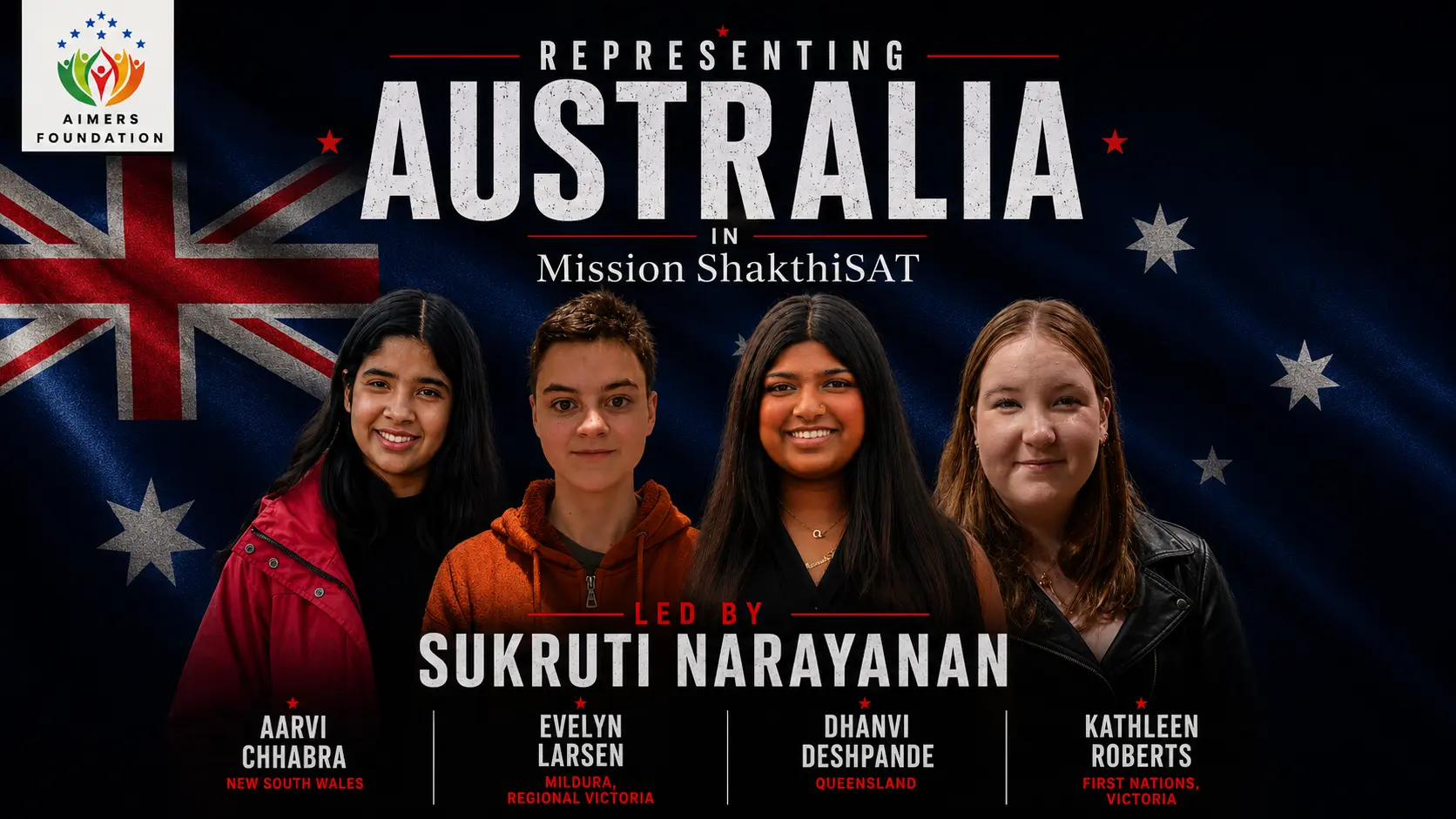
Four Australian schoolgirls have been selected to represent their country in one of the most ambitious STEM education initiatives ever attempted: an all-girls satellite mission that will eventually send a spacecraft to the Moon.
Aarvi Chhabra from New South Wales, Evelyn Larsen from Mildura in regional Victoria, Kathleen Roberts, a First Nations student from Victoria, and Dhanvi Deshpande from Queensland make up Australia’s delegation to Mission ShakthiSAT, an initiative founded by Dr Srimathy Kesan that describes itself as the world’s first female-led lunar satellite mission. The four were chosen through a selection process that organisers said assessed their interest in STEM, leadership qualities, determination, and commitment to using science and technology to shape the future.
The Australian delegation will be led by Sukruti Narayanan, who serves as Australia’s Ambassador for Mission ShakthiSAT and as the initiative’s global head of partnerships. The students are scheduled to travel to India to take part in Mission ShakthiSAT activities from 22 to 31 August 2026, working alongside student delegations from 108 countries.
What Mission ShakthiSAT actually is
Space Kidz India runs Mission ShakthiSAT under the leadership of Dr Srimathy Kesan, and aims to empower more than 12,000 girls from 108 countries through hands-on training in STEM, satellite engineering, coding and space systems. Each participating country sends one student delegate and one ambassador to India for an intensive, in-person phase of the programme.
What is Mission ShakthiSAT?
Mission ShakthiSAT is a global, all-girls space education and satellite-building initiative led by Space Kidz India and founded by Dr Srimathy Kesan. It is designed as the world’s first female-led lunar satellite mission, involving girls from 108 countries in the design, engineering and cultural exchange surrounding two satellites: a Low Earth Orbit satellite intended to launch from ISRO’s Satish Dhawan Space Centre in Sriharikota on 11 October 2026, timed to coincide with the International Day of the Girl Child, and a subsequent Moon-bound mission.
Students who complete the programme receive approximately 120 hours of free, structured training covering satellite engineering, coding and space systems, delivered through both remote learning and an in-person phase in India.
The initiative has been supported by figures including India’s President Droupadi Murmu, who received a delegation of participating students at Rashtrapati Bhavan, and Meenakshi Lekhi, who serves as the mission’s Global Patron d’Honneur.
The in-person phase brings together nearly 108 global ambassadors and 108 student delegates, alongside international advisory scientists, technical experts, research collaborators and mission operations teams, for satellite integration work, leadership engagements, scientific exchange and cultural collaboration in India between 23 August and 1 September 2026.
Australia’s path into the mission
Australia’s involvement in Mission ShakthiSAT runs through the AIMERS Foundation, a Hornsby-based, technology-focused not-for-profit founded by Sukruti Narayanan with the stated ambition of positioning Australia as a global innovation hub by 2050. AIMERS Foundation serves as the Australian home for Mission ShakthiSAT and has also been entrusted with leading the international fundraising campaign to support one student and one ambassador from every participating country travelling to India for the programme.
The foundation was formally registered in September 2025 and launched as a hybrid event on 31 January 2026, with support from figures including T.S. Krishnamurthy, a former Chief Election Commissioner of India, and video messages of support from Australian political figures including NSW Shadow Minister for Science and Technology Jacqui Munro.
A community fundraiser held at Hornsby Library in March 2026 featured a live satellite showcase, including a viewing of the Waratah Seed satellite, an Australian-built satellite that has been orbiting Earth for over 18 months under the leadership of Professor Iver Cairns, giving Australian students a tangible link to existing local space engineering work ahead of their own participation in the India-led programme.
Why this matters for the India-Australia relationship
Mission ShakthiSAT’s selection of an Australian delegation sits within a broader pattern of deepening India-Australia collaboration in science, technology and education that has accelerated through 2026, including the University of Melbourne’s new technology centre in Tamil Nadu and the PACTS technology partnership announced during the Modi-Albanese summit in Melbourne.
For Indian-Australian families specifically, the mission’s structure offers a distinctive point of connection: an India-founded, India-led global STEM initiative that has found an institutional home in Australia through an Indian-Australian founder, and that is now sending young Australian students, none of Indian heritage themselves among the four named delegates, to train and build satellites in India alongside girls from 107 other countries.
Kathleen Roberts’ selection as a First Nations Australian student adds a further dimension to the delegation’s composition, reflecting the mission’s stated goal of ensuring space education access reaches beyond capital cities and traditionally well-resourced student cohorts, extending to regional Australia, as represented by Evelyn Larsen from Mildura, and Indigenous communities.
What comes next
The Australian delegation departs for India in August, joining the in-person phase of the programme running from 23 August to 1 September 2026. The Low Earth Orbit satellite the students will help develop is scheduled to launch from ISRO’s Satish Dhawan Space Centre on 11 October 2026, positioned by organisers as a prelude to the mission’s eventual Moon-bound satellite.
What Australian families are asking
How were the four Australian students selected?
Organisers said the selection process assessed candidates’ interest in STEM, leadership qualities, determination, and commitment to using science and technology to contribute to the future. The specific application and assessment process was administered through the AIMERS Foundation, the Australian partner organisation for Mission ShakthiSAT.
Is Mission ShakthiSAT free for participating students?
The mission provides approximately 120 hours of free, hands-on training in satellite development to participants. Costs associated with international travel to India for the in-person phase are supported through a dedicated fundraising campaign led by the AIMERS Foundation on Australia’s behalf.
When does the actual satellite launch happen?
The Low Earth Orbit satellite, developed as the mission’s initial technology demonstration phase, is scheduled to launch from ISRO’s Satish Dhawan Space Centre in Sriharikota on 11 October 2026. It is described by organisers as a prelude to a subsequent Moon-bound mission, for which a specific launch date has not yet been confirmed.
Who leads Mission ShakthiSAT and where is it based?
The mission is led by Dr Srimathy Kesan, founder of Space Kidz India, and is based in Chennai. Australia’s participation is coordinated through the AIMERS Foundation, based in Hornsby, New South Wales, and founded by Sukruti Narayanan, who also serves as Australia’s Ambassador for Mission ShakthiSAT.
Can other Australian students apply to future rounds of Mission ShakthiSAT?
Information on future application rounds is best sought directly through the AIMERS Foundation, the Australian partner organisation for the mission.