
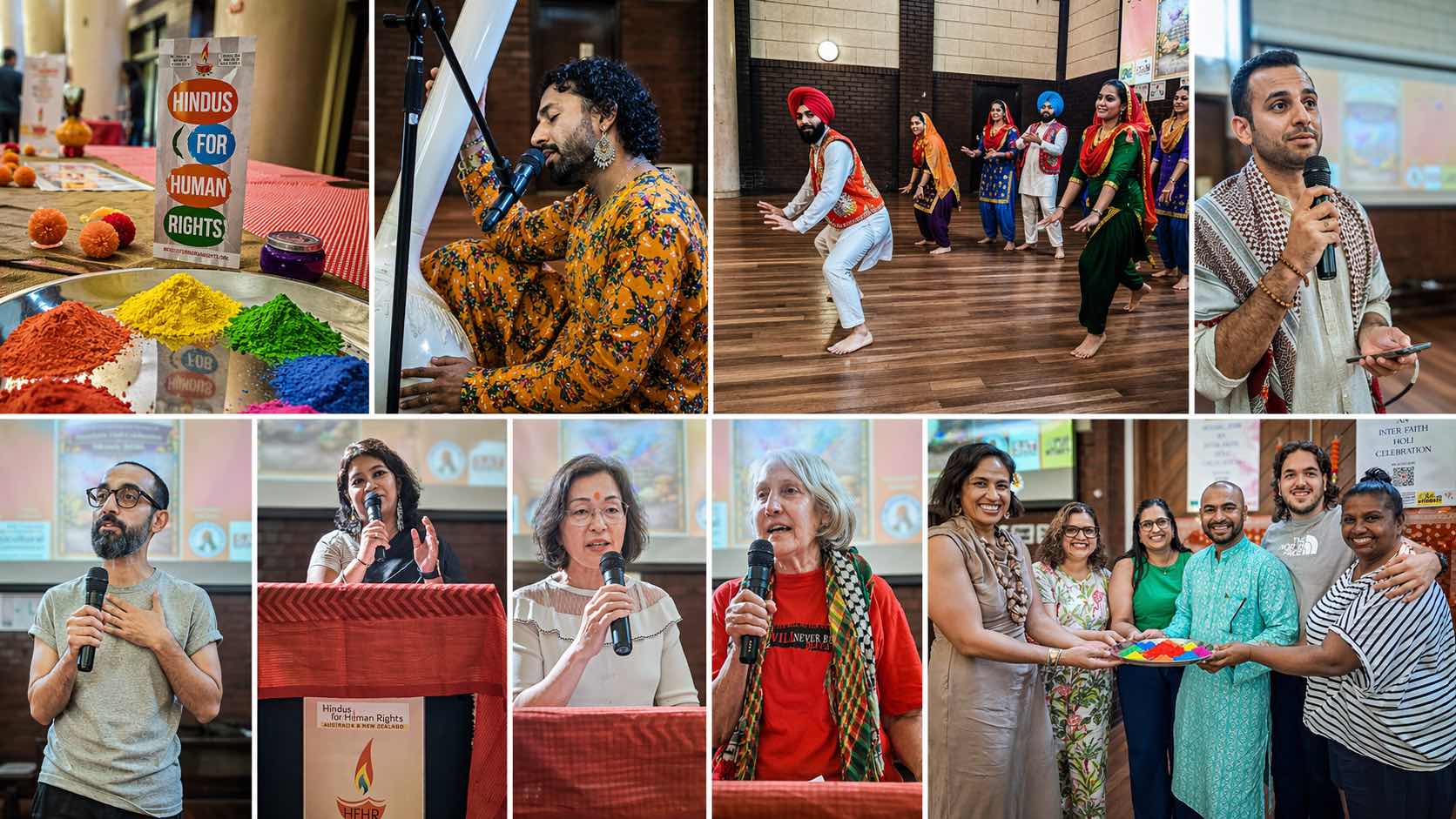
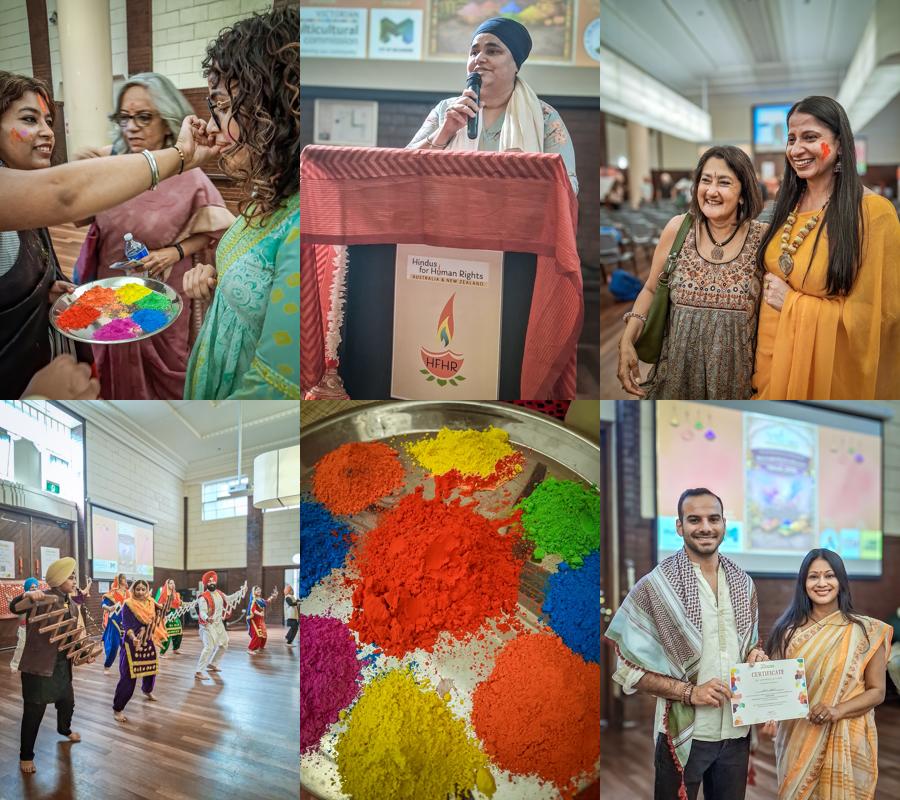
More than 100 people from diverse faiths and cultural backgrounds came together at the Drill Hall in Melbourne on 22 March for an interfaith Holi celebration hosted by Hindus for Human Rights Australia, in an event that blended colour, culture and calls for peace and justice.
Hosted by Nandini Sen Mehra and Chris Mallika Bhadra, the event—titled Mosaic 2026: Unity in Diversity—brought together community leaders, elected representatives and performers in a powerful display of interfaith solidarity.
Opening the event, Mehra emphasised the organisation’s commitment to interfaith respect and human rights, grounded in values of truth, justice, peace and humanity. She noted that in a time marked by global conflicts and rising divisions, communities must respond by “raising our voice for peace and justice… and countering hate with love, community and resilience.”
Music, dance and shared traditions
A highlight of the afternoon was the melodious musical performance by Bimal Singh, accompanied by tabla player Jigar Doshi. Their renditions, including a Hori bhajan and a composition blending ghazal traditions, reflected the deep syncretic roots of South Asian culture and drew warm appreciation from the audience.
The energy lifted further with vibrant Bhangra performances by Bhangra Junction, celebrating Holi’s connection to harvest traditions in Punjab and inviting audience participation in a joyful, communal atmosphere.
Poetry bridging faiths
One of the most poignant moments came through a joint poetry recital by Deepak Joshi, an Indian Hindu, and Alea Rizvi, a Pakistani Muslim. Their presentation traced Holi’s syncretic traditions across South Asia—from Mughal courts to Sufi dargahs—highlighting how the festival has long transcended religious boundaries.
Drawing on the works of Sufi poets like Amir Khusrau and Bulleh Shah, the recital emphasised a shared spiritual language of love and devotion, where Holi becomes “Eid-e-Gulabi”—a celebration beyond religious divides.
Voices from across faiths and communities
Speakers from a wide range of faith and community backgrounds reflected on the significance of interfaith solidarity in a fractured world.
Victorian Greens leader Ellen Sandell highlighted the alignment between Holi’s message and broader values of social justice, peace and non-violence, describing Melbourne as a “melting pot” where diversity is a strength and shared humanity must remain central.
Yusuf Zarani from the Islamic Council of Victoria spoke about the richness of Australia’s multicultural fabric while warning against rising racism and disinformation, stressing the importance of building understanding across communities.
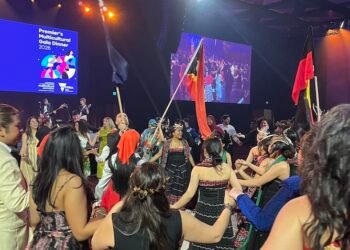
Palestinian representative Amin Abbas drew parallels between the Holi story of Prahlad and contemporary struggles against oppression, emphasising themes of resilience, truth and resistance to injustice. His speech was followed by an engaging tutorial on the traditional Palestinian dance Dabke, where volunteer participants—young and old—joined in enthusiastically, adding a lively and inclusive dimension to the event.
Sikh community leader Gurinder Kaur underscored the importance of interfaith engagement, noting that “we don’t say festival of one colour… we say festival of colours,” as a metaphor for unity in diversity and the need to transform unfamiliarity into friendship.
City of Melbourne Councillor Gladys Liu praised the event’s inclusive and interactive format, celebrating Melbourne’s multicultural identity and the opportunities it offers for communities to connect and thrive.
Merri-bek Councillor Sue Bolton called for going beyond symbolic multiculturalism to actively confront racism and build solidarity across struggles, while Ohad Kozminsky from the Jewish Council of Australia spoke about the importance of representing diverse voices within communities and advocating for justice.
Former Mayor and current Councillor Pradeep Tiwari of the City of Maribyrnong also made an appearance, joining community members in celebrating the spirit of interfaith harmony.
A celebration with purpose
The event concluded with collective Bhangra dancing and an outdoor Holi colour play, reinforcing the spirit of joy and togetherness.
As Hindus for Human Rights Australia’s first Holi event in Melbourne, the gathering stood out not just as a cultural celebration, but as a deliberate act of interfaith bridge-building—bringing together Hindu, Muslim, Sikh, Jewish and other community voices in a shared commitment to peace, justice and human dignity.