
India in the World
- The EU and India have finalized their Free Trade Agreement, both sides commit to eliminating almost all tariffs and expanding bilateral trade. The trade deal does not require approval by each of the 27 national member states, which could speed up the operationalization of the agreement, but it would still need Parliamentary approval. Both parties desire the FTA to be operational within a year. PM Modi and his government have received a lot of critique in congress, particularly for its inability to secure an exemption for India’s aluminum and steel sectors from the EU carbon Border Adjustment Mechanism. Further critique comes from the left-leaning factions, such as the Communist Party of India, who argue that the tariff cuts on luxury goods will only benefit the wealthy, while threatening the livelihoods of farmers, workers and ordinary citizens. Indian Farmer unions, united under the umbrella body Sanyukt Kisan Morcha (SKM), condemn the “double standard” where complex EU barriers block Indian farm exports, while India lowers its own import standards. According to the SKM, the FTA’s high-level Intellectual Property protection will act as a Trojan horse for EU seed and agro-chemical monopolies. It further calls the trade deal “a blueprint for economic colonization” that will lead to the systematic corporate capture of the vast India market, decimating the agriculture and industry and ruining employment opportunities in India. The agreement marked a new milestone in EU–India relations, but failed to protect democratic institutions, the rule of law, and respect for human rights.
- On the 6th of February, the US and India released their joint statement on the Interim agreement. The statements reveals that India committed to buy $500 billion worth of “U.S. energy products, aircraft and aircraft parts, precious metals, technology products and cooking coal” at the rate of $100 billion each year over the next five years. Both countries will significantly increase trade in technology products and goods used in data centers. Additionally, they addressed non-tariff barriers, India will eliminate restrictive import licensing procedures that delay market access for U.S. ICT products. This interim commitment is viewed as significantly one-sided, as stated by economics at the Wire, drastically changing the status-quo of free and fair trade among nations. India’s $500 billion commitment will erode India’s trade surplus of $45 billion and replace it with a growing trade deficit, no other East Asian economy has offered to dilute its trade surplus with the US like India has done.
- On the 13th of February, the US District Court has formally accepted the guilty plea of Nikhil Gupta, the Indian charged in the trans-national plot to kill Sikh separatist and activist Gurpatwant Singh Pannun. Pannun is a U.S. citizen of Indian origin, a vocal critic of the Indian government and leads a U.S.-based organization that advocates for the secession of Punjab. On the 18th of June 2023, a leader of the Sikh separatist movement and associate of Pannun was murdered in Canada. 12 days later, Gupta was arrested in the Czech Republic and subsequently extradited to the United States, preventing the murder of Pannun. The US Department of Justice released a press statement that claimed Gupta “acted on the direction of an Indian government employee”, Vikash Yadav, who was an officer of India’s external intelligence agency at the time. FBI Assistant Director Roman Rozhavsky stated that “the U.S. citizen became a target of transnational repression solely for exercising their freedom of speech. The Indian government has denied any knowledge or involvement in the plot to kill Mr. Pannun.
- From the 16th to the 21st of February, India hosted the AI impact Summit, bringing together 20 national leaders, 45 ministerial-level delegations and Big-tech executives. PM Modi inaugurated the 5-day event, stating that they aim to create a “shared roadmap for global AI governance and collaboration” and discuss issues such as changing labor markets, regulation, security and ethics. The theme of the summit was Sarvajana hitaya, Sarvajana sukhaya; welfare for all, happiness for all. India positioned itself as a service provider for AI for the whole world, aiming to democratize access to compute, datasets and algorithms. Modi revealed India’s AI vision ‘MANAV’, referring to Moral and ethical systems, Accountable governance, National sovereignty, Accessibility and inclusivity and Valid and legitimate means. The key outcome document, the New Delhi Declaration on AI impacts, has been signed by 88 countries and international organizations. Throughout the document, India focused on the key pitch to ‘democratize AI’ as countries commit to promoting access to foundational resources, locally relevant innovation and pooling AI research capabilities. Leading international and domestic AI companies, including Google, OpenAI, Meta and Microsoft signed the New Delhi Frontier AI Impact Commitments, a voluntary framework stating the companies will evaluate their AI systems for global context and, by the next AI Summit, they have pledged to publish statistical insights derived from anonymized, aggregated, and taxonomized usage data. Many companies also announced partnerships with Indian government and research institutions. The event marked the first time an AI summit was held in the Global South and positioned new Delhi as a convening power in Global AI governance. The rapid growth of AI does bring about challenges to the large data centers necessary to deploy AI models, as they place sustained pressure on electricity grids which strain the local energy distribution. They also require massive amounts of water to cool the hardware, which is a serious concern when 24% of Indians still lack access to clean water and adequate sanitation. Further challenges lie with policy gaps and institutional capacity: India still lacks a formally adopted national data center policy, which means that state-level policies remain fragmented even though state utilities and regulators often lack the technical expertise to assess the long-term implications of large digital loads. There are no compulsory energy efficiency rules or sustainability standards, nor a clear policy or financial support for green data centers, making clean power storage and sustainable cooling costly.
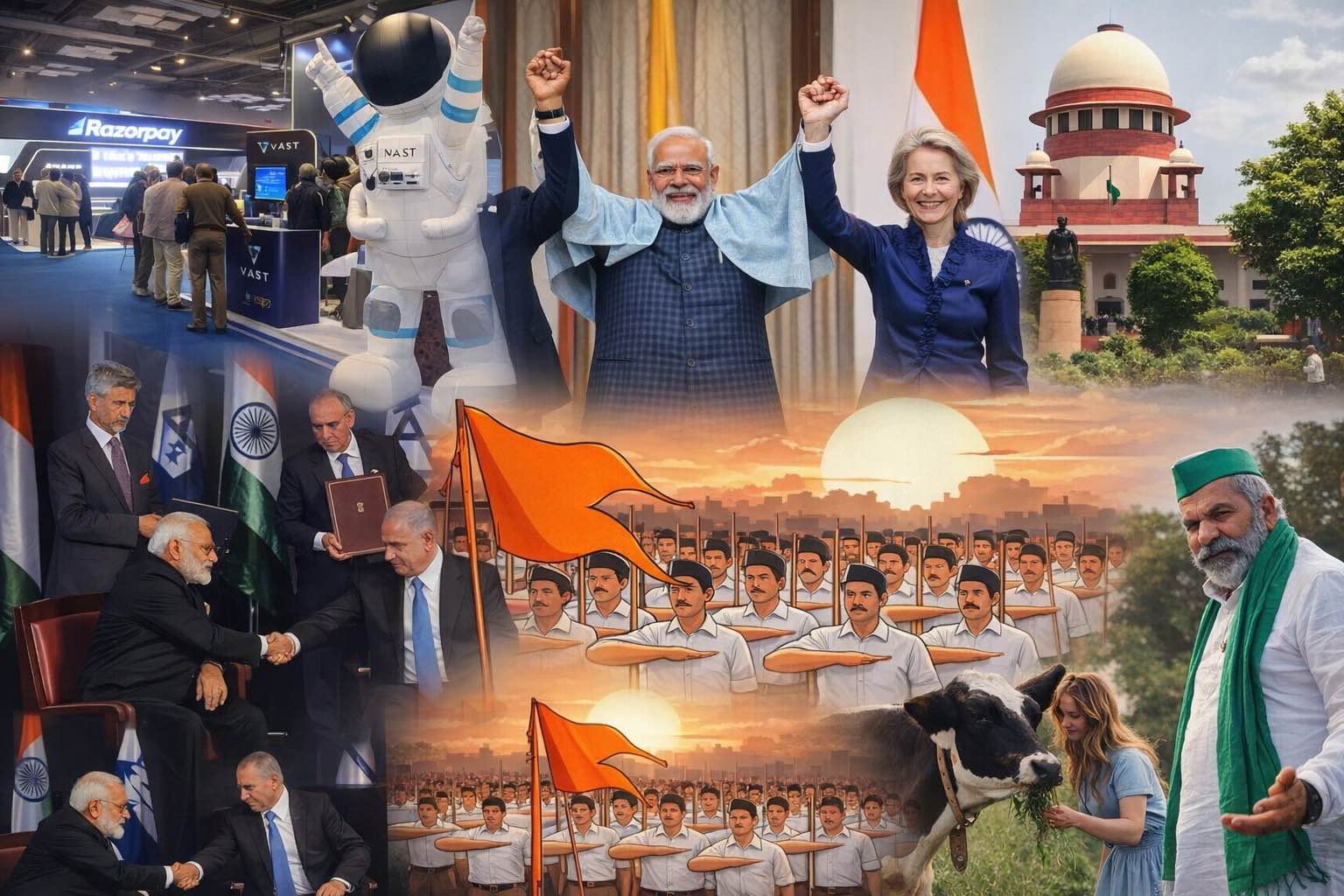
- On the 25 and 26th of February, PM Modi made a standalone visit to Tel Aviv, accompanied by a high-level delegation comprised of senior ministers and officials. PM Modi’s last visit to Israel was in 2017, when he notably did not visit Palestine as well, which was part of all previous official visits. Modi historically supported the establishment of a Palestinian state and condemned Israeli measures in the West Bank earlier this month, yet it has abstained from criticism of Israel in international forums like the United Nation. Netanyahu and Modi have spoken at least 10 times over the last 3 years, the two signed a pact on defence and started free trade negotiations in November 2025. In a joint statement following the visit, the countries reaffirmed their special strategic partnership and announced, “a new era” of collaboration across diverse domains “including emerging technologies, cyber, agriculture, water management, health, entrepreneurship, defence, security, and more.” Oppositional party, the Indian National Congress, termed the visit “shameful” and “ill-timed”, stating the visit “creates the perception of a political endorsement of military escalation” which is antithetical to India’s commitment to the rules-based international order. The party reaffirmed its commitment to “peaceful coexistence, stability and shared prosperity” in the region and warned the BJP to be mindful of India’s geopolitical and diasporic ties with other countries in the region.
Civil society, human rights defenders, and journalists
- On the 10th of February, the Final voter list of Assam was published after the Special Revision (SIR) of electoral rolls. The list showed a decrease of 2.43 lakh voters from the draft released in December. Booth-level officers (BLO’s) went house-to-house to verify voters and identified over 4.78 lakh names for deletions due to death of electorates, 5.23 lakh due to change of registered locations, and more than 50,000 identified duplicate entries. The publication of the draft list was followed by a period of claims and objections, in which new voters could apply for inclusion, and people can object to the inclusion of another individual. In some districts, the scale of objections filed caused hearings to come to a halt until the district administration could expand the infrastructure at those centers. The final list is followed by a window of appeal for 30 days.
- On the 10th of February, a magistrate court in Mansa convicted Indian freelance journalist Ravi Nair in a criminal defamation case and sentenced him to 1 year of imprisonment and a Rs 5,000 fine. The judgment followed a private complaint filed by Adani Enterprises, LTD (AEL), the flagship entity of Adani Group, an Indian conglomerate in de sector of energy production, mining, logistics and agriculture. Nair frequently used social media to critique the Adani Group, owned by billionaire Gautam Adani, which has come under sustained scrutiny over allegations of financial irregulates. The court concluded that the journalist’s comments and publications were defamatory and with knowledge of their likely impact on the company’s reputation. In September, Nair was among 10 defendants barred from publishing allegedly defamatory content about the Adani Group. The Committee to Protect Journalists (CPJ) expresses deep concern with the sentence, stating “the conviction of journalist Ravi Nair for criminal defamation sets a dangerous precedent for press freedom and free speech in India”. The CPJ has called on the Indian government to protect journalists from being jailed for defamation.
- On the 30th of January, Human Rights Foundation (HRF) and the Asian Forum for Human Rights and Development (FORUM-ASIA) submitted an individual complaint to the UN Working Group on Arbitrary Detention (WGAD) on behalf of Kashmiri journalist and human rights defender Irfan Mehraj. The complaint urges the UN Working Group to declare his detention arbitrary, in violation of international law and to call on the Indian government to immediately and unconditionally release him. Mehraj was arrested on the 20th of March 2023 by the National Investigation Agency and remains in pre-trial detention in Tihar Jail. According to HRF, his case exemplifies India’s practise of ‘trial by jail” where court relentlessly extend pre-trial detention and delay decisions on bail applications. Probe agencies allege Mehraj’s detention to be linked to his association to the Human rights organisation Jammu Kashmir Coalition of Civil Society (JKCCS), accusing him of terrorism and secessionism with the “NGO terror funding case.” JKCCS has been under broader investigation since 2020 together with another Kashmiri NGO’s, and the allegations have been widely criticised by international observers, including the UN Working Group on Arbitrary Detention. Kashmiri human rights defender Khurram Parvez remains detained under the same case. FORUM-ASIA’s Executive Director state that their cases “highlight India’s failure to protect freedom of expression and to meet its international human rights obligations.”
- Despite their significant contributions to journalism, female journalists in India continue to face significant obstacles, facing constant harassment, both online and offline, legal threats, professional isolation and persistent online trolling. Their opinions are often not valued says Padmaja Shaw, retired professor in the Department of Journalism at Osmania University. Shaw notes that although women have long shaped journalism, advocating for gender justice, redefining public issues, and challenging legal and social inequities, their independent opinions are still often dismissed, and they remain vulnerable to systemic obstacles that threaten both their safety and professional autonomy. She also warns of broader societal patterns that deprive women of property rights, financial independence, and equitable treatment, underscoring how these structural barriers compound the abuse women journalists endure today.
- On the 14th of February, the Uttar Pradesh police arrested a 22-year-old man for allegedly posting a video insulting PM Modi. The man, identified as Jitendra Kumar Kashyap, has been accused of intentional insult with intent to provoke breach of peace and statements conducing to public mischief. He was arrested shortly after his video went viral. Just last month, Youtuber Sangram Patil, A London based doctor who is known for his criticism of the BJP, was taken for questioning during his visit to India and released after 15 hours of detention. His detention stemmed from a complaint filed by BJP functionary Nikhil Bhamre who claimed Patil had posted “objectionable content” on Facebook that tarnished the image of a senior party leader.
Hate Crimes and Hate Speech against Minorities
- On the 26th of January, in Uttakhand’s Pauri Garhwal, a group of men intimidated an elderly Muslim shopkeeper, threatening that he had to change the name of his shop (Baba Clothes). A local gym owner, named Deepak Kumar, overheard the commotion and confronted the mob. A video of Kumar defending the shop owner has since gone viral and sparked backlash online. The next Saturday, around 40 people gathered in front of Kumar’s gym, Kumar told officials that he feared his family’s safety. Uttarakhand Police have since filed a First Information Report (FIR) under the sections of unlawful assembly, obstructing the duty of public servants and promoting enmity. The FIR further states that “the group then reached Baba Dress shop and started raising slogans in front of the shop and used abusive language while spreading religious frenzy,” and that the crowd claimed themselves to be members of the Bajrang Dal, a right-wing militant youth organization of the Vishva Hindu Parishad.
- On the 7th of February, BJP state Chief Minister of Assam, Himanta Biswa Sarma, posted an AI video of himself with a rifle shooting at a photograph of two men in skullcaps, one resembling an MP of the opposition Indian National Congress party Gaurav Gogoi. The video further shows Sharma dressed as a cowboy wielding a gun and texts stating, “No mercy to Bangladeshis”, “Why did you go to Pakistan?” and “Foreigner-free Assam.” The video, captioned “Point blank shot”, led to backlash across the political spectrum prompting the party to delete the post from X. In an official statement, the All India Trinamool Congress states the video “Appears to glorify the targeted, ‘point-blank’ murder of minorities” and amounts to “a call to mass violence and genocide”. It further calls the posts a reflection of “the true face of this fascist regime” that has tried to normalize this content for the past 11 years. Congress MP Sagarika called for the arrest of the creator of the ad. In September 2025, the same account posted an AI generated video captioned “Assam without BJP” showing men in skullcaps and women in bourkas and hijabs with the text ‘beef legalization’ and ‘illegal immigrants.’ The chief minister has recently escalated his rhetoric against Bengali-origin Muslims in Assam, linking them to crime and demographic change. Speaking on the special revision of electoral rolls in Assam, Himanta said that “four lakh to five lakh Miya (Derogatory term for Bengali speaking Muslims) voters” will be deleted from the electoral rolls, that his job was to “make them suffer.” He further admitted that “Yes, we are trying to steal some Miya votes. Ideally, they should not be allowed to vote in Assam”. The comments triggered outrage, and multiple petitioners, including the Communist Party, lawyers and human rights activists, approached the Supreme Court, stating that the comments were communal, unconstitutional, and amount to hate speech by a person holding a high constitutional office. The petitioners provided a detailed chronology from 2021 to February 2026 of statement by Sarma allegedly calling for social, economic, and civic exclusion of Bengali-origin Muslims. They further claimed that the statements resulted in real-world consequences as perpetrators of discrimination and harassment have reported acting on the chief minister’s directions. On the 16th of February, the Chief Justice of India Surya Kant refused to invoke Article 32, which guarantees the right to move the Supreme Court directly for the enforcement of fundamental rights. Instead, he argued that the petitioners should first approach the jurisdictional high courts who can “effectively adjudicate” the issues, claiming their move to approach the SC was a “calculated” effort to “demoralize’ high courts”, referring to alleged aim to politicize the upcoming elections in Assam.
- A query filed by the Quint under the Right to Information Act revealed that Modi’s government funded Rs 63 lakh to an event calling for the “mass deportation” of Muslims. At the event, organized on the 13th and 14th of December by the Sanatan Rashtra Shankhnad Mahotsav, the organizers publicly called for “Mass conversion”, “a cap on Muslim population” and “a constitutional Hindu Rastra”. The event in Delhi had over 3000 participants including prominent figures such as BJP politicians, Hindu NGO’s, the Sudarshan TV chief and supreme court lawyer Ashwini Upadhyay. Union ministers Gajendra Singh Shekhawat, Shripad Naik and Sanjay Seth, and Delhi’s tourism minister Kapil Mishra spoke at the event. The concerned ministries responded to the query revealing the donation.
Religious Freedoms and Minority Rights
- On the 2nd of February, the Supreme Court sought responses from the central government and several states in response to a petition filed by the National Council of Churches in India challenging the constitutionality of anti‑conversion laws enacted across multiple states, arguing that these laws violate fundamental rights by criminalising voluntary, conscience‑based religious conversions and imposing requirements such as prior government permission, which petitioners say undermine privacy and personal autonomy. One of the laws challenged is the Orissa Freedom of Religion Act (1967), enacted to prevent large-scale conversion of tribals. According to the petitioners, the laws have deliberately defined ‘conversion’, ‘inducement’ and ‘allurement’ vaguely to give uncanalised authority to states who show uniform patterns of misuse. “Routine worship, prayer meetings, charitable activities and interfaith marriages are criminalised through expansive interpretations of ‘allurement’ and ‘inducement’.” This produces “a chilling effect on free speech and religious propagation” as vigilante groups function as de facto enforces, legitimising social hostility and instilling fear among minority communities. They further argue that the stricter provisions on the conversion of women “deny women equal decisional autonomy”.
- In Surat, Indian state of Gujarat, BJP’s local corporator Vikram Popat Patil has been accused of misusing application forms to declare hundreds of living Muslim voters as ‘deceased’ and removing their names from the voter list. Hundreds of Muslim residents have filed formal complaints with the police, demanding action and an investigation against Patil for misusing Form 7- meant for removing names of deceased or ineligible voters- to falsely declare living Muslim voters as dead and eliminate them from the electoral rolls. A draft of the electoral roll was published on the 19th of December as part of the Special Intensive Revision of the Election Commission. Since then, 73.73 lakh names have been removed from the list. BJP leader Himanta Biswa Sarma has publicly urged BJP workers to file complaints against Muslim community members and “fill out form 7 wherever possible”. Similarly in Indore, bulk objections have been filed against thousands of voters by workers of the BJP, alleging that fellow residents have moved or are not Indian citizens. Booth level officers, residents and local corporators told Scroll that a majority of objections have been filed against Muslim voters. Fakir Mohamed, who is an Indian citizen born in Madya Pradesh, received such an application on the grounds that he was not an Indian citizen. “How can anyone decide that I can no longer vote?” He said, producing a list of documents, including land records from 1961 as proof. Rafique Khan, a former corporator, said the objections seem to be “a systematic attempt to cut Muslim votes.
- On the 8th of February, a new wave of violence has erupted Manipur’s Ukhrul district between the Tangkhul Naga tribe and the Kukis community, triggered by a drunken brawl the night prior. During the clashes, around 40 houses were burned in the district. The state Home Department issued a curfew and an order stating a 5-day internet ban in Ukhrul, effective immediately as a “preventative” and “precautionary” measure. The order stated that “anti-social elements might use social media” for the transmission of content and further stated that “there is an imminent danger of loss of life (…) as a result of inflammatory material and false rumours”. The following Monday morning, the 9th of February, villagers in and around Litan abandoned their homes, fearing further escalation. On the 16th of February, 51 Kuki Students were evacuated as a precautionary measure. Local civil society organizations helped the administration in deescalating tensions and persuading villagers to ensure safe evacuation. The students were handed over to the Saikul police station team for their onward movement to a sister school in the Kangpokpi district. Since May 2023, Manipur has been rocked by ethnic violence which has led to deaths of at least 260 people and the displacement of thousands.
- While addressing an election rally in Assam, Union Home Minister Amit Shah claimed that seven of the districts in the state have been “occupied by 6.4 million infiltrators.” He further stated that the ruling Congress party was to blame and that only the BJP could halt the alleged infiltration. In response to an information request under the Right to Information (RTI) Act, the Ministry of Home Affairs clarified that it does not have any centrally available data regarding the identification, arrest, or deportation of infiltrators in the country. Amit Shah has repeatedly referred to large numbers of ‘infiltrators’ in the country and stated that these illegal infiltrations pose a serious threat to the country’s security and demography. In October 2025, during a memorial lecture, he claimed that “the growth of the Muslim population in India is not owing to fertility rates but is instead a result of extensive infiltration.”
- The Union of Ministry of Home Affairs released an order stating that all six stanzas of Vande Mataram will be sung first when the national song and national anthem are played at any event. The direction drew criticism from prominent Muslim bodies, calling it a “blatant attack” on the freedom of religion guaranteed by the Constitution, contrary to Supreme Court judgements and directly conflicting with the religious beliefs of Muslims. Verses in the song refer to beliefs that portray the homeland as a deity, which contradicts the fundamental belief of monotheistic religions. General secretary of the All-India Muslim Personal Law Board (AIMPLB) stated that “A secular government cannot forcibly impose the beliefs or teachings of one religion upon followers of other religions.”
Internet and Technology
- On the 10th of February, the Ministry for Electronics and Information Technology published the Information Technology (Intermediary Guidelines and Digital Media Ethics Code) Amendment Rules, 2026. The document shows that the takedown timeline of unlawful content has been cut from 24-36 hours to just three hours. This change is expected to receive pushbacks from big tech firms due to a heavy compliance burden, which might initiate over-censorship to comply with such a short window. The Ministry dropped their earlier proposal that forced all AI-generated content to carry a label that covers at least 10% of the content; the rule now refers to a ‘prominent’ label. The definition of synthetically generated information (SGI) has been broadened to include assistive and quality-enhancing uses of AI. Routine and good faith editing of audio, video or audio-visual content is excluded from the definition of SGI. Companies must take “appropriate” and “expeditious” action when they become aware of their intermediary hosting or disseminating unlawful SGI. Big tech companies must also ensure that they require users to declare when information is SGI, deploy appropriate technical measures to verify the accuracy of such information, and prominently display an appropriate label. The rules came in effect on the 20th of February, the last day of the AI India Summit.
- On the 19th of February, the Wire published their findings of a government manual on takedown orders of social media content. The User Manual for Sahyog Portal (IT intermediaries) became active in October 2024 and lays down the union government’s takedown mechanism for online content with the goal of automating the process of central and state authorities, including police officers. Before the Sahyog portal had been developed, written orders stating reason, notice to the affected party, and review by a judicial committee were needed for blocking content. The new mechanism effectively bypasses the Ministry of Information and Broadcasting and the Ministry of Electronics and Information Technology. The manual further shows direct correspondence between government agencies and social media companies and telecom providers while excluding affected parties such as journalists and content creators from their definition of ‘stakeholders’. The document claims that the platform ensures “immediate action against the unlawful information by removing or disabling access and providing a clean and safe cyber space to the citizens of India,” and allows the removal or disabling of access “not only to unlawful information, but also to any information, data, or communication link which is being used to commit an unlawful act.” Social media company X is the only major tech company that is not integrated in the portal, while Microsoft, Google, Meta, and LinkedIn are. X challenged the government’s use of the portal, which the Karnataka high court dismissed in September.
- In the beginning of February, social media platforms in India became flooded with alarming posts claiming that over 800 people, mostly women and children, had gone missing in Delhi in the first 15 days of 2026 alone. The posts questioning women’s safety in Delhi, suggested a sudden spike in disappearances, sparking panic. A fact-check by BOOM found that, while the figure of 807 missing person is factually correct, it does not represent a “surge” and is in fact a lower average than previous years. Additionally, out of 807 missing, 235 individuals were already traced within two weeks.
- At the AI Impact Summit, between the 16th and the 21st of February, India announced the launch of its first set of sovereign AI models, a national AI research program, an expansion of computing facilities, and a roll out of AI labs with standardized curriculum across 500 universities. Trained on Indian datasets, the models are designed to handle the country’s linguistic divers and sector-specific challenges across divers sectors such as governance, healthcare, science, agriculture and industry. Electronics and IT minister Ashwini Vaishnaw claimed that Indian IT firms have already built over 200 sector-focused AI models aimed at improving productivity and efficiency and that nearly $70 billion has already been invested in AI-related infrastructure.
Political Parties
- On the 4th of February, in the Jammu and Kashmir Assembly, the BJP took back their demand for a separate Statehood of the Jammu region. Back in January, BJP member and former minister Sham Lal Sharma called for a division of the Pir Panjal Valley, citing discrimination against and neglect of the region by the government, a demand he shared as early as 2010. His comments were met with critique by the Chief Minister of J&K, who accused the BJP of aiming to “dismantle and destroy J&K.” According to the National Conference minister and senior leader in the region, Javid Rana, there has been no demand for a separate Jammu state by the people in the valley. During the J&K Assembly, leader of the BJP, Sunil Sharma, stated that they see J&K as “one entity”, adding that they “will not allow any division” and that attempts to create regional identities “challenge the historical and cultural unity of J&K”. Mr. Sharma’s statement is a strong departure from the narrative set by senior BJP leaders Sham Lal Sharma and Vikram Randhawa. Sunil Sharma’s speech resulted in a staged walkout by BJP members who accused him of defending the ruling National Conference (NC) party.
- On the 14th of February, PM Modi questioned Congress’ commitment to national security while addressing a large crowd of BJP booth-level workers in Assam. The PM arrived early in the morning in his aircraft, landing on the new Emergency Lading Facility (ELF), indented to support the landing and takeoff of military and civilian aircraft during emergencies. Referring to ELF, he stated that there was much progress happening in Assam which he credited to the hard work of the booth workers and the BJP government. When talking about the Congress party, he alleged that the party “always kept the country in danger” and “never gave priority to the country’s security”. The day marked the seventh anniversary of the 2019 Pulwama terror attack, Modi stated that India punished the terrorists harshly and claimed that Congress couldn’t make such “strong decisions”. Modi’s comment came after Congress accused PM Modi of compromising India’s sovereignty and shortly before the announcement of elections.
Police and authorities
- On the 25th of February, UN Special Rapporteur on torture and other cruel, inhuman or degrading treatment or punishment and UN Special Rapporteur on extrajudicial, summary or arbitrary executions issued a formal warning to the Indian government, citing a pervasive pattern of excessive force, custodial torture, and extrajudicial killings, particularly in Uttar Pradesh and Assam. They described the violence as systemic, not sporadic, and urged urgent independent investigations and major reforms to align policing with international human rights standards.
Judiciary
- A local court in Muzaffarnagar, Uttar Pradesh, acquitted 22 individuals charged with murder, arson and other violence during the 2013 anti-Muslim violence in the area, claiming there was not enough evidence for a conviction. Communal riots had erupted after a resident was allegedly murdered by eight men; soon after, a mob caught two of the alleged attackers and killed them. The chain of events led to widespread violence in which 62 people were killed and over 50,000 displaced. During the communal violence, there were also instances of sexual violence, including seven cases of rape filed and one conviction of gang-rape. The prosecution had claimed that a large mob went on a rampage in the village, setting houses on fire, vandalizing a mosque and attacking police personnel deployed at the spot. The verdict stated that the “prosecution could not establish the charges beyond a reasonable doubt”, as reported by the Times of India. According to the defence council, Sub-Inspector Gaga Prasad had lodged a FIR under multiple sections, including murder. The Special Investigation Team (SIT) filed a chargesheet against 26, all members of the Jat community, who were all tried as a single case before the local court. Four of the accused died during the decade long pendency of the trial, the remaining 22 have now been acquitted.
- The Supreme Court has tasked a committee led by NJA director Justice Aniruddha Bose to frame guidelines for Judicial Sensitivity in Sexual Offence Cases. The committee will first prepare a detailed report on measures taken in the past, before framing the draft guidelines. The court stated the recommendations will entail the “the approach of Judges and the Judicial System when dealing with cases of sexual offences and other similarly sensitive occurrences involving vulnerable victims, complainants, and/or Witnesses”. The order was made during a Supreme Court hearing of a 2022 case on an alleged rape-attempt of a minor, the high court had declared that the actions of the accused could not be seen as an attempt to commit rape, but as ‘preparation’ to attempt rape, a decision that the Supreme Court revoked. Action is required “to inculcate and nurture an inherent sensitivity and discernment into the approach of members of the judiciary, as well as into the accompanying court procedures”, the top court remarked. The court further advised the committee to not use complicated and technical vocabulary but instead use simple language, so that the guidelines are contextualized “in the real and lived experience of the stakeholders in the Indian judicial process”. The Chief Justice of India Surya Kant had critically called an earlier handbook on gender stereotypes published by the SC “Harvard-Oriented.” An increased understanding of the offensive nature of colloquially used expressions can “empower the victims to give better and fuller narrative of the trauma undergone by them”, according to the Court.
- On the 17th of February, a Supreme Court bench, led by the Chief Justice of India (CJI), called attention to the issue of lawyers submitting petitions drafted by AI. Some of the petitions contained fake case citations, Justice Nagarathna recalled an instance of coming across a citation “Mercy v. Mankind”, which never existed. In other instances, the citation would be correct, but the quotes attributed to the judgement were not, which creates an additional burden on the judges, she added. In January, the Bombay high court imposed a Rs 50,000 fine on a litigant for citing AI-generated citations. CJI Kant described the shift as ‘alarming’ and “absolutely uncalled for.” Justice Bagchi argued that the art of legal drafting has suffered setbacks in recent times, recalling an earlier generation of advocates whose pleadings were precise, concise and original.
Business & economy
- On the 14th of February, Leader of the Lower House Opposition Rahul Ghandi argued that the US-India trade deal will “destroy and finish” the textile industry. In a video statement, Ghandi accused PM Modi and his ministers of inflicting deep damage on the cotton farming and textile export industries, adding that a “visionary government” would have promoted the national interest and negotiated a deal that would protect both sectors. He claimed that “5 crore families employed by the industry will be hit by the 0% tariff on Bangladesh and 18% on India”, referring to the fact that Bangladesh, India’s competitor, has negotiated a 0% tariff on garments and textiles produced using U.S. cotton. “The Bangladesh textile industry will finish off the Indian textile industry,” he stated in the video. Ghandi further alleged that there was pressure on the PM due to the Epstein files naming the Union Minister Hardeep Puri and the industrialist Anil Ambani, allegations that Puri denied. Commerce Minister Piyush Goyal has stated that the trade deal will have provisions for a limited quality of India textile and clothing to be exported to the US at zero reciprocal duty. Ghandi named the suggested policy of a minister to import cotton from the US to receive special concessions a “trap.” “If we import American cotton, our own farmers will be ruined. If we don’t import it, our textile industry will lag behind and get destroyed,” he added.
- Farmer unions in India have announced protests and called for a general strike on Thursday the 12th of February against US-India trade deal framework. The concerns of farmers unions, organized under the Samyukt Kisan Morcha (SKM), range from the Indian markets being opened to US agricultural products to benefits for US agricultural corporations at the cost of Indian farmers. The farmers call the framework a direct threat to Indian agriculture, dairy and rural livelihoods, as 86% of Indian farmers are small or marginal, with landholdings below two or one hectare. SKM national coordination committee member Dr Darshan Pal says, “Indian agriculture would be left hanging at the mercy of multinational corporations, undermining food sovereignty, rural employment and long-term sustainability.” The unions see the agreement as part of a broader agrarian crisis and warn that it opens the door to imports of Genetically Modified foods and seeds, which could damage soil fertility, biodiversity and domestic seed systems. SKM has requested political parties, farmers’ organisations, agricultural workers’ unions, trade unions and mass organisations to oppose an “anti-national” trade agreement being pushed without parliamentary discussion.
Compilation by: Diaspora in Action for Human Rights and Democracy.