
Zohran Kwame Mamdani was sworn in as Mayor of New York City on 1 January 2026, opening his term with a forceful pledge to reset expectations, govern “expansively and audaciously”, and put City Hall to work for ordinary New Yorkers from the very first day.
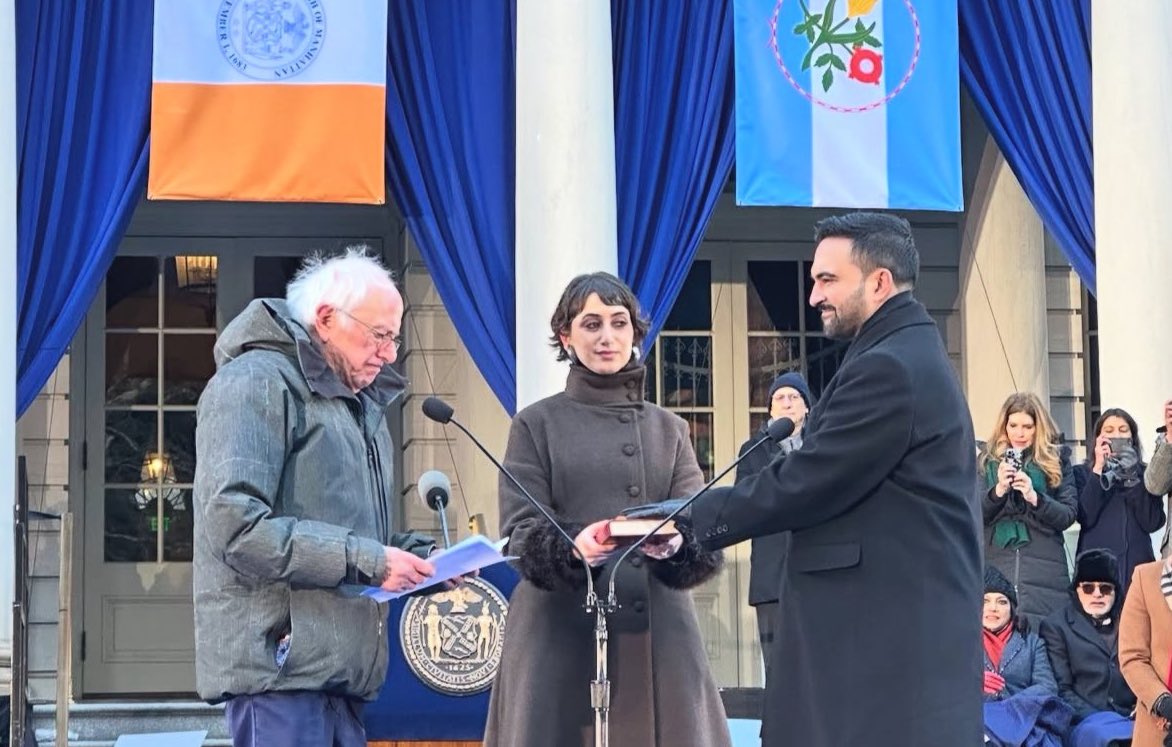
The inauguration ceremony, held at City Hall in Lower Manhattan, marked a rare convergence of political symbolism, cultural performance and multi-faith participation. Mamdani took the oath of office after being introduced by Democratic congresswoman Alexandria Ocasio-Cortez and formally sworn in by independent senator Bernie Sanders. The event also saw Mark Levine sworn in as Comptroller of the City of New York and Jumaane Williams begin his second term as Public Advocate.
Ocasio-Cortez framed Mamdani’s election as a decisive choice by New Yorkers to prioritise working-class needs, saying the city had chosen “courage over fear” and “prosperity for the many over spoils for the few”. She described the moment as historic, noting that Mamdani is the city’s first Muslim mayor, its first immigrant mayor in more than a century, and the youngest to hold the office in generations. Above all, she said, he would be “a mayor for all of us”.
The ceremony reflected that message. A multi-faith prayer led by Imam Khaled Latif brought together representatives from Jewish, Christian, Hindu, Sikh and other faith communities. Musical performances included actor Mandy Patinkin singing with the PS22 chorus from Staten Island, a reading of an original poem titled Proof, and a rendition of the labour anthem Bread and Roses, underscoring the ceremony’s emphasis on solidarity, dignity and social justice.
New York Attorney General Letitia James administered the oath of office to Mark Levine, who used his address to outline the comptroller’s role as a guardian of public trust and public money. Levine spoke of ensuring retirees can live with dignity, holding city agencies and contractors to account, expanding affordable housing investment, protecting immigrants, accelerating the transition to green energy and making sure the city’s budget reflects shared values rather than entrenched inequality.
The swearing-in of Jumaane Williams as public advocate was preceded by testimony from New Yorkers affected by immigration enforcement, including accounts of detention, fear of family separation and community advocacy. Williams described New York as a city of contradictions — immense wealth alongside deep poverty — and argued that hardship is driven not by migrants or marginalised communities but by systems “entrenched at the top”. He pledged to continue using the public advocate’s office to push government to work for those too often left behind.
Before administering Mamdani’s oath, Bernie Sanders praised New Yorkers for mounting what he called a grassroots political upset powered by tens of thousands of volunteers. He rejected claims that Mamdani’s agenda was radical, arguing that affordable housing, free childcare, free public transport and fair taxation are practical necessities in a city where many residents live paycheck to paycheck. Sanders said the task of governing would be harder than campaigning, and urged New Yorkers to remain actively involved.
In his inaugural address, Mamdani declared: “My fellow New Yorkers, today begins a new era.” He spoke directly to both supporters and sceptics, promising to serve all residents regardless of how they voted. He acknowledged widespread distrust in politics, saying only action could rebuild confidence, and vowed never to “hide” from the people of the city.
Rejecting advice to lower expectations, Mamdani said the only thing he intended to reset was “the expectation of small expectations”. He pledged that City Hall would no longer hesitate to use its power to improve people’s lives, arguing that government must be judged by results and excellence, just as New Yorkers demand excellence in culture, sport and industry.
Returning repeatedly to the question of belonging, Mamdani said New York should not be governed for the wealthy and well-connected alone. Instead, he described a vision of “eight and a half million cities” — one for every New Yorker — bound together across languages, faiths and neighbourhoods. He promised an agenda centred on safety, affordability and abundance, and said his administration would govern openly as a democratic socialist government, without apology.
Within hours of the ceremony, Mamdani moved to demonstrate that the rhetoric of a “new era” would be matched by immediate action. Speaking at a press conference on housing held on the first day of rent payments for the new year, he pointedly noted the contrast between the celebratory morning and the reality faced by tenants returning to unsafe, unaffordable homes.
Announcing three executive orders, Mamdani said his administration would revive and empower a Mayor’s Office to Protect Tenants, tasked with enforcing housing standards, resolving long-standing violations and holding negligent landlords to account. He also launched two new task forces: one to inventory city-owned land and fast-track sites suitable for housing development, and another to streamline permitting and approval processes that slow construction and push up costs.
The mayor also revealed that the city would intervene directly in bankruptcy proceedings involving a major landlord with thousands of unresolved hazardous violations, instructing his nominee for corporation counsel to pursue action that prioritises tenant safety, prevents displacement and asserts the city’s interests as a creditor.
Questioned on funding and fiscal pressures, Mamdani reiterated plans to raise additional revenue by increasing taxes on the city’s highest earners and lifting the top corporate tax rate, arguing that fiscal challenges should not become an excuse for austerity but a reason for ambition.
Taken together, the day’s events set the tone for Mamdani’s administration: a blend of symbolism and speed, expansive promises and immediate confrontation with entrenched power. As he told New Yorkers in his inaugural address, the election marked not an end point but the beginning of work that, he said, “has only just begun”.