
By Zulker Naeen
Misinformation about Rohingya refugees often starts in Myanmar and Bangladesh, then spreads across borders and shapes public opinion throughout South Asia. Images and videos from refugee camps in Bangladesh are reused in anti-immigrant narratives against the Rohingya, stateless Muslim refugees who have been forced to flee Myanmar due to an ongoing genocide and oppression against them.
Since 2017, some have used false narratives to suggest that Rohingya fleeing to Bangladesh from the Myanmar genocide are evidence of Bangladeshi infiltration into India, which in turn justifies hostility toward Rohingya refugees in Indian territory.
Between 2017 and 2025, Indian fact-checking organizations themselves have debunked instances of anti-Rohingya misinformation circulated across India’s digital spaces. However, the prejudice remains strong — often with disastrous consequences.
In May 2018, a deeply disturbing video went viral across WhatsApp and Facebook platforms, claiming to show Rohingya Muslims killing and consuming Hindus, which generated widespread panic. Fact-checkers uncovered multiple inconsistencies in this video, exposing it as a complete fabrication.
Another egregious example emerged in December 2018, a fake news website published a report with horrifying photographs claiming that Rohingyas in Mewat, Haryana, were killing Hindus and consuming their flesh, a narrative that tapped into primal fears and ancient prejudices. However, Alt News investigators revealed the photographs actually depicted a traditional Tibetan sky burial ceremony.
The summer of 2019 witnessed a dangerous wave of misinformation when messages flooded WhatsApp groups across Madhya Pradesh, India, claiming that between 500 and 2,000 Rohingya Muslims armed with weapons were arriving in various groups to kidnap teenagers from outside schools. Alt News’s investigation revealed that the photograph actually shows members of a sex-trafficking ring arrested. These child-lifting rumors have already resulted in over 30 mob lynching deaths across India between 2017 and 2019.
In May 2020, a video showing men brutally beating two others circulated widely with claims that Rohingya Muslims in West Bengal were assaulting Hindus. The video is actually from March 2019 and originates from Bangladesh, having nothing whatsoever to do with Rohingya refugees. This footage heightened communal tension without any factual basis.
These cases have already highlighted how anti-immigrant discourse in India’s online spaces weaponizes the Rohingya identity through systematic misinformation.
Root causes of anti-immigrant narratives
Approximately 40,000 Rohingya refugees have sought safety in India since fleeing Myanmar’s military-led genocide in 2017. Since then, they started encountering intensified hostility amplified through social media platforms. False narratives consistently portray Rohingya refugees as criminals engaged in theft, violence, and various unlawful activities.
They are frequently described as agents of “demographic jihad,” a conspiracy theory that posits organized Muslim infiltration designed to alter India’s religious demographics, with exaggerated claims such as “50 million Bangladeshi and Rohingya immigrants live illegally in India.”
The conflation of “Bangladeshi” and “Rohingya” using this demographic panic narrative simultaneously denies the Rohingya their actual origin in Myanmar and links them to decades-old anxieties within India about illegal Bangladeshi immigration.
Analysis of more than twenty fact-checked reports on anti-Rohingya narratives reveals systematic patterns in how false narratives are constructed, disseminated, and weaponized against this stateless Rohingya population, with India’s unique socio-political and technological landscape making it particularly fertile ground for such disinformation.
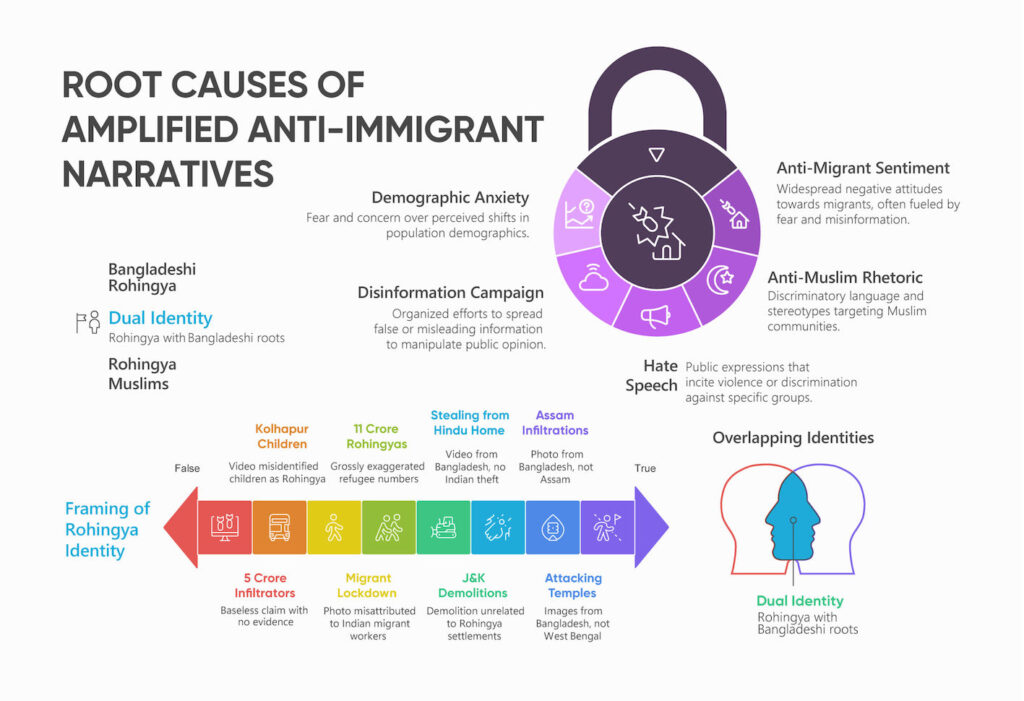
These fact-checks from 2017 to 2025 highlight how “Bangladeshi Rohingya” framing has become a central weapon in anti-immigrant narratives through systematic disinformation campaigns in India’s digital sphere.
In India, government officials’ public statements calling Rohingya illegal immigrants provide official legitimacy to social media misinformation. Particularly, following the Citizenship Amendment Act (CAA) of 2019, which specifically excluded Muslims from protection while offering citizenship to persecuted minorities from neighboring countries, created political incentives for portraying Rohingya refugees as threats rather than victims deserving protection.
Pre-existing anti-Muslim sentiment in India, amplified by powerful Hindu nationalist political movements, periodically creates a receptive audience for negative claims about Muslim refugees. It has been systematically cultivated in the country’s digital spaces, particularly following the rise of Hindu nationalism as a dominant political force.
During the COVID-19 pandemic, false claims about “Corona jihad” blamed Muslims for deliberately spreading the virus, leading to attacks on Muslim vegetable vendors and widespread discrimination despite the complete absence of evidence.
The religious identity of Rohingya Muslims marks them for collective suspicion under the doctrine of Islamic terrorism regardless of their actual beliefs, practices, or political positions.
Why “Bangladeshi Rohingya” framing frequently emerges
A recent study traces how anti-migrant narratives targeting Rohingya migrants across borders — from Myanmar to Bangladesh, India, and beyond — transform humanitarian suffering into socio-political fiction.
Most significantly, this study classifies over 20 fact-checked reports on anti-immigrant misinformation that have circulated widely on Indian social media and even in some news outlets.
This analysis highlighted how “Bangladeshi Rohingya” framing has become a central weapon in anti-immigrant narratives through systematic disinformation campaigns. This narrative conflates anti-migrant sentiment, anti-Muslim rhetoric, and hate speech targeting Bangladeshis into a unified exclusionary discourse.
The conflation of “Bangladeshi Rohingya” serves as a foundation for broader anti-Bangladesh discourse in India while simultaneously denying Rohingya refugees the recognition of their Myanmar origins.
This merged identity reinforced patterns of misinformation, beginning with the “Bangladeshi Rohingya” label, that transform perhaps 40,000 refugees into an imagined invasion of 50 million illegal immigrants supposedly overwhelming India’s borders and social systems.
Simultaneously, it portrays “Illegal Bangladeshi” migration as intersecting with “Rohingya Muslim” identity in narratives of organized illegal infiltration, demographic conspiracy, and threats to national security.
Such demographic anxiety functions as a powerful motivator in Hindu nationalist political discourse, which consistently portrays Muslim population growth as an existential threat to the Hindu majority status despite demographic data showing Muslim growth rates declining and projections indicating no plausible scenario in which Muslims become the majority in India.
Rohingya refugees, despite constituting a tiny fraction of India’s population, become symbolically significant in this imagined demographic war precisely because they are Muslim refugees crossing borders.
This confusion is actively exploited rather than corrected by those propagating anti-Rohingya misinformation.
Key factors influencing repeated anti-immigrant narratives
The dissemination of anti-Rohingya content across multiple platforms, moving from Facebook and Twitter to WhatsApp and Telegram, intensifies over time, transforming humanitarian displacement into a perceived existential threat within public discourse across borders.
Fundamentally, stateless Rohingya lack media access and political representation to challenge mainstream misinformation. It reflects a fundamental voicelessness of stateless Rohingya refugees.
It has already created new circuits of hatred that have real-world consequences, including detention, deportation, and violence.
They are, in effect, perfect victims for the digital age persecution because they cannot defend themselves, cannot leave, and cannot appeal to protective institutions that might shield them from coordinated hate campaigns.
The digital voicelessness of stateless Rohingya must be recognized as violence that enables and justifies physical violence, demanding urgent action before more anti-narrative intensifies.
Disclaimer: The study mentioned in the article has been published by the author on ResearchGate.
Zulker Naeen is a Bangladesh-based digital rights advocate and researcher examining disinformation, propaganda, and rights violations surrounding the Rohingya crisis.
This article is republished from Global Voices under a Creative Commons license. Read the original article.