
Sangeeta Khorana, Aston University
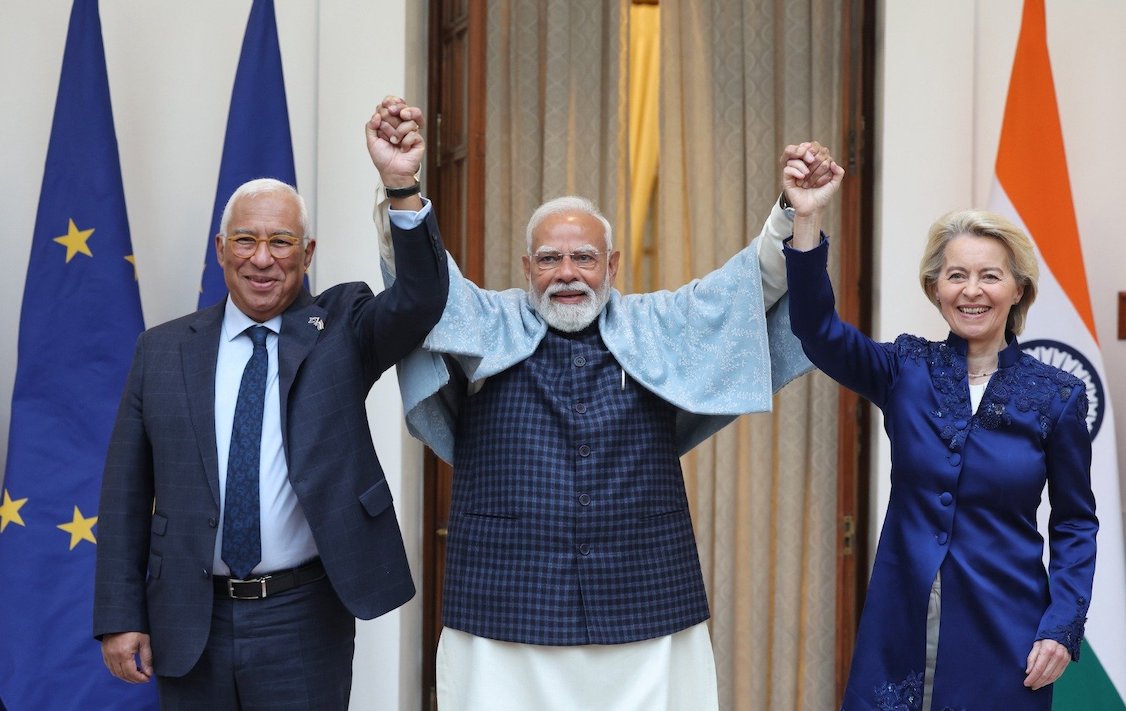
The recently concluded EU-India free trade agreement is notable for the huge scale and ambition of the deal. Labelled the “mother of all deals” by European Commission President Ursula von der Leyen, it comes as India has overtaken Japan as the world’s fourth-largest economy.
Bilateral trade in goods and services between the EU and India is already worth €180 billion (£155 billion). The agreement aims to double EU exports to India by 2032 and create a free-trade area representing around a quarter of the world’s population (nearly two billion people). This would also cover about 25% of the world’s GDP.
At this point in history, the world’s multilateral trading system is under threat from tariffs and geopolitical tensions. But this agreement offers a clear example that the era of free trade is not over.
Rather, it demonstrates how countries are adapting to new global realities to liberalise trade (that is, remove barriers). Instead of steering away from free trade, countries are becoming selective and seeking bilateral arrangements with strategic partners. The UK signed its own trade agreement with India in July 2025.
Traditionally, a free trade agreement would have a set of rules for how two or more countries must treat one another when importing, exporting, investing or doing any other business together.
But to view the EU-India trade agreement through the lens of classical free trade would be misleading. Trade agreements of the 1990s and early 2000s such as Nafta and the EU, were driven mainly by tariff reductions and efficiency gains. The EU-India deal on the other hand has been shaped by shifting geopolitical pressures and concerns about resilience in the face of trade shocks or other crises.
Long time in the making
Trade talks between the EU and India began in 2007 but negotiations gained momentum in 2025 amid renewed tariff threats from the United States under Donald Trump’s second administration.
This deepened trade imbalances between the EU and China due to Beijing’s drive to be more self-reliant and employ export controls. It also raised concerns about the resilience of global supply chains. The EU-India Trade and Technology Council was set up in 2023, modelled on the EU-US framework, and highlights how modern trade agreements can bundle economic, technological and strategic objectives together.
At a time when global trade has become increasingly protectionist and with geopolitical rivalry growing, this agreement provides an opportunity to recalibrate trade alignment. It is also a chance to reshape trade architecture while bolstering supply chain resilience across Asia, Europe and the Atlantic.
For the EU, the deal is a central pillar of its diversification strategy. There was an urgent need for the bloc to reach an agreement with India in order to be less dependent on China, its largest trade partner.
In 2024, more than 21% of the EU’s imports came from China. Meanwhile, China bought only 8.3% of the bloc’s exports. For the EU, this has resulted in a €304 billion (£264 billion) trade deficit with China.
So the EU-India deal provides an opportunity for the EU to reduce its excessive dependence on China. It’s also a chance to remove some of the risk from its supply chains and secure access to India’s fast-growing consumer market. This should offer European firms growth opportunities in Asia at a time when EU domestic demand is sluggish and flat.
The agreement will also make it easier for EU firms to source suppliers quickly and build alternative manufacturing bases when supply chains are threatened. India’s location in the Indo-Pacific is of strategic interest for the EU due to the growing interdependence and the importance of maritime supply chains. This also makes India a key partner against the uncertainty of the bloc’s future relations with the US.
For India, the agreement guarantees market access to Indian firms at a time of rising trade uncertainty – especially after its relations with the US were damaged following Trump’s threat of 500% tariffs.

The EU-India deal will eliminate tariffs on textiles and apparel, and when it comes into force it will give Indian garment-producers a reliable trading partner. The deal will allow European brands, such as Zara and H&M, to diversify away from China towards Indian manufacturing hubs. It is estimated costs here could be lower as the deal will allow garments to be zero-tariff.
The pharmaceuticals sector also offers an opportunity for India. While EU tariffs are already low, the deal aims to simplify regulation and to achieve stronger intellectual property frameworks. This could integrate Indian generic drug producers into Europe’s healthcare supply chains.
The scope of the agreement extends well beyond goods, services and investment. Plans to co-operate on clean energy aligns Europe’s Green Deal (the bloc’s framework for achieving net zero) with India’s target of producing 500 gigawatts of renewable capacity by 2030. This should open up avenues for joint leadership in solar, wind, grids and green hydrogen.
The EU-India deal neither marks a return to the free trade orthodoxy of an earlier age nor signals the end of free trade in today’s fractured global order. Rather, it highlights how trade has evolved into a tool for achieving geopolitical objectives. The deal also shows that countries are opening their markets – selectively and after careful deliberations. Trade agreements are evolving: increasingly they are shaped not only by market access considerations, but also by economic security.
Sangeeta Khorana, Professor of International Trade Policy, Aston University
This article is republished from The Conversation under a Creative Commons license. Read the original article.