


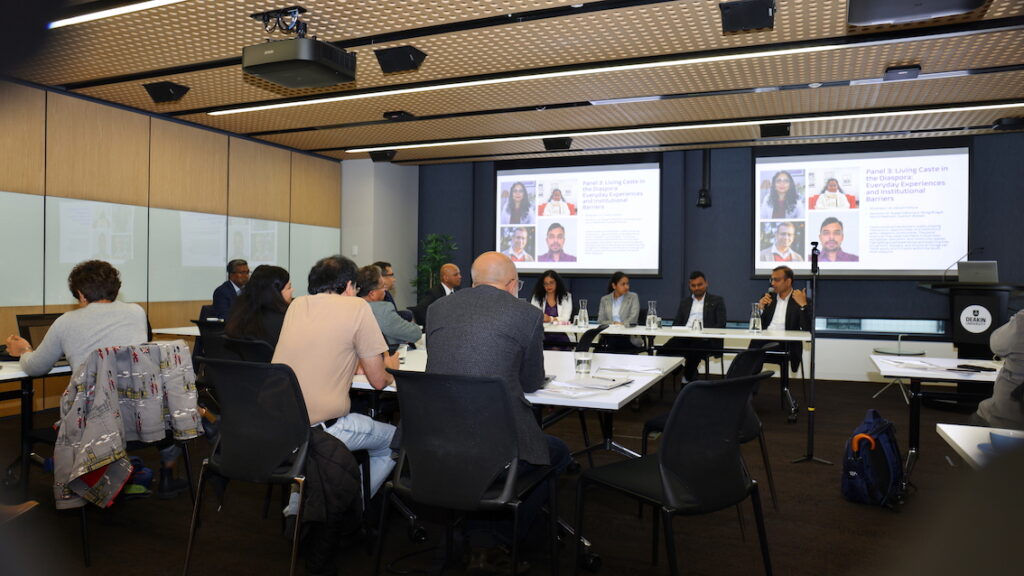
A first-of-its-kind symposium in Melbourne, Understanding Caste Discrimination in Diaspora: Building Dialogues and Allyship, brought together scholars, activists, and community leaders on 3 November 2025 to confront caste-based inequality within Australia’s South Asian diaspora.
Held at Deakin Downtown, this symposium was organised by the Digital Heritage Centre, Institute of Asia and Pacific Studies, University of Nottingham Ningbo China, in collaboration with the Asian Media and Culture Society, Deakin University, Australia, and supported by Hindus for Human Rights (Australia), The Humanism Project, PATCA, The Navayana Buddhist Charitable Trust, and The Global Ambedkarite Federation.
“Caste is invisible until it is named”: Prof Hari Bapuji’s keynote
In his keynote address, Invisibility of Caste in the Australian Diaspora, Professor Hari Bapuji of the University of Melbourne unpacked how caste persists in the diaspora “largely because of its invisibility”—a condition sustained by its amorphous and socially embedded nature.
Drawing from his research at the intersection of business, inequality, and society Prof Hari Bapuji argued that caste operates as a system of inequality that quietly influences workplace hierarchies, social networks, and access to opportunities across migrant communities.
He proposed a framework to make caste visible in contexts where it is routinely denied, urging that “recognition and responsibility must underpin any effort to address caste”. The struggle against casteism, he said, “is not the burden of one community but a collective responsibility to confront exclusion in all its subtle and structural forms.”

Building dialogues and allyship
Opening the symposium, Dr Vikrant Kishore invited participants to see caste as a global social condition. He emphasised that the event was “not merely an academic gathering but a collective space of recognition and responsibility” — one that calls for awareness, solidarity, and action.
Dr Kishore noted that the inclusion of caste in the Australian Human Rights Commission’s National Anti-Racism Framework provided a vital starting point for policy dialogue, but the real task lies in transforming social and institutional awareness.

Panels explore humanism, gender, and everyday caste realities
The morning sessions traced intersections of caste with gender, identity, and everyday life. Indian parliamentarian and poet Rajathi Salma opened the first panel, Breaking Barriers, with a self-composed poem on women’s marginalisation. Speakers including Advocate Arulmozhi called for a renewed commitment to humanism and self-respect movements.
Subsequent panels examined the invisibility of Dalit voices in women’s movements and the persistence of caste-based exclusion in Australia’s workplaces and community spaces. As Dr Rupali Bhamare observed, “Caste prejudice is frequently dismissed as a cultural difference, allowing discrimination to persist unacknowledged within institutions.”
From solidarity to media accountability
Afternoon sessions explored allyship, empowerment, and representation. Professor Catherine Gomes (RMIT University) spoke on the empowerment of migrant communities in research, while the Caste Allyship and Anti-Caste Solidarity panel called for empathy and accountability in cross-caste collaborations.
A closing media panel — featuring Neeraj Nanda (South Asia Times), Deepak Joshi (NRI Affairs), and Dr Fotis Kapetopoulos (Neos Kosmos) — examined how ethnic media could responsibly address caste discrimination. Joshi emphasised that diaspora journalism must “confront caste directly and consistently, rather than treating it as a peripheral or uncomfortable issue.”
“Caste is a virus; its cure is humanism”
The symposium concluded with the screening of Dr Kishore’s documentary Resisting Cast(e)ism in Australia, followed by open reflections. One participant summed up the mood: “Caste is a virus; its solution lies not in embracing caste identities, but in humanism and human rights. Caste must be criminalised — it cannot be accepted, defended, or justified.”
A roadmap for future collaboration
The symposium culminated in the launch of the Casteism Studies Network, a new initiative to connect scholars, artists, and community advocates for joint research, policy engagement, and creative projects.
As the Anti-Caste Symposium post by Hindus for Human Rights noted, the Melbourne gathering represented a “turning point in acknowledging the lived realities of caste in Australia” and “a collective step towards building transnational solidarity against caste-based exclusion.”