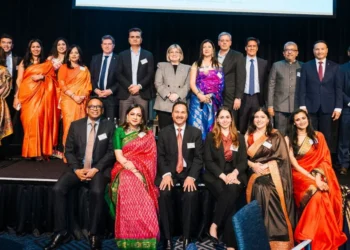


An Indian business network Melbourne membership is credited with keeping one small IT firm afloat. Prakash and Seema Gupta spent six years running TechnoSource Australia, an IT services business based in Tullamarine, without knowing whether it would hold together. Growth had stalled, and the isolation of running a small business alone was wearing them down. “Running a business can be lonely,” Prakash Gupta said in a 2021 interview about that period. “At the beginning, you do feel isolated because you are learning on your own about how to operate and grow the business.”
The turning point came through TiE Melbourne, the local chapter of The Indus Entrepreneurs, a global mentoring network for Indian-origin founders. A mentor connection through TiE is credited with keeping TechnoSource from folding, giving the Guptas a sounding board and practical guidance that six years of trading alone had not produced. It is one of the only on-the-record accounts of what an Indian business network Melbourne membership actually delivers for a specific business, rather than a general claim about what membership offers.
That gap matters because the demographic case for these networks is not in doubt. Census data puts Wyndham’s India-born population at 50,435 people, 17.3 per cent of the municipality, against 4 per cent for Victoria and 2.6 per cent for Australia as a whole. Neighbouring Casey, Hume and Greater Dandenong have all recorded India-born population growth above 70 per cent in the years leading into the last two censuses. Point Cook is 17 per cent Indian by ancestry, and Tarneit ranks as one of the country’s most multicultural suburbs, with Punjabi its most common household language.
Central Dandenong shows what a concentrated Indian business precinct can look like in practice. The Little India Cultural Precinct on Foster Street has been home to Indian-linked traders since it was formally established in 2011, and now counts around 62 Indian-linked shops in the wider central Dandenong area, 33 of them inside the precinct itself, serving a local India-born population estimated at 12,000. Greater Dandenong City Council ran a Business Skills and Development Mentoring Program for precinct traders in 2014, alongside safety, parking and shopfront upgrades through to 2020.
Beyond Dandenong, the networking infrastructure is real but general rather than India-specific in most cases. Wyndham Entrepreneur Connect, a council-listed group founded by Imran Abul Kashem, and Wyndham Biznet, an independent not-for-profit running since 1998, both operate in the municipality with the largest India-born population in outer Melbourne, but neither is built around Indian founders specifically.
The Australia India Business Council’s Victoria chapter marked its fortieth anniversary in Melbourne on 4 September, drawing more than 250 people, but its public activity centres on trade delegations, roundtables and corporate partners rather than small, outer-suburb businesses. The Australia India Chamber of Commerce and the India Australia Business & Community Alliance are both active in Melbourne on a similar, city-wide basis. Readers can browse further business coverage of the diaspora economy here.
Wyndham’s own economy has been growing fast enough to support more of this kind of infrastructure. The municipality had 38,000 GST-registered businesses as of a business expo held in May, with registrations up 61 per cent between 2020 and 2024, in a population of 337,000 where nearly half were born overseas. None of the figures available break registrations down by founder’s country of birth, so it is not possible to say how many of those businesses are Indian-founded, only that the conditions for growth in the area are well documented.
What actually separates a mentoring network from a business chamber?
A chamber of commerce or trade body such as AICC or AIBC exists mainly to connect members with contacts, trade missions and corporate partners, useful once a business already has some scale. A mentoring network such as TiE pairs an established entrepreneur with someone earlier in the journey, on an ongoing basis, which is closer to what kept TechnoSource trading through its hardest years. A small business in its first years is likely to get more from the second kind of relationship than from an introductions-focused chamber, though the two are not mutually exclusive.
What the record does not show is whether Prakash and Seema Gupta’s experience is common or rare. Every organisation contacted through its public materials for this piece describes broad benefits, collaboration, commercial introductions, a platform for dialogue, without publishing a single further case of what a small, Indian-founded business in Melbourne’s outer suburbs actually gained from joining. Foster Street’s 2014 mentoring programme has no published outcomes data either, more than a decade on.
That absence is itself a finding. Councils in Wyndham, Casey and Greater Dandenong all track population growth and business registration numbers closely. None of them, on the evidence available, track whether Indian-founded businesses join local networks or what changes when they do. A founder deciding whether an Indian business network Melbourne membership is worth the time currently has one detailed public account to go on, not a body of evidence. For the wider context behind these figures, see this outlet’s news coverage of Melbourne’s Indian diaspora.
Indian Business Network Melbourne: What Founders Should Ask Before Joining
Is this a mentoring relationship or a contacts list? TechnoSource’s experience points to ongoing mentorship, not a single introduction, as the more durable form of support for an early-stage business.
Does the network reach my suburb, or just the CBD? Most Indian-specific business networks identified for this piece are Melbourne or Victoria-wide rather than based in Wyndham, Casey, Hume or Dandenong specifically, so distance and time commitment are real costs to weigh.
Is there a general local network as well as an Indian-specific one? Wyndham Entrepreneur Connect and Wyndham Biznet are open to all local founders and sit alongside, rather than instead of, Indian-specific groups such as TiE.
Will anyone measure what changes? Ask a prospective network directly whether it tracks outcomes for small-business members. On the public record checked for this piece, none currently publish that data.