India has fallen to 157th out of 180 countries in the 2026 World Press Freedom Index published by Reporters Without Borders (RSF), marking a further deterioration in the country’s media environment and placing it among the world’s most challenging contexts for journalism. The drop comes at a time when global press freedom has reached its lowest point in a quarter of a century, with RSF warning that the average score across all countries has “never been so low” in the index’s 25-year history.
The 2026 index paints a stark picture: more than half of the world’s countries are now classified as having “difficult” or “very serious” conditions for press freedom, underscoring a systemic erosion of the right to information across democracies and authoritarian regimes alike.
India’s decline: from 151 to 157 in one year
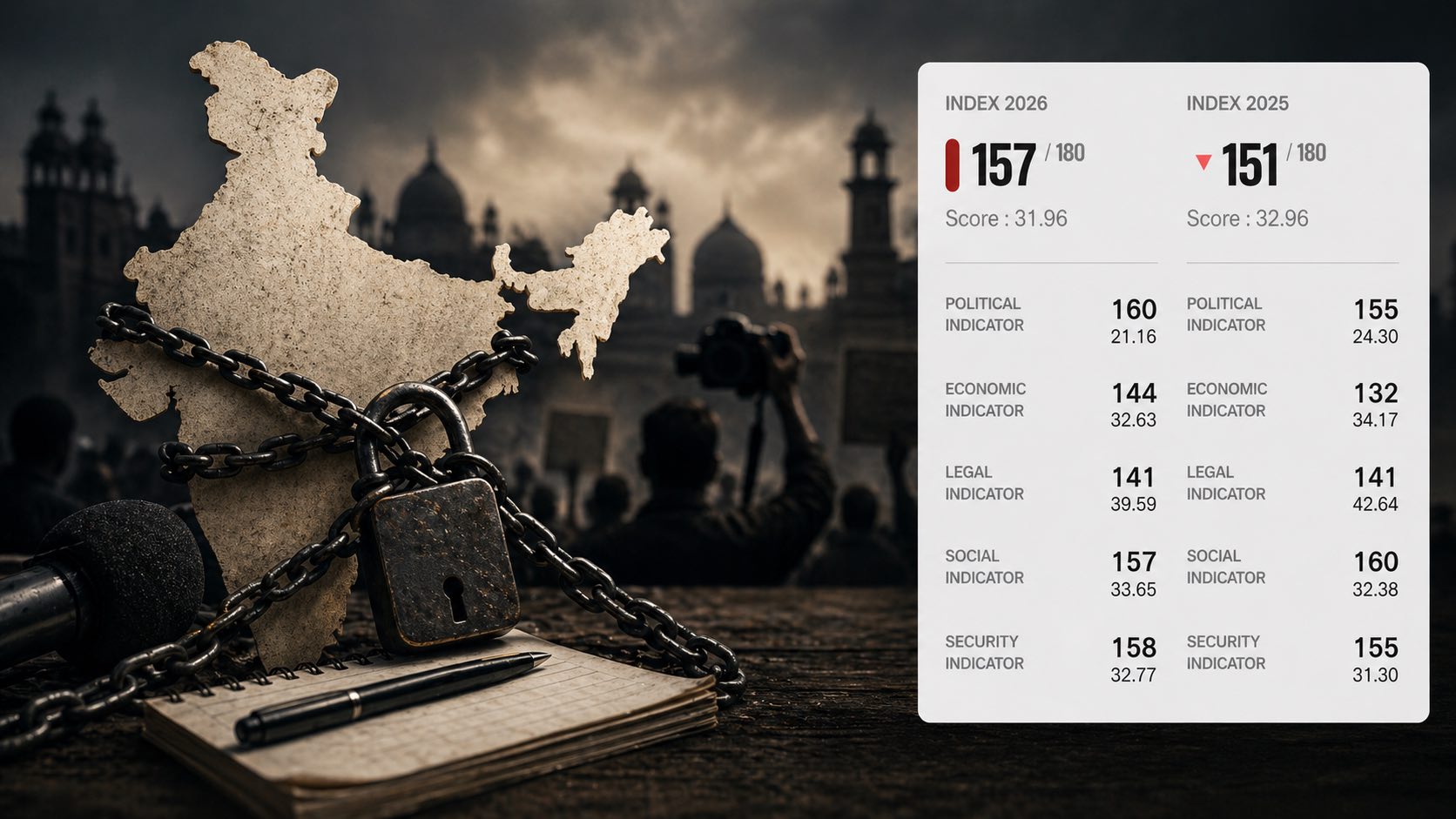
India’s ranking has worsened from 151st in 2025 to 157th in 2026, accompanied by a drop in its overall score from 32.96 to 31.96.
The RSF report attributes this decline to a combination of structural and political factors, including:
- Rising violence against journalists
- Increasing concentration of media ownership
- Growing political alignment of major news outlets
- Expanding use of legal tools to suppress critical reporting
The data shows deterioration across several key indicators. India’s political indicator ranking worsened from 155 to 160, while its economic environment ranking slipped to 144, reflecting increased pressure on independent media through funding and ownership structures.
“Unofficial state of emergency” in the media
RSF’s country assessment describes India’s media environment as being in crisis, noting that press freedom has been under sustained pressure since 2014 under Prime Minister Narendra Modi.
The report highlights what it calls an “unofficial state of emergency” in the media landscape, characterised by:
- Close ties between political power and major media conglomerates
- The growing influence of pro-government outlets, often referred to as “Godi media”
- Limited access to the prime minister, who rarely holds open press conferences
- Harassment campaigns against journalists critical of the government
The concentration of ownership among a handful of powerful business groups — including those aligned with the government — has further eroded editorial independence, according to RSF.
Legal pressure and criminalisation of journalism
One of the most significant global trends identified in the 2026 index is the sharp decline in the legal environment for journalism, with laws increasingly used to silence reporters.
India is specifically named among the countries where the legal indicator has deteriorated most sharply.
Domestically, RSF points to:
- Continued use of colonial-era laws such as sedition and defamation
- Expanding use of anti-terror legislation against journalists
- New laws, including the Telecommunications Act and IT rules, that increase state control over digital media
This legal framework, combined with economic pressure and political influence, has created an environment where journalists face both institutional and informal constraints on their work.
Safety concerns: a dangerous environment for journalists
India remains one of the more dangerous countries for journalists, with RSF noting that two to three journalists are killed each year in connection with their work.
Journalists face:
- Physical attacks and threats
- Online harassment campaigns, often coordinated
- Arbitrary arrests and criminal prosecutions
- Intimidation from political actors, police, and criminal networks
Women journalists, in particular, are subjected to severe online abuse, including the exposure of personal data and threats of violence.
A global crisis: press freedom at its lowest in 25 years
India’s decline is part of a broader global trend. The 2026 RSF index finds that press freedom worldwide has reached an unprecedented low:
- The average global score is the lowest ever recorded
- More than 52% of countries fall into “difficult” or “very serious” categories
- Legal frameworks are increasingly used to criminalise journalism
- Economic fragility and political hostility are undermining media independence
RSF warns that the erosion of press freedom is being driven by a combination of authoritarian governance, weak regulatory protections, and the misuse of national security laws — trends now visible even in democracies.
How India compares with its neighbours
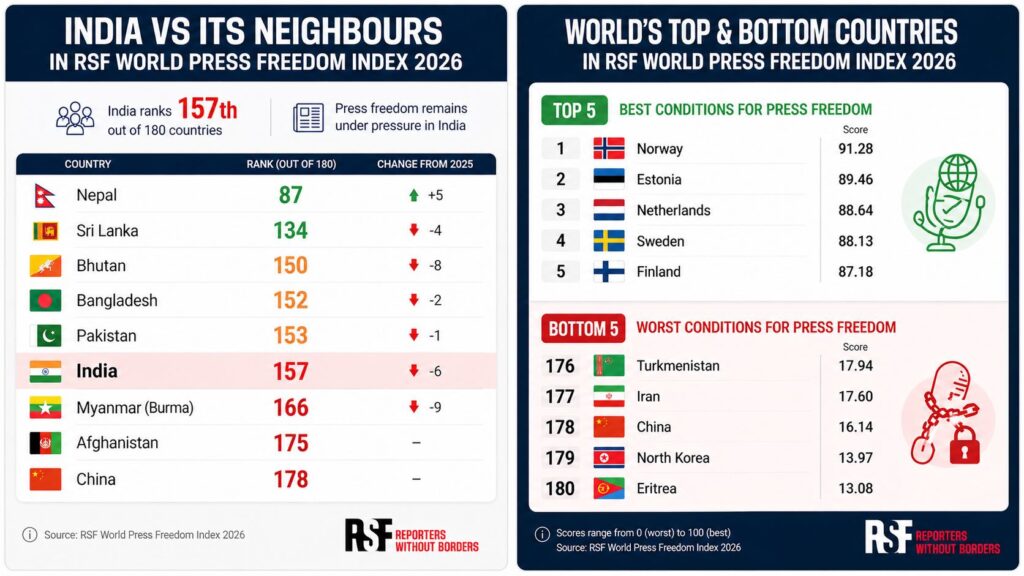
India’s position at 157th places it below most of its South Asian neighbours, highlighting regional disparities in press freedom:
- Nepal: 87th
- Sri Lanka: 134th
- Bhutan: 150th
- Bangladesh: 152nd
- Pakistan: 153rd
- India: 157th
Only a few countries in the region rank worse:
- Afghanistan: around 175th, among the world’s most repressive media environments
- China: 178th, one of the worst globally for press freedom
- Myanmar (Burma): in the lower tier, also classified as highly restrictive
This regional comparison underscores a striking reality: despite being the world’s largest democracy, India now ranks below nearly all of its immediate neighbours in terms of press freedom.
Structural issues: ownership, diversity and representation
Beyond legal and political pressures, RSF highlights deeper structural concerns in India’s media ecosystem:
- Dominance of upper-caste men in newsroom leadership
- Underrepresentation of women and minority voices
- Increasing influence of religious nationalism in editorial content
- Growing focus on polarising and religiously charged programming
These factors, the report suggests, limit the diversity of perspectives in public discourse and further narrow the space for dissent.
Digital shift and new vulnerabilities
While India has one of the world’s largest media markets — with hundreds of TV channels and tens of thousands of publications — the shift towards digital and social media has created new challenges.
Online platforms, while expanding access to information, have also:
- Amplified misinformation and propaganda
- Enabled coordinated harassment campaigns
- Reduced the financial viability of independent journalism
A warning for democracies
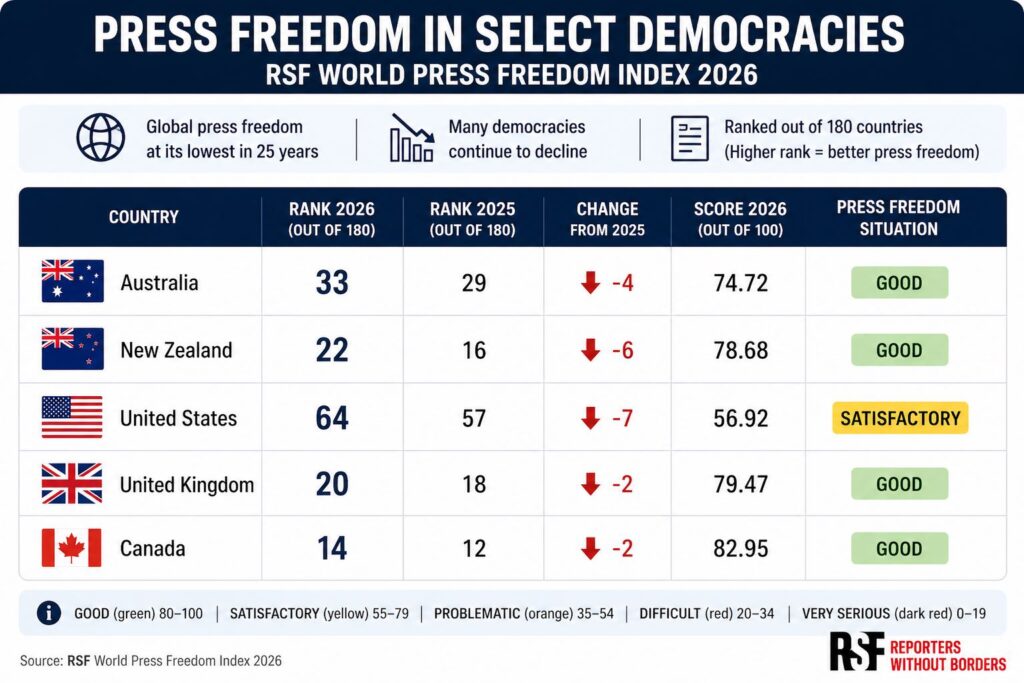
The 2026 RSF report frames the global decline in press freedom as a warning, not just for authoritarian regimes but for democracies as well.
It argues that the criminalisation of journalism, misuse of legal frameworks, and economic capture of media are now systemic threats that require urgent action.
For India, the drop to 157th signals more than a statistical decline. It reflects a broader transformation in the country’s information ecosystem — one where political influence, economic pressure, and legal constraints are reshaping the role of the press.
Why this ranking matters
India’s fall in the 2026 World Press Freedom Index comes at a moment when global press freedom itself is under unprecedented strain. While the country continues to maintain a vast and diverse media landscape, the conditions under which journalism operates have become increasingly restrictive.
With most of its neighbours now ranking higher and global standards deteriorating, the report raises pressing questions about the future of media freedom in India — and the health of democratic institutions that depend on it.